
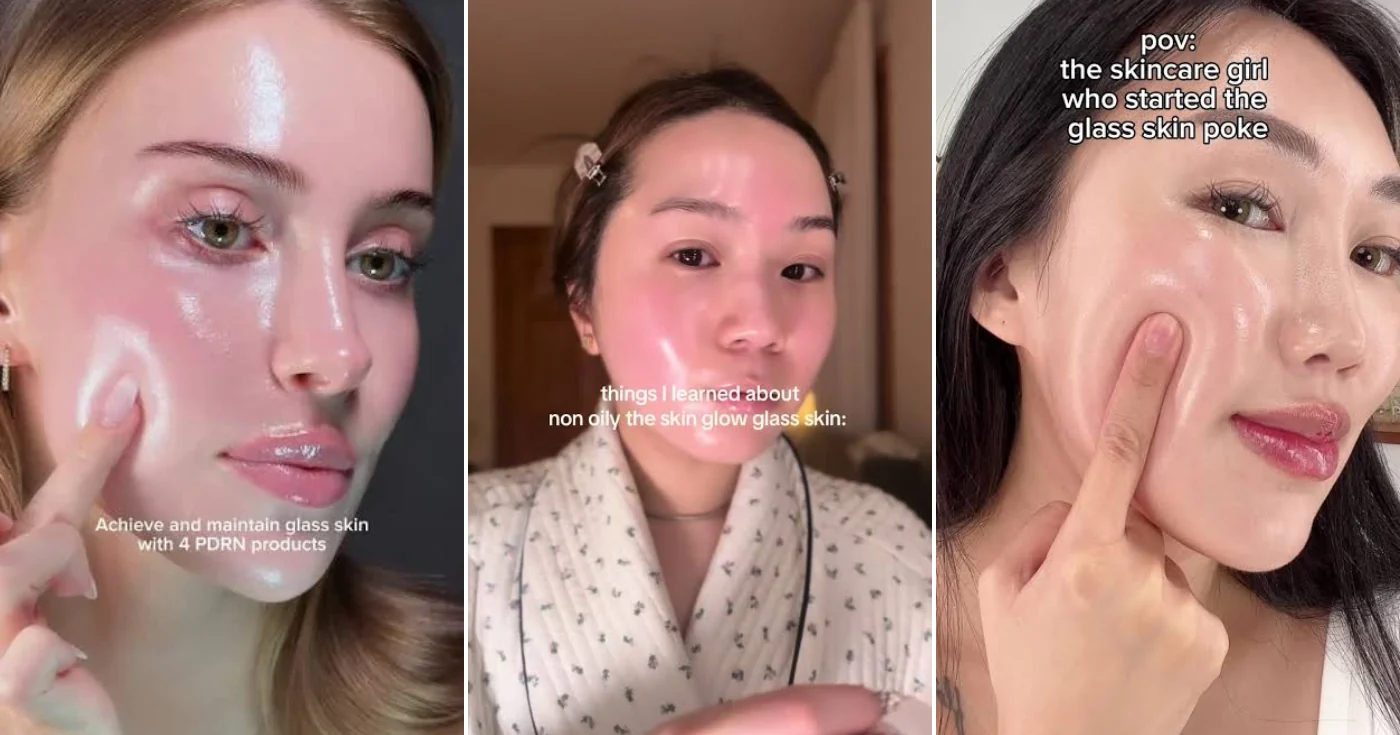
Double cleansing, essence, toner, serum, sheet mask, moisturizing cream… For several years, Korean skincare has established itself in Western bathrooms, driven by the promise of perfectly plump, luminous and almost translucent skin. On TikTok, this quest for the famous “glass skin” gives rise to ever more elaborate routines, sometimes made up of ten or more products. Seductive videos, which accumulate views and make you want to reproduce the gestures of the content creators.
But can we really follow this advice with our eyes closed? Researchers decided to look into the question and their conclusions, presented at the 2026 congress of the European Academy of Dermatology and Venereology (EADV), are particularly intriguing. According to their analysis, nearly 95% of TikTok videos dedicated to Korean skincare and glass skin contain at least one potentially misleading claim. Even more worrying: basic precautions to protect your skin are almost absent from this content.
95% of TikTok videos about Korean skincare contain misleading information
To arrive at this observation, the researchers analyzed popular videos published on TikTok around Korean skincare and glass skin. Their selection was made in May 2026, based on five searches related to K-beauty. In order to limit the influence of the algorithm and its personalized recommendations, they used a neutral account, with no interaction history. In total, 38 videos were selected and evaluated according to several criteria: accuracy of dermatological claims, safety information, quality and reliability of content.
The result is clear: 94.7% of the videos examined included at least one potentially misleading statement. In detail, 84% did not take into account the differences between skin types, while 45% encouraged excessive combinations of active ingredients without providing sufficient precautions. Another observation: 32% promised immediate results. None of the content analyzed cited a scientific source or external reference, and none had been produced by a dermatologist. Nearly 82% came from non-doctor influencers, 11% from beauty brands, and around 8% from other beauty content creators.
Exfoliating acids, retinol, vitamin C: combinations of active ingredients can become problematic
What particularly worries researchers is not the very principle of a Korean routine, but the multiplication of products and active ingredients without taking into account the real needs of the skin. In certain videos, the creators combine serums and treatments containing exfoliating acids (AHA and BHA), retinol, vitamin C or even niacinamide. However, even when they are of individual dermatological interest, these ingredients are not necessarily suitable for all skin types or for all combinations.
By multiplying applications, certain gestures can end up producing the opposite effect to that sought. Too frequent exfoliation or poorly used irritant active ingredients can cause redness, burning sensations, flaking and weaken the skin barrier. Skin whose protective barrier is altered becomes more sensitive to external aggressions and can react to products that are usually well tolerated. The problem is all the more important because, in the EADV analysis, only one video out of the 38 mentioned the risk of irritation, only two mentioned sun protection and none talked about contact dermatitis. There was also no content recommending seeing a dermatologist.
94 patients developed skin problems after following beauty trends on social media
A second study presented at the same conference sheds additional light on the possible consequences of these habits. Researchers followed 94 patients who developed a new skin condition or noticed the worsening of an existing problem after using cosmetic or dermatological products promoted on social networks. Among the most frequently implicated products were chemical exfoliants containing AHAs or BHAs (34% of cases), over-the-counter retinoids (27%), vitamin C serums (14%), and niacinamide-based skincare (11%).
The manifestations observed were varied. Irritant contact dermatitis topped the list at 42%, followed by new or worsening acne (28%), rosacea flare-ups or similar reactions (12%), post-inflammatory hyperpigmentation (11%) and superficial chemical burns (7%). Another revealing figure: 63% of patients used more than three active ingredients simultaneously, while almost half had adopted a complete routine directly inspired by social networks. However, be careful with interpretation: this observational study concerns people who already had skin problems. It therefore does not allow us to state that these products systematically cause reactions in all those who use them.
Is Korean skincare really dangerous for the skin?
However, it would be wrong to conclude that K-beauty is bad for the skin. Researchers are keen to make this distinction. The fundamental principles of Korean skincare, such as gentle cleansing, hydration and preservation of the skin barrier, are not called into question. Some products and ingredients can even be perfectly interesting, provided they are adapted to your needs and used correctly.
Rather, the real problem lies in the way these routines are presented and reproduced on social media. Dry, oily, sensitive skin or skin prone to rosacea does not have the same needs. A routine that seems to work on one influencer will therefore not necessarily give the same results on another person. Added to this are filters, lighting, commercial partnerships and promises of express transformation, which can give an image that is very far from reality. The researchers therefore point out that the popularity of a beauty tip absolutely does not constitute a guarantee of its effectiveness or safety.
How to adopt a skincare routine without weakening your skin barrier?
Should we therefore abandon our favorite serums and treatments? Certainly not. The idea is rather to return to a consistent routine, adapted to your skin type and its problems. Dermatological recommendations generally favor a simple base: a gentle cleanser, a moisturizer and appropriate sun protection in the morning. Active ingredients, such as retinol or exfoliating acids, can then be introduced gradually, depending on their actual usefulness and skin tolerance.
It is also best to avoid introducing multiple new assets simultaneously. By proceeding step by step, we can more easily identify a possible ingredient responsible for a reaction. Skin that feels tight, red, peels or burns is not necessarily in the process of “purifying” or getting used to a product: these manifestations can be signs of irritation. If a reaction persists, it is best to discontinue the suspect product and seek advice from a dermatologist. True glass skin should never come at the price of a damaged skin barrier.
FAQ: the most asked questions about Korean skincare and glass skin
1. Is Korean skincare good for the skin?
Yes, some principles of Korean skincare, such as hydration, gentle cleansing and protection of the skin barrier, are interesting. However, it all depends on the products used, their formulation and their suitability for your skin type.
2. Is the glass skin trend dangerous?
The glass skin is not dangerous in itself. On the other hand, certain very complex routines, which multiply exfoliating active ingredients and treatments without taking into account individual needs, can cause irritation, acne breakouts or weaken the skin barrier.
3. Which ingredients should not be mixed in a skincare routine?
Certain combinations of active ingredients can increase the risk of irritation, particularly when several chemical exfoliants and retinoids are used in the same routine. It depends on the concentrations, formulations and tolerance of each skin. If in doubt, it is best to seek advice from a dermatologist.
4. How do you know if your skin barrier is damaged?
Unusual redness, tightness, a burning sensation, itching or peeling skin can signal a weakened skin barrier. These symptoms can also have other origins: if they persist, dermatological advice is recommended.
5. What is the best skincare routine for beautiful skin?
An effective routine doesn’t need to have ten steps. A gentle cleanser, a suitable moisturizer and daily sun protection provide a good foundation. Targeted treatments can be added according to needs: imperfections, pigment spots, wrinkles or dehydration.
