
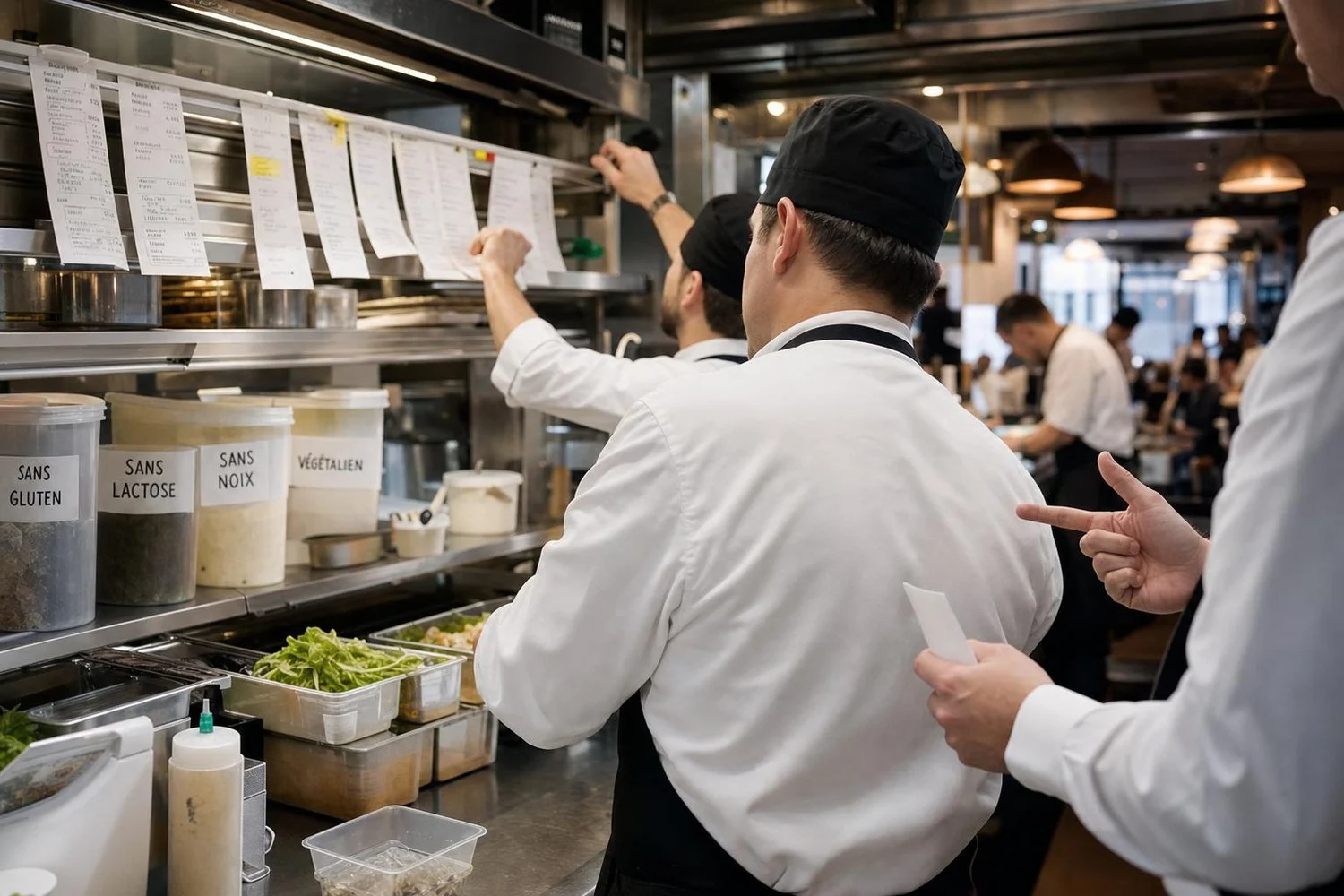
On a Saturday evening of service, the room fills up and the requests cascade: gluten-free, lactose-free, vegan, no garlic, no pork, “strong” allergy to nuts. In a few minutes, the menu thought of as a whole transforms into a puzzle, and each dish becomes a special case to be secured. For the brigades, the pressure builds very quickly.
Over the past ten years, chefs interviewed by the professional press have described a continuous rise in restaurant food allergies, intolerances and exclusion diets. Everything is mixed with ethical or religious aspirations, but also with fashion effects. In this tense climate, certain rants from chefs on the networks, in France and elsewhere, are causing a lot of talk.
Food allergies in restaurants: a wave of requests that shakes up everything
The testimonies compiled by the professional magazine in its survey *New diets: the impossible equation?* describe the same curve: customers who increasingly report their allergies to shellfish, gluten, lactose or peanuts, sometimes cumulative. Restaurant owners learn to manage the risk of anaphylaxis while maintaining an identifiable cuisine, which quickly becomes a headache.
Alongside proven allergies, there are diagnosed food intolerances, vegan diets, religious prohibitions, but also simple preferences. In the same department, a manager may have to deal with all these constraints, often specified at the last moment. In the dining room, you have to sort between what concerns survival, digestive comfort or personal choice, without judging but without making a mistake.
Chefs under pressure: risks, organization and fear of making mistakes
The reports show how critical each link in the chain is: order taking, transmission, installation, preparation, sending. A simple inversion between a gluten-free plate and a classic plate is enough to cause drama. In Europe, Regulation (EU) No. 1169/2011 requires clear information on the presence of allergens, which adds a legal dimension to the fear of “doing the wrong thing”.
Many kitchens, especially in cities, lack space to separate fryers, griddles and work surfaces. Chefs say they deal with such a volume of allergies every day that they sometimes have to refuse a dish to remain honest about the risk of traces. Procedures such as those of the ITHQ in Quebec recommend noting the allergy upon reservation, recording it, then checking it at each stage of the service.
Food bans: from nervous breakdown to possible dialogue
Articles like the one in the Swiss daily question: have we become impossible-to-satisfy customers, always ready to show last-minute intolerance? On the networks, a foreign chef who asked those with allergies not to come created a buzz, proof of a fed-up that transcends borders. In France, starred chef Michel Sarran reacted to a canteen tray for his granddaughter by calling it , before warning that , cited by Capital.
On the customer side, associations like Allergies Québec advise calling beforehand, avoiding rush hours and finding out about staff training. Guides explain that a serious restaurateur can legitimately refuse to guarantee zero traces, precisely to protect the allergic person. Because ultimately, everything comes down to this clear contract between the room, the kitchen and the guests: saying exactly what is possible, and assuming what is not.
How does a restaurant handle reported food allergies?
Organized restaurants note the allergy when booking or taking the order, indicate it on the receipt, inform the kitchen then check the plate before sending it. Some have written protocols and specific training.
What does Regulation 1169/2011 provide for on allergens in restaurants?
This European regulation requires restaurateurs to clearly inform customers of the presence of substances that could cause allergies or intolerances, via the menu, a poster or a consultable document, and to avoid unnecessary systematic precautionary labeling.
What can customers with allergies do to eat safely at a restaurant?
The associations recommend calling the restaurant in advance, explaining your allergy precisely, avoiding kitchens with a very high risk for the allergen in question and verifying that the staff knows how to handle this type of request.
