
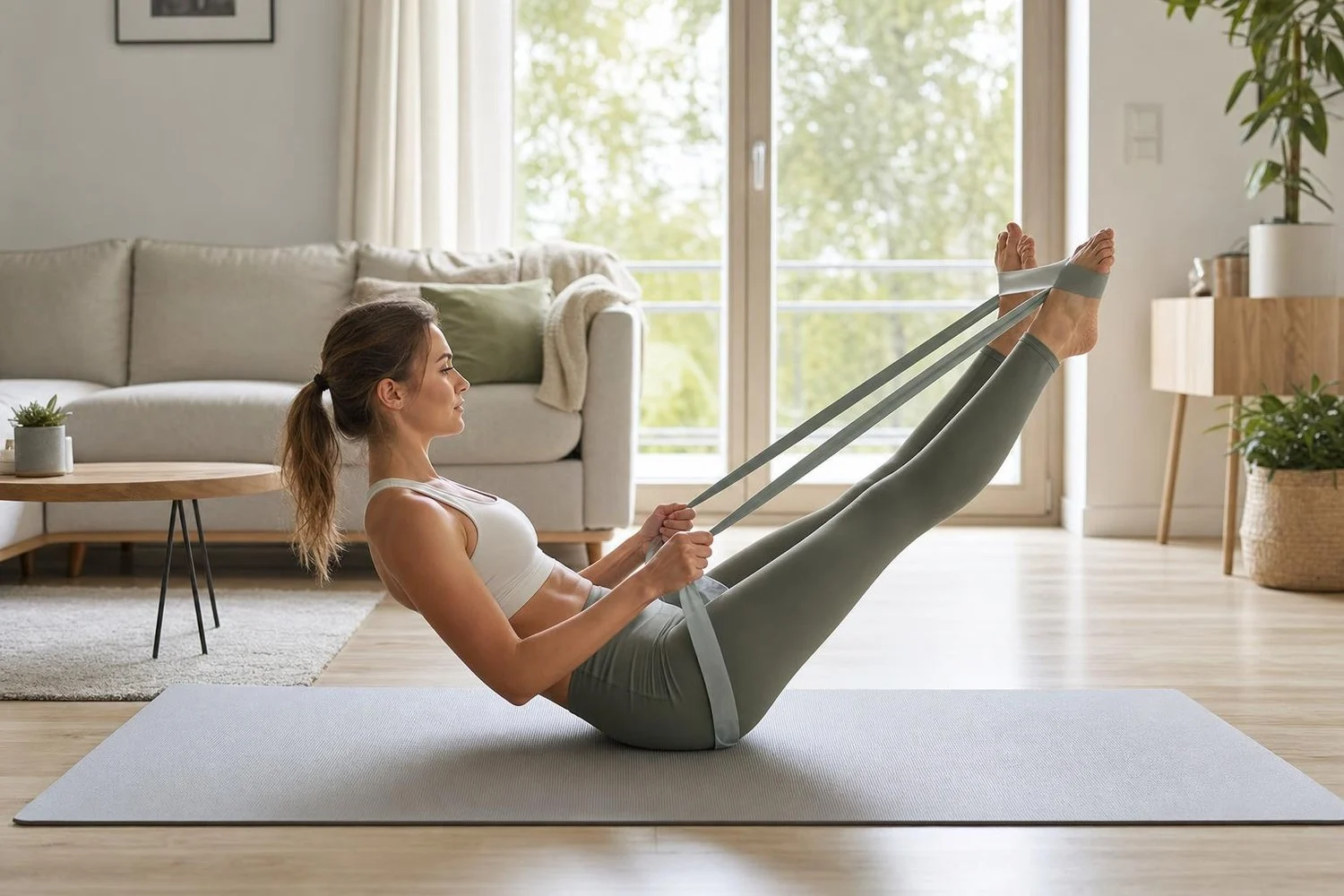
A Reformer in the living room, you dream of it, not your banker. This favorite machine from Pilates studios takes up space, is expensive and remains difficult to fit into an already busy daily life. However, many would like to find at home these fluid movements, in resistance, which work the body in depth. The solution is contained in a simple ribbon of latex.
Pilates was designed in the 1920s by Joseph Pilates for, in his words, he said, quoted by Elle. This gentle but precise method targets deep muscles, posture and breathing. With an elastic band, we keep this spirit while approaching the sensations of a machine class.
Pilates elastic band: recreate the Reformer effect without the machine
The Reformer is a platform with a sliding carriage and adjustable springs that provide progressive resistance. On treadmills, Reformer-inspired classes replace these springs with an elastic band to keep the same controlled traction. Depending on the model, it adds around 2 to 4 kg of resistance, enough to immediately awaken the thighs and abdominal muscles.
To illustrate this spirit, qualified coach Myriam Ferrus describes the Criss Cross movement as She recommends , then The expert also emphasizes that , she explained to Here. This same commitment of the center, you will find it in the exercises with band.
5 Pilates exercises with elastic band inspired by the Reformer
Lie on your back, band passed under your feet and held in your hands, knees at 90°. Gently extend legs forward and arms back, then return, keeping your lower back stable and breathing smooth. Then, place yourself in bridge, hips raised, band under one foot and in both hands, arms extended towards the ceiling; raise and lower your leg, keeping your abs engaged.
On all fours, the band passes under one foot and is held firmly in the hands: extend the leg backwards, slightly higher than the glutes, then bring the toe to the ground without arching your back. Lying on your side with one knee bent and the other leg straight in the band, raise and lower your leg about ten times on each side. Finish on your back, one leg in the air with the band under your foot, the other on the ground, and draw slow circles without letting your hips move.
Structuring a Reformer-style elastic band Pilates session
To turn these movements into a real session, do them in order with 10 to 12 repetitions per leg or side. Perform 2 to 3 rounds, with 30 seconds of rest between exercises, to obtain controlled work of 30 to 40 minutes which awakens the abdominal muscles, glutes and back.
Start with two sessions per week, then increase to three or four if your body is comfortable, always keeping a slow pace. Adapt the intensity by shortening the band or choosing a stronger resistance, and listen to your joints. A mat and a resistance band, often between around $10 and $20, are already enough to bring back some of the sensations of a Reformer class at home.
Can the elastic band replace a Reformer Pilates at home?
It does not offer all the options of the machine, but reproduces progressive resistance and deep work at a much lower cost.
What equipment for an elastic band Pilates session?
A comfortable mat, a flat band of medium resistance, plus possibly a small cushion to support the head or knees.
How many times to practice these Pilates exercises with a band?
Aim for two to four sessions of 30 to 40 minutes per week to start to feel changes in posture and tone.
