
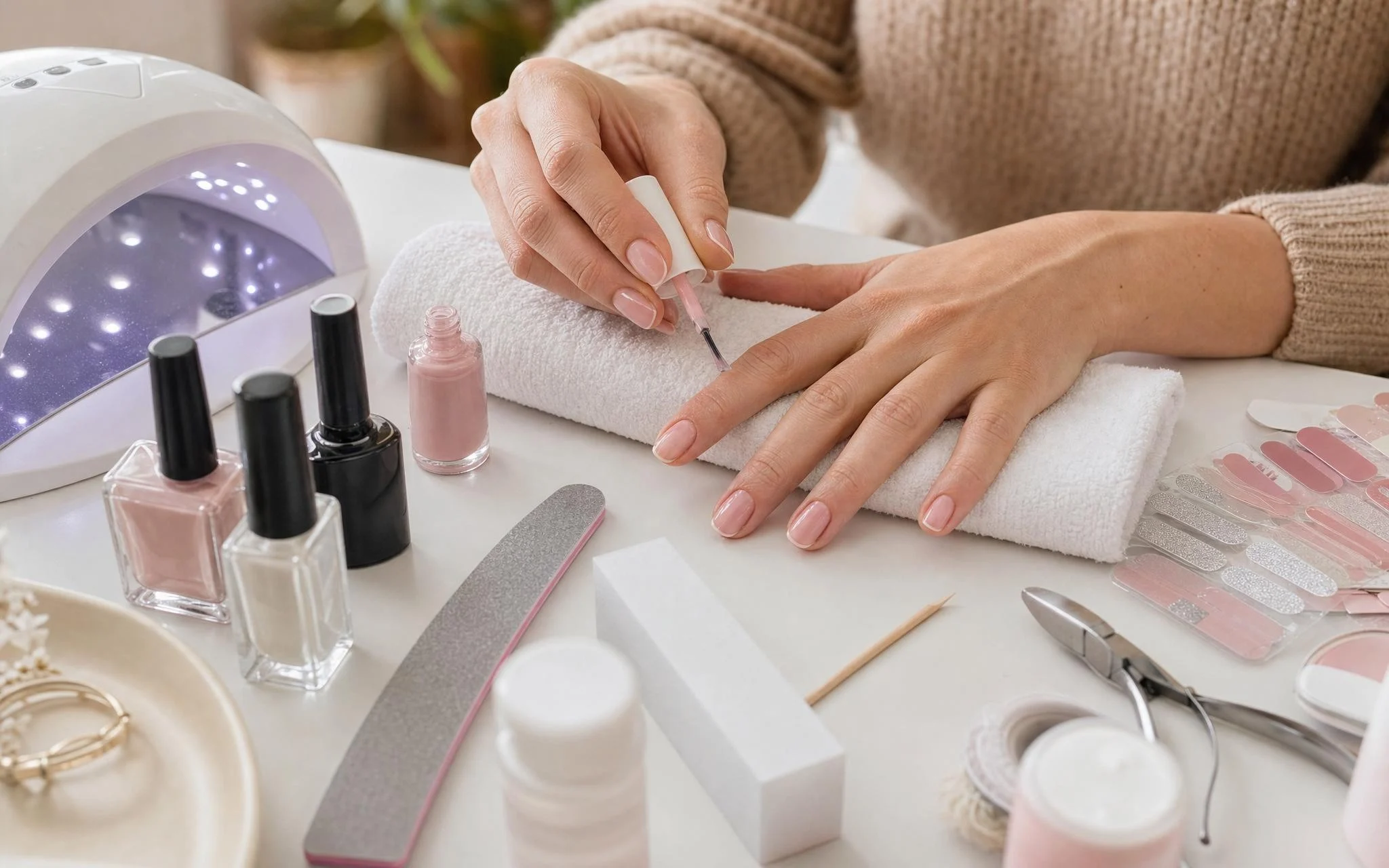
Between the desire for impeccable hands and rising salon prices, manicure at home has never been more of a dream. UV patches, semi-permanent varnish, clip-on false nails or simple treatment lacquers: the options are multiplying to transform your salon into a mini nail salon. It remains to be seen which one really keeps pace.
Because between the promises of lasting three weeks, the UV lamps to buy and the risks for the natural nail, it’s difficult to see clearly when you’re not a professional. This guide sifts through seven key home manicure techniques to help you choose based on your time, budget and condition of your nails.
Home manicure, UV patches and false nails: what’s changed
In just a few years, the bathroom has been filled with kits: UV gel patches, homemade semi-permanent varnish, clip-on capsules that are much thinner than before. The UV gel patches appear as preformed gel stickers to be glued then catalyzed for 120 seconds under a UV lamp; The advertised hold lasts 2 to 3 weeks, with a result very close to a salon semi-permanent. The homemade semi-permanent varnish kits use the same protocol as in the institute (base, two coats of color, top coat, passage under a lamp at each stage) for a hold of approximately 15 to 20 days.
And then there are solutions without a lamp: classic adhesive patches which are applied in 5 minutes to last 7 days or more, gel-effect varnishes showing an average hold of around ten days with top coat, ultra-natural enhancing varnishes and treatment varnishes enriched with keratin or vegetable oils. Clip-on false nails promise 3 to 10 days of peace of mind depending on the length and use of the hands. As the outfit increases, preparation, equipment and technique become more important.
Seven home manicure solutions compared: hold, time and level
Long-lasting options often rely on technology. The UV gel patches are applied to prepared nails, cut roughly, run under a lamp then filed to fit the shape; you can add a gel top coat for even more shine. Their major advantage: a very clear result in around fifteen minutes, without drying time, and a gentle application with oil and boxwood stick. Homemade semi-permanent varnish also offers 15 to 20 days of intense shine, but the procedure is longer and requires very thin layers. Between the two, gel effect varnishes are used like a classic varnish, dry in the air and, combined with a dedicated top coat, last around 10 days while giving that sought-after “mirror” shine, provided you do not overload the nail.
- Needs 2 to 3 weeks of wear: UV gel patches or homemade semi-permanent varnish, with UV lamp.
- About 10 days without a lamp: gel effect varnish applied in thin layers with top coat.
- A quick week: adhesive patches or clip-on false nails, applied in just a few minutes.
- Fragile nails or nails undergoing treatment: enhancing varnishes and care varnishes to gently strengthen them.
The UV-free adhesive patches seduce with their playful side: you stick, cut off the excess, and the manicure remains clear for at least 7 days, provided you choose the size carefully and do not tear off the patch when applying. Sublimating varnishes unify the surface, blurring streaks and small irregularities with a single, almost transparent coat; some versions are matte, others slightly pink or iridescent. Care varnishes, often biosourced, offer the same colors and the same shine as a classic varnish, while leaving the nails less brittle after application. As for the clip-on false nails, thinner than before, they stick in 5 minutes with glue or adhesive film, filing as needed to adjust the shape, for a hold of 3 to 10 days depending on the activities.
UV patches, semi-permanent and treatment: choosing your manicure at home
A test of UV gel stickers clearly illustrates the limits and advantages of these new products. A discovery kit around $47.90 includes, for example, four colors of stickers and a free UV lamp. After careful preparation (cuticles, light filing, degreasing), a first installation carried out by applying then catalyzing the sticker before cutting off the excess took almost an hour, with a few peelings at the free edge and a comfortable hold of around a week before the hair clung to it. By changing the method and cutting off the excess before catalysis, the second application lasted around thirty minutes, with a hold of close to 10 days. The removal, carried out with oil by gently lifting the capsule, left the nail intact, making it a popular one-off solution for an event, vacation or to help a broken nail grow back.
For already soft or damaged nails, treatment and enhancer varnishes remain the most prudent allies, even if it means accepting a hold comparable to a classic varnish, often 2 to 4 days. When you want long wear without all the commitment of semi-permanent, gel-effect varnishes and adhesive patches offer a good compromise. Techniques with UV lamp require more rigor: thin layers, catalysis time respected, and deposit without aggressive filing or tearing. Some gel patches feature formulas without HEMA or TPO, to limit the risk of allergies, which appeals to those who have already reacted to varnishes. And here again, alternating “intense” manicures with periods of treatment varnish or simple cuticle oil helps the nails stay in shape.
Which homemade manicure technique lasts the longest?
UV gel patches and homemade semi-permanent varnish are those which last the longest, around 2 to 3 weeks for the first and 15 to 20 days for the second, when the application is carried out correctly. Gel effect varnishes tend to last around 10 days, adhesive patches and false nails between 7 and 10 days, a classic varnish rarely exceeds 2 to 4 days.
How to avoid damaging your nails with a manicure at home?
Everything depends on the preparation and application: file the surface very lightly, do not sand until the nail is refined, respect the times under the lamp and above all never tear off patches, semi-permanent or false nails. Using oil or a suitable nail polish remover, then follow up with a course of treatment varnish and cuticle oil to limit damage.
Home manicure: what to choose when you’re starting out?
When you still lack dexterity, adhesive patches, enhancing varnishes and treatment varnishes are the most forgiving, because an approximate layer or a slightly imperfect patch size is hardly visible. Short clip-on false nails can also help out for an occasion. Lamp techniques, such as semi-permanent, require more practice and precision.
