
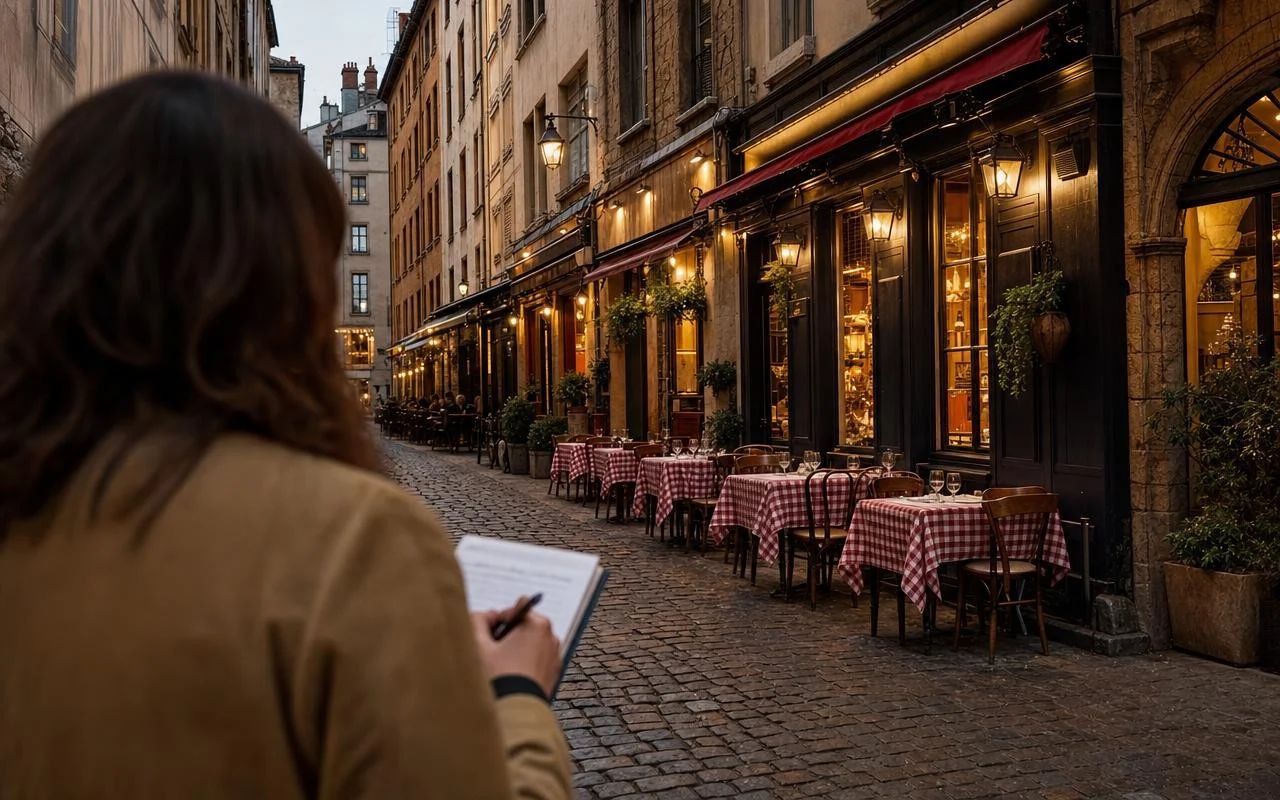
Notebook in hand, beret screwed on her head, Carole leaves a youth hostel in the Guillotière district of Lyon. She has just checked every detail, incognito, like an ordinary customer. , she tells France 3. A banal scene for this professional traveler.
An investigator for nearly 30 years, Carole travels around the capital of Gaul to update the local edition. His work nourishes this cult traveling companion, sold nearly two million copies per year, which backpackers still slip into their backpacks. But what is really hidden behind these few lines of address in the guide, written as if by a good travel friend?
The daily life of a Guide du Routard investigator in Lyon
Carole continues visits to accommodation, cafes, corks or more chic tables, always undercover. For her, there is no question of being satisfied with memories: everything must be verified on site, again and again. , she summarizes.
Behind this seriousness, there is above all an immense greed. Carole embraces her appetite for good restaurants and local produce: , confides the investigator. This complicit tone is found in the style of the guide, designed to speak to the reader like a friend.
A day of investigation between Lyon traffic jams and plant-based addresses
At noon, head to a stopper in the second arrondissement, tested like any customer, notebook placed discreetly next to the plate. Here again, Carole judges the welcome, the prices, but also the cuisine, in detail. In front of a quenelle of pike, she decides: , a real favorite promised to have a good place in the book.
Later, the investigator completely changes register with a plant address where vegetables are in the spotlight. Between two bites, she admits: . But enthusiasm does not prevent demands, especially for high-end or contested places: . Each note, each photo taken during the day will then be used to write or review the few lines which will guide future travelers.
Why the Routard Guide remains the bible for backpackers
The story begins far from Lyon: in 1971, two students, Michel Duval and Philippe Gloaguen, left Paris for Sri Lanka, returned with their pockets full of notes and published the first in 1973. Five decades later, Carole assures us: . Despite the purchase of the guide by Hachette, controlled by Vincent Bolloré, the investigators continue to travel incognito, pay their bills and tell what they really experienced.
This direct link also fosters a strong bond with the public. , says Carole. Internal studies report a very high satisfaction and recommendation rate, driven by thousands of reader feedback which also feeds into this ongoing investigative work.
How does a Guide du Routard investigator work?
The investigators travel incognito, pay for their meals and nights like ordinary customers, take notes and photos, then write down or update the addresses, often once a year for major destinations.
Are Le Routard addresses really tested on site?
Yes, every address is visited, including the safe bets. Places reported by readers’ complaints are systematically reviewed to check whether the experience still meets the guide’s expectations.
Are the Routard guides often updated?
The majority of titles are updated very regularly, with tours of investigators who return to the field to check practical information, prices, changes in offer or ownership.
Has the takeover by Hachette changed the work of investigators?
The guide now belongs to Hachette, controlled by Vincent Bolloré, but the principle remains the same: independent investigators go out on the roads, test the addresses incognito and preserve the original spirit of Le Routard.
