
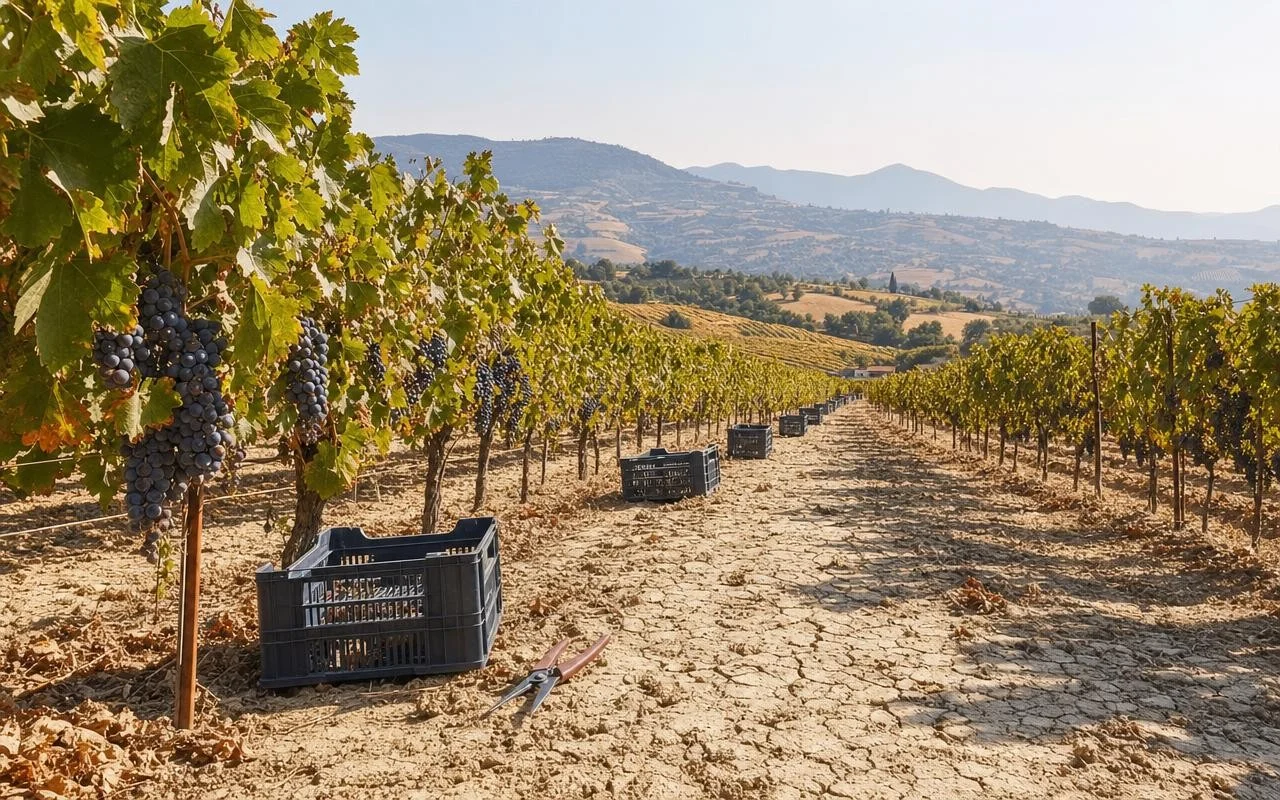
In the vineyards of the South, the harvesting machines are already running while summer is still in full swing. From Provence to the Atlantic, the 2026 harvests are up to a month and a half in advance. A record advance which questions and worries winegrowers.
Since the beginning of August, we have been cutting the grapes at Château Virant near Marseille, at Domaine du Bagnol in Cassis, on the Ile de Ré and even in Muscadet. In certain Loire vineyards, the harvest began a week before the 2003 record. The French harvest calendar has been disrupted.
In Provence, August harvests have become the norm
In Lançon-Provence, in Bouches-du-Rhône, Château Virant launched the white harvest on August 10, a first. Its owner Philippe Coutin notes: , he confides to France 3. The teams now work at night to bring in fresh grapes.
At Domaine du Bagnol in Cassis, the harvest begins on August 17, two days earlier than in 2025. Over thirty years, its director Lisa Genovesi observes a shift of around a month and a half in the start of the harvest, under the effect of more frequent heat. For this Mediterranean terroir, August harvests are becoming the new baseline.
Île de Ré: drought, tiny berries and falling yields
On the Ile de Ré, the Uniré cooperative had never started so early: the harvest began on August 11, ten days before 2025, while Anthony Cordon’s father cut between September 10 and 15. Between March and June, the vines only received 15 to 20 mm of rain. The clusters are smaller, less juicy, sometimes marked by the sun.
The water deficit can be read in the bins as well as in the accounts. For Jérôme Poulard, technical manager of Uniré, the shock is clear: . The cooperative is already thinking about later grape varieties.
Working at night, tending the vines: adaptation strategies
In the South, protecting the plant becomes a constant job. Philippe Coutin explains it this way: . In many areas, the harvest now sometimes starts as early as 2 a.m. to avoid the heat.
In Cassis, we rely on sea air, gentler products like aloe vera and the rapid cooling of grapes in the cellar to limit the effects of global warming. In the Loire, François, an employee of the Huchet estate, recalls the challenge for society: . Behind these increasingly early harvests, the entire wine-growing model is being questioned.
Why are these 2026 harvests brought forward?
Prolonged heat and lack of water ripen faster.
What effect on wine yields?
Volumes may drop by around 50%.
How do the domains adapt in practice?
Night work, protection of grapes, new grape varieties.
