
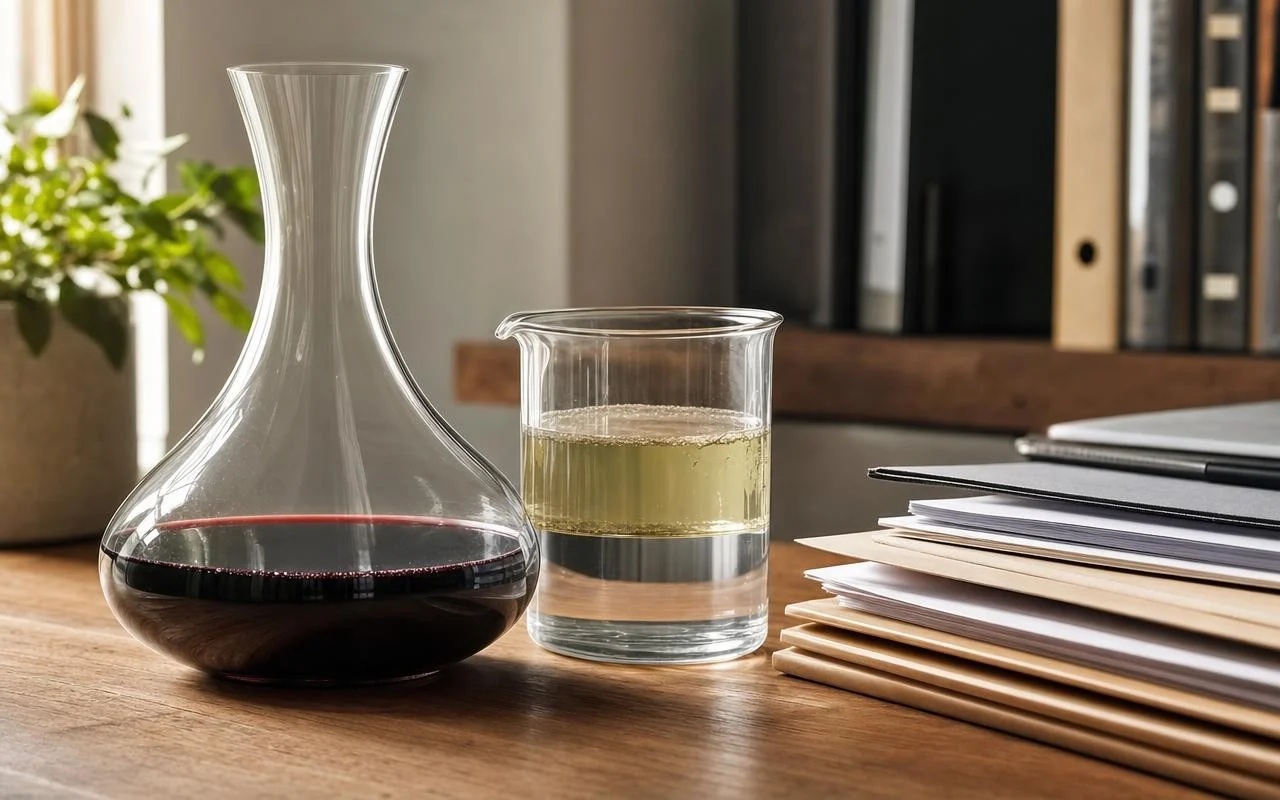
You have undoubtedly already heard a sommelier suggest letting the wine settle, or a colleague explain that he prefers to wait for the situation to settle before deciding. Same verb, two very different scenes. And yet, the mechanics behind this word remain the same. What lies behind this seemingly banal gesture often surprises.
Because decanting is not only used to remove a deposit in a bottle. The verb comes from alchemy, migrated into chemistry laboratories, then into kitchens and finally into our daily vocabulary. Between science, gastronomy and language, it tells a little story of clarity.
Decant: definition of gesture to verb
Modern dictionaries agree: decanting first means gently transferring a liquid to separate it from its deposit or suspended particles. It is the image of the carafe of wine that is filled without bringing up the lees, or of the broth that is poured in, leaving the bones at the bottom of the pot. The same logic applies to two immiscible liquids, such as water and oil, when the lighter phase is allowed to float to the surface before separating it. For a complete decanter definition, we must keep this key idea of separation by gravity.
- Technical verb: separate a liquid from its impurities or from another phase by simple rest then controlled transfer.
- Intransitive verb: a mixture or preparation settles when the disturbing elements settle and leave a clearer liquid.
- Figurative meaning: to put ideas in order or to let a situation become more readable, close to clarifying or purifying.
From alchemy to cooking: decantation in action
Historically, decantation appears among alchemists, before entering the vocabulary of chemistry and pharmacy in the 18th century. The Encyclopedia directed by Denis Diderot and Jean Le Rond d’Alembert already describes the action of very gently pouring a clarified liquor above its deposit. The word itself comes from the Latin of alchemists, derived from , the spout of a jug, according to the French Academy. In laboratories, chemists have shown that suspended particles, after a short acceleration, descend at a constant speed: the smaller they are or the viscous liquid, the longer settling takes.
Another discrete parameter: these particles often carry an electric charge. By adding coagulants or flocculants, they clump into larger grains which fall much faster. And then the gesture counts too. Chemists tilt their tubes about 45 degrees so that heavy particles slide down the wall without blocking the lighter liquid’s rise to the surface. In the mining industry or water treatment, this principle has given rise to large settling tanks, when the kitchen prefers more compact tools.
When everything settles: science of gesture and everyday language
In cooking, decantation is seen everywhere: decanting a wine to separate it from the potassium bitartrate crystals and avoiding an unpleasant taste, letting the cream form on the surface of the milk before recovering it, preparing clarified butter where the aqueous phase settles at the bottom. Hervé This says that he proposed using separatory funnels, these bottles fitted with a tap, to separate water and oil or different aromatic compounds and, he says, in an article published on Nouvelles Gastronomiques. The same logic is further accelerated in a centrifuge, where the force applied can exceed ten thousand times gravity and do in a few seconds what would take a day.
No wonder this verb has slipped into everyday language. When we say that we let our memories settle, we express the idea that a little time will remove the confusing details and keep only the essentials. The dictionaries also give the example of a situation which settles, for example a professional file or a negotiation, when the parasitic elements disappear and the issues finally become readable. In the sports or political press, we often read that an end of season or an expected decision could settle a file: the word suggests an active wait, where we let things settle before deciding. In conversation, using it discreetly brings back the image of a liquid which becomes clear, where a verb like settle remains much drier.
What does decanting mean in cooking?
In cooking, decanting involves letting a liquid rest and then transferring to separate deposits or fat: wine without lees, defatted broth, clarified butter.
What is the figurative meaning of the verb decant?
Figuratively, to settle means to let a situation or ideas become clearer, after the disappearance of confusing or disruptive elements.
What is the difference between decanting and clarifying?
Decanting relies on gravity and gentle transfer. Clarifying is broader and can involve heat, a filter or specific ingredients.
What tools are used to decant a liquid?
Chemists use test tubes, separating funnels and centrifuges. In cooking, we mainly use carafes, narrow pots, Chinese pots and sometimes suitable light bulbs.
