
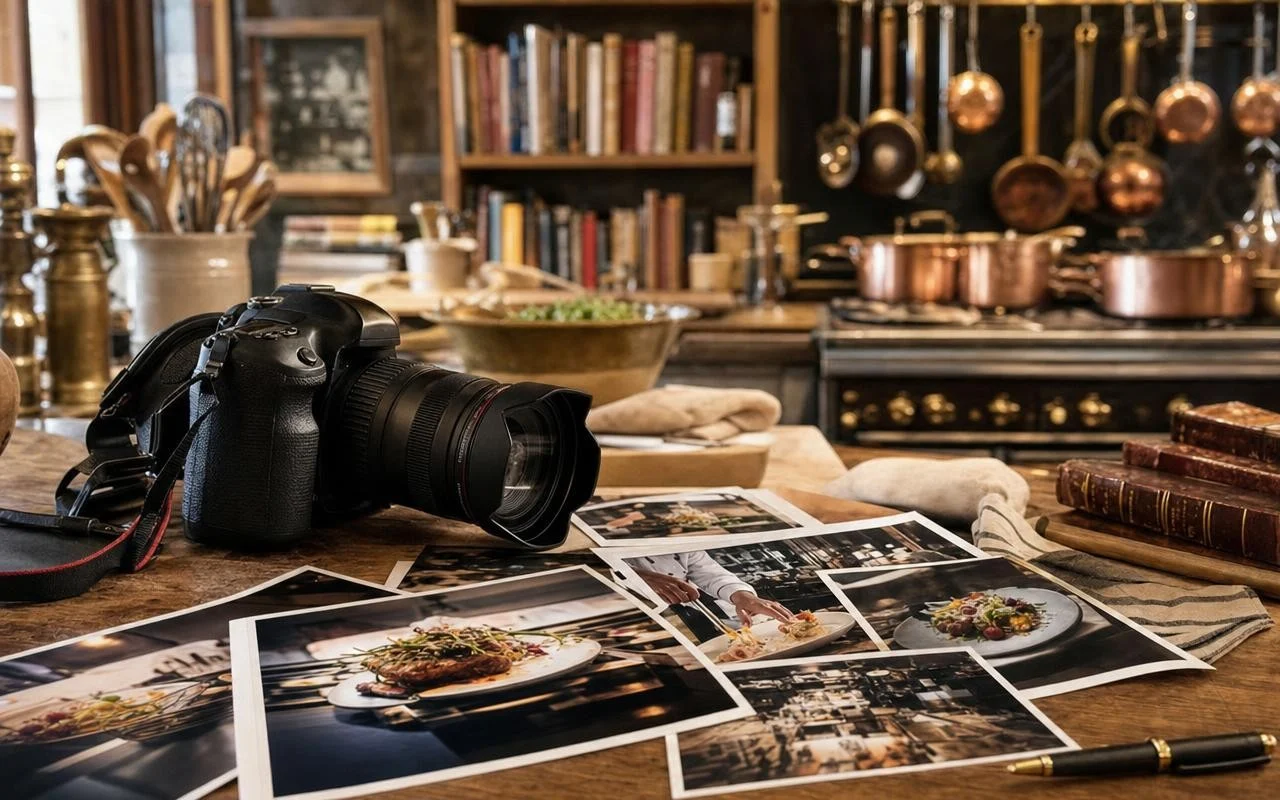
The world of gastronomy is losing one of its most discreet views. The photographer Maurice Rougemont, known for having placed generations of chefs, artisans and producers at the center of his lens, died at the age of 79, on August 31, 2026. For almost half a century, he followed gourmet France, from the kitchens of palaces to the andouillette or blackcurrant workshops. Behind many images familiar to lovers of good cuisine, it was his eye that we looked at without always knowing it.
Its disappearance was announced by the gastronomic critic Gilles Pudlowski, a lifelong traveling companion. He greeted the one who was his “”, his “” and his “”, Gilles Pudlowski told Food & Sens. The two men met at the end of the 1970s, before doing reports and columns for , , or even . Their text-image duo has accompanied, year after year, the rise of contemporary French gastronomy.
Maurice Rougemont, portrait of a chef photographer
Born in 1947, Maurice Rougemont first worked as a photojournalist from 1976, before becoming independent in the early 1980s. He then established himself as a portraitist of writers, photographing Henri Troyat, Bernard Clavel, Jacques Lacarrière, Patrick Modiano and Jean d’Ormesson. This passage through the world of letters lastingly marks his relationship to the face, to the look, to the character more than to the staging.
From the 1980s, his work shifted towards the table and the stove. He collaborates with , , , then illustrates the gastronomic section of . At the same time, he follows Gilles Pudlowski on a vast exploration of gourmet France: starred restaurants, bistros, markets, ports, vineyards, farms. In 2007, he also participated in the collective of photographers Pixgallery, while continuing his projects from Malakoff, where he had lived since the early 2000s.
In the lens of Maurice Rougemont, the human before the plate
Photographer of the chefs, Maurice Rougemont did not concentrate on the perfect plate. What he was looking for was a chef in front of his stove, a precise gesture, attentive hands, an attitude, a light that tells a story. “”, remembers Gilles Pudlowski. His images show the cooks in action rather than in representation, in the heat of service as well as in the calm of preparations.
His gaze did not stop at the big hats. He photographed with the same attention a fisherman, an oyster farmer, a winemaker or a confectioner. For a long time, he worked in kitchens before Instagram and smartphones, at a time when you had to gain the chef’s trust, observe the light and wait for the right moment. From 1990 to 2020, his reports with Gilles Pudlowski have drawn a vast portrait of the professions that shape French gastronomy.
Books, exhibitions and archives of a gourmet France
From this complicity were born numerous works that have become references. We find the images of Maurice Rougemont in , , , , or even . Chefs, neighborhood bistros, iconic products and artisans create a sensitive atlas of taste, where each face counts as much as each plate.
In 2021, the exhibition at the Rungis Market brings together some of his portraits of artisans created between 1990 and 2020: andouillette from Troyes, blackcurrant from Dijon, salmon from Adour, poultry from Bresse. These images, also from works like and , give the impression of a journey through time. With the series, dedicated to the inhabitants of the island of Noirmoutier, he extends this work on faces. Chefs come and go, restaurants change, but his photographs continue to tell the story of an era and those who made it.
Who was Maurice Rougemont, photographer of the chefs?
Maurice Rougemont was a French photographer born in 1947 and died in 2026 at age 79. Initially a portraitist of writers, he became one of the great photographers of French gastronomy, following chefs, artisans and producers for nearly fifty years.
With which media did Maurice Rougemont work?
He started before collaborating with , , , and . His reports often accompanied the texts of the gastronomic critic Gilles Pudlowski.
Where can we discover the work of Maurice Rougemont today?
His images remain visible in numerous books, including , or . The series exhibited at the Rungis Market and on the island of Noirmoutier also demonstrate the breadth of its archives.
