
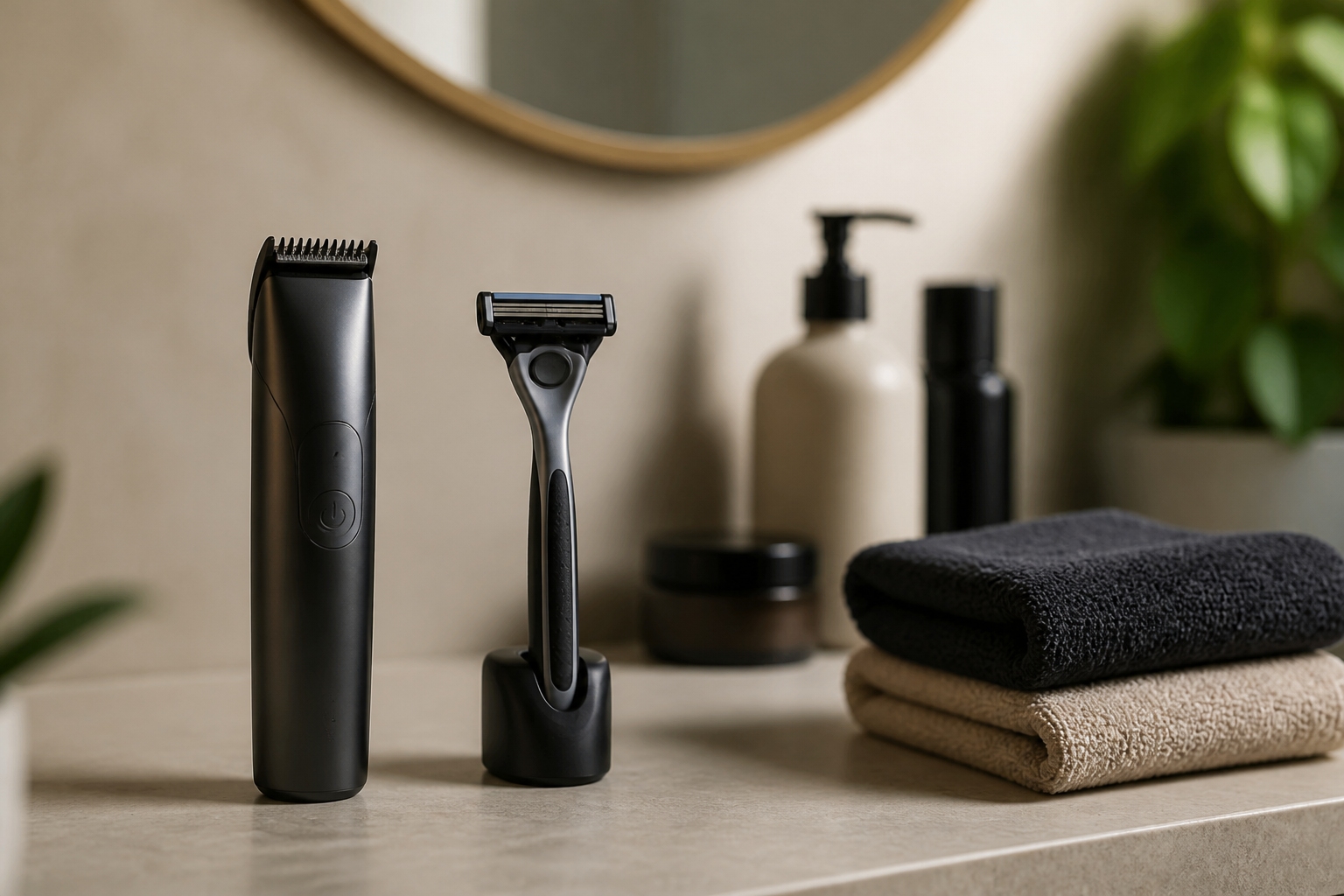
At a glance
-
Skin thinner, more supple, richer in nerve endings: the most sensitive area of the body.
-
Thicker, curly hair, grown in several directions, in an area that is difficult to see.
-
Pre-mowing is the step most often forgotten, and the one that avoids the most cuts.
-
We shave in the direction of the hair, without pressing, with a shaving preparation.
-
48 to 72 hours between two clean shaves on this area.
-
A facial tool is not suitable: it gets dirty on long, curly hair.
Why this area requires a separate method
Four characteristics distinguish it from the rest of the body, and each increases risk. The skin is thinner and more flexible, and contains more nerve endings, which makes it very sensitive to the friction of a blade. The hair is generally thicker and curly, and grows in several directions: an unsuitable tool requires multiple passes. The area is difficult to see and reach, which reduces the precision of the gesture. Finally, the operation is often done in the shower, in wet and slippery conditions.
The 6 steps to a safe shave
-
Mow first. The body is shaved less often than the face, so the hair is longer. Pre-trimming prevents the razor from clogging and gives a cleaner shave in a single pass.
-
Take a shower with hot water. Hot water softens the hair, which cuts with less resistance. This is especially true on thick hair.
-
Apply a shaving cream or gel. The glide protects the skin and reduces blade friction, the primary cause of irritation in this area.
-
Stretch the skin with your free hand. The skin appears in folds and does not remain taut on its own. Flattening it prevents a crease from entering the cutting area: this is where the nicks occur.
-
Shave in the direction of the hair, without pressing. We let the tool work. We rinse the blade every one or two passes: a loaded blade pulls and pushes to press.
-
Rinse, blot, moisturize. We dry by dabbing, never by rubbing, then we moisturize to prevent redness and itching from regrowth.
To avoid: dry shaving, pressing to compensate for a dull blade, making two passes against the grain without reapplying cream, and sharing your tool.
Should you shave clean or keep length?
Both are valid choices, and the mower is the more prudent route to start. Clean shaving gives clean, soft skin; mowing leaves a uniform length and is maintained more quickly. If you’re prone to ingrown hairs, clipping has a distinct advantage: it cuts the hair just above the skin, or at hoof height, and lets it grow back freely.
|
Your need |
Recommended tool |
For what |
|
Clear and soft skin |
Razor designed for the body and intimate area |
Cut at skin level, with protection system |
|
Maintenance of a length |
Trimmer with 3 mm comb |
Even height, quick action, no clean shaving |
|
First time |
Trimmer with sensitive skin comb |
The comb prevents direct contact of the blade with the skin |
|
Frequent ingrown hairs |
Trimmer, or razor with anti-ingrown hair bar |
The hair is not cut below the surface of the skin |
|
Difficult to see area |
Mower with integrated lighting |
Visibility is a cutting factor in its own right |
|
Use in the shower |
Waterproof, cordless tool, non-slip grip |
Safety and cleaning in wet conditions |
How to limit ingrown hairs and spots after shaving?
Avoiding the hair being cut below the surface of the skin. The hair in this area is curly and grows in several directions: with a classic multi-blade razor, it can be cut several times and retract under the skin, then turn around when it grows back. Two parades. The trimmer, which cuts just above the skin. Or a razor with an anti-ingrown hair bar, whose wider blade spacing reduces pressure and cuts level with the skin without digging into it.
What hygiene around shaving?
Daily washing with water and mild soap is sufficient, and shaving does not replace it. We clean before shaving, to work on clean skin, and after, to remove cream residue. The tool rinses thoroughly after each use and stores upright to preserve the blades. A non-negotiable point: shaving tools are never shared. Each person has their own microbiota, and superficial rinsing does not remove all microorganisms.
What tools are designed for this area?
A razor or trimmer dedicated to the body, because the skin and hair differ from the face. The GilletteLabs BODY + INTIMATE range, launched in March 2026, was designed for this use. The brand presents it as its safest body and intimate area shave, and as the first body and intimate shaving regimen approved by the Skin Health Alliance.
|
Product |
Price observed |
What it brings |
|
BODY + INTIMATE razor |
$34.90 · blades $14.90 for 3 |
Triple Defense System: anti-irritation bar, anti-ingrown hair bar, long-lasting lubricating strip. FlexDisc 2D, widely spaced blades, handle designed for the shower |
|
i7 lawn mower |
$99.50 |
SkinFirst up to 0% nicks and cuts, LED spotlight, AutoSense, 3 combs including sensitive skin, 100 min |
|
i5 lawn mower |
$64.90 |
Same technologies as the i7, without lighting |
|
2-in-1 shaving cream |
$8.25 at Carrefour |
Cleaner and shaving preparation, for gliding |
FAQs
Does the hair grow back thicker after a close shave? No. An unshaven hair becomes thinner towards its tip, while a cut hair has a clear end: the regrowth appears thicker, but the thickness and density do not change. No removal method modifies the structure of the hair.
How long to wait between clean shaves? A delay of 48 to 72 hours is generally recommended for sensitive areas. It gives the skin time to recover from the friction of the blade.
Can you use your facial razor on the intimate area? This is not suitable. A cartridge designed for short, straight hair becomes clogged on long, curly hair, which forces you to press and increases the risk of cutting already sensitive skin.
Is it better to shave, trim or wax? Shaving gives a clean, quick and convenient finish. Clipping maintains length and reduces the risk of ingrown hairs. The wax removes the hair at the root, with a result that lasts three to six weeks, but it is more painful and more likely to irritate sensitive skin.
Do you need shaving cream with a trimmer? No. Shaving preparation is useful for wet blade shaving. For shearing, the skin and hair must be dry.
