
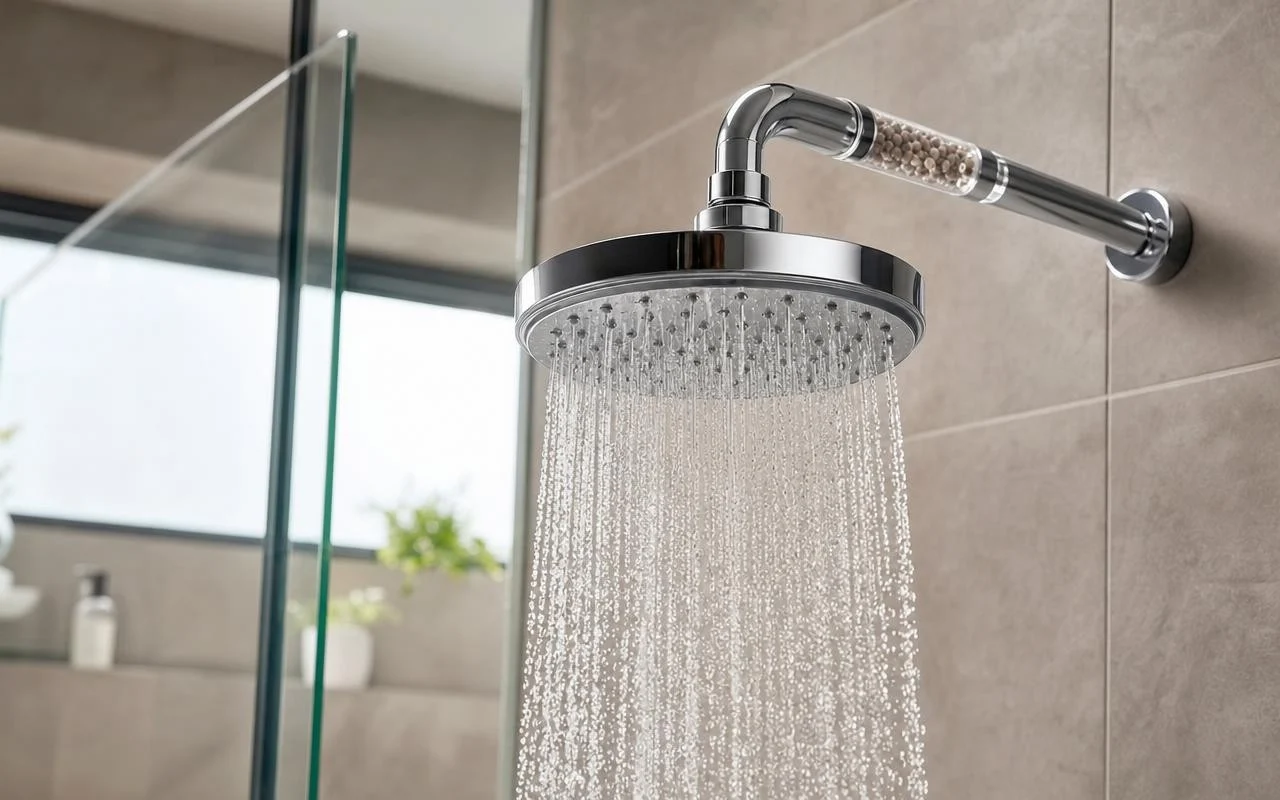
A softer jet, less tight skin, hair supposed to regain shine… Videos on the networks sell the filtering shower head as the new miracle gesture in the bathroom. For many, it would be enough to screw on a special shower head to transform ordinary tap water into a beauty ally.
Behind these promises, however, there are very concrete physical constraints on what can actually be filtered at the exit of the wall. And this is where the question really arises: useful investment or simple design gadget?
Filtering shower head: what it does to the water coming into your home
In city water, the main enemy of beauty remains chlorine, essential for drinkability but irritating to the skin barrier and the hair cuticle. Dermatologist Julie Russak summarizes the effects: , she says in an interview relayed by NewBeauty. Added to this are limestone minerals (calcium, magnesium) and sometimes traces of metals such as copper.
The filter heads try to act just before the water hits the skin. According to cosmetic chemist Julie Pefferman, some use calcium sulphite to reduce chlorine, others use a KDF-type copper-zinc alloy which also attacks certain metals. Vitamin C cartridges, she explains to NewBeauty, while activated charcoal helps retain free chlorine and odor-causing compounds.
Skin and hair: real but limited benefits
In practice, what does it feel like to shower? In highly chlorinated water, many describe less tight skin, a slightly less irritated scalp and slightly softer hair. Pefferman points out that certain high-end filters, combining activated carbon and fine membranes, have shown in the laboratory that they can eliminate up to 99% of chlorine, 98.5% of chloramine and 99.9% of lead.
On colored hair, reducing chlorine and metals can also limit dulling. Pefferman notes that . Filters containing KDF, which retains some of this copper, can therefore help the color stay sharper. This remains a support: they do not erase the damage of discoloration or excessively used heating tools.
What a Filtering Shower Head Can’t Do, and How to Keep It Effective
The big limit is limestone. Pefferman warns: , she warns in NewBeauty. Softening water requires ion exchange or reverse osmosis, systems installed on plumbing, much larger than a shower cartridge. French tests on ball models presented as “anti-limescale” have also shown almost unchanged water hardness and pH.
Last point often forgotten: maintenance. A saturated filter loses its effectiveness and can even significantly reduce the flow rate. Some serious manufacturers give a volume of water or a number of months before replacement, to be followed closely. On the materials side, the Hansgrohe brand warns against products that are too aggressive, explaining that they, recalls the brand in a document cited by Journal des Seniors. Instead, she recommends gentle and regular cleaning, without white vinegar, to extend the life of the filter head like a classic hand shower.
Does a filter shower head really remove limescale?
No, most models hardly change the water hardness. They mainly act on chlorine, certain metals and odors, not on the limescale responsible for white marks.
Is it useful for sensitive or atopic skin?
On highly chlorinated water, a filter can reduce tightness and feelings of irritation. This remains a comfort supplement, which does not replace a suitable dermatological treatment.
Does colored hair really benefit from a filter showerhead?
By limiting chlorine and metals like copper, a filter often helps the color stay brighter and less dull, especially in areas with heavily loaded water.
How often should the cartridge be changed?
It all depends on the model and your consumption. Most brands indicate a duration in months or liters; beyond that, efficiency drops and throughput can drop.
Do you still need a skin and hair care routine?
Yes, a filter shower head does not replace good hydration or appropriate hair care. It simply creates a water environment that is a little gentler on the skin and fiber.
