
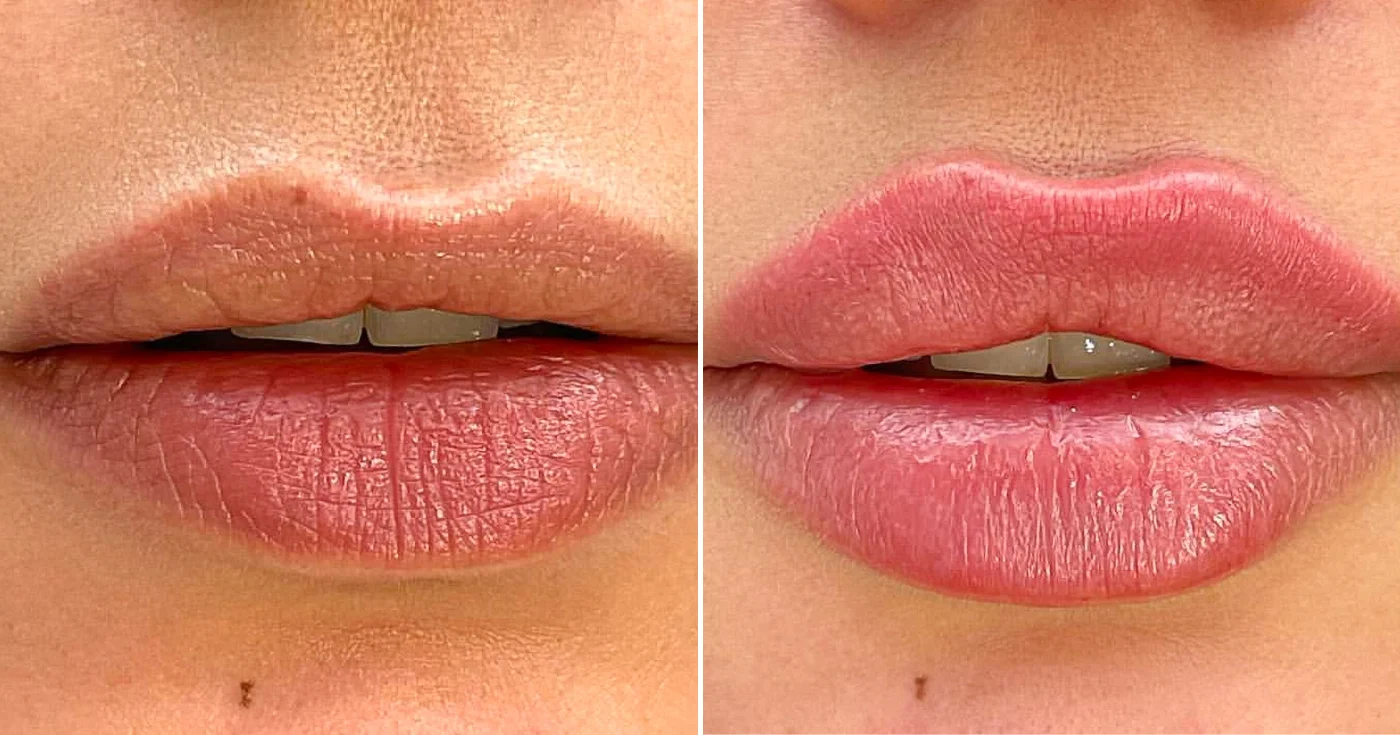
Plumping balms that tingle, menthol glosses and even hyaluronic acid injections have long been the only reflexes to find fuller lips. In recent months, a new object has appeared in bathrooms: red light therapy devices dedicated to the mouth and its contour. Enough to finely smooth fine lines and awaken volume… or a simple gadget?
Before investing in an LED tip for the lips, many look at what is done in aesthetic medicine and among celebrities. Kate Moss, for example, is a fan of red light and uses the Dermalux Flex device, described as , according to the device’s website. She also confides that she loves , she tells The Standard. Enough to make you want to take an interest in this technology for the fragile area of the lips.
Red and Lip Light Therapy: What Light Really Does
The AFME (French Association of Aesthetic Medicine) describes photobiomodulation by LED as cold light which stimulates mitochondria, cellular metabolism and fibroblasts, these cells which produce collagen and elastin. Red LEDs are used for tissue regeneration, action on wrinkles and scars, with a gradual improvement in skin quality after several sessions.
On the lips, dermatologist Karan Lal summarizes the mechanism very clearly: , he details in Elle. He also recalls that. And to add: .
From facial devices to targeted lip devices
In the office, red LED panels treat the entire face or part of the body. AFME explains that a session generally lasts 20 to 30 minutes, without pain or recovery time, with a protocol of 5 to 10 sessions at a rate of 1 to 2 per week. The Dermalux Flex appreciated by Kate Moss belongs to this category of professional devices that can include the area around the mouth in a global anti-aging strategy.
At home, brands are offering the same technology in face masks or small devices directly targeting the lips and their contours. Their objective is to concentrate red light on this very mobile area to smooth vertical lines, improve microcirculation and give a more homogeneous and slightly plumper appearance. To ensure these effects remain visible, AFME insists on regularity: without respect for duration and frequency, the treatment loses much of its interest.
How to integrate red light into a lip routine
To remain in the spirit of medical protocols, it is recommended to use these devices several times a week and over several weeks, with improvements only appearing after 3 or 4 sessions according to the AFME. Before light, it is better to gently cleanse the lips and avoid photosensitizing products. After the session, a repairing balm can help maintain hydration and support the work on the skin barrier.
On the safety side, the association recalls that LED phototherapy is painless, non-invasive and known to have no side effects, but that certain situations require the advice of a doctor: history of melanoma, systemic lupus erythematosus, diseases with DNA repair disorders, photosensitizing treatments, previous exposure to ionizing radiation or arsenic, among others. Blue LEDs can be partially harmful if exposure is excessive, the mouth remains an area where we clearly favor red. And, as Karan Lal points out when talking about fillers, light does not replace a syringe to gain a lot of volume, but it can help preserve collagen and hydration in the long term.
Red lip light therapy: does it really plump up?
Red LEDs increase cellular energy and support collagen production, which can soften fine lines and make lips look a little fuller and even. However, the results remain progressive and subtle compared to an injection of hyaluronic acid.
How many red light therapy sessions for lips are needed?
AFME indicates that the first changes with LEDs are generally seen after 3 to 4 sessions, as part of protocols of 5 to 10 sessions at 1 or 2 per week. For lips, the same logic applies: regularity and maintenance remain the key.
Is red light therapy for lips safe?
LED phototherapy is described by AFME as painless, non-invasive and without known side effects, but it has contraindications in cases of melanoma, lupus, DNA repair disorders or photosensitizing treatments. A dermatological opinion is recommended in case of doubt.
Sources
- Top Health
“Discover Kate Moss’ 13 beauty must-haves”
