
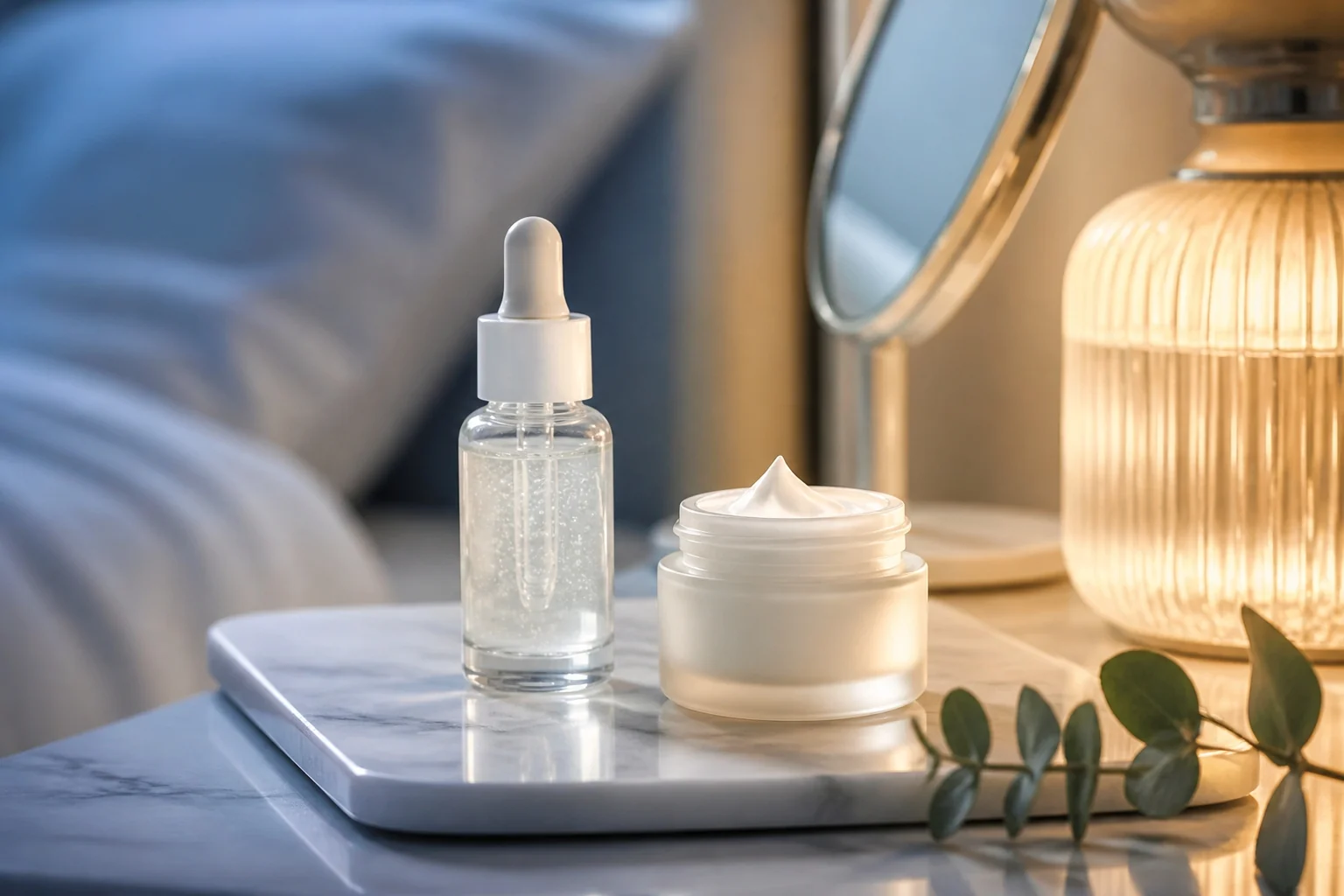
Serum and night cream: two galenics with very distinct roles
To understand the impact of these treatments on the skin, it is first necessary to look at their formulation and their physical structure, which we call the galenic. Serum and cream do not target the same layers of the epidermis and do not have the same biological function.
The facial serum is distinguished by its fluid, light texture, sometimes aqueous or in the form of a highly penetrating gel. Its formula is specifically designed to be quickly absorbed by the epidermis. Made up of small molecules, the serum penetrates deep to deliver its active ingredients directly where the skin needs them most. It is an intensive targeting and correction treatment.
Conversely, night cream is an emulsion, that is to say a mixture of water and fatty substances (oils, butters, ceramides). Its texture is significantly richer, smoother and more enveloping. Due to its lipid composition and the larger size of its molecules, the cream acts mainly on the upper layers of the epidermis. It forms a protective film on the surface of the skin to seal in hydration and strengthen the skin barrier.
The concentration of active ingredients: the strong point of the serum
If your main objective is to treat a specific skin problem (established wrinkles, pigment spots, loss of firmness, severe dehydration or imperfections), the serum is the product to choose. Its refined formulation makes it possible to integrate a concentration of active ingredients much higher than that of a classic cream.
- Targeted effectiveness: Serums contain little or no texturizing agents or heavy emollients. This leaves plenty of room for active molecules like hyaluronic acid, retinol, vitamin C or niacinamide.
- Optimal assimilation: Thanks to its fluid texture, the serum instantly fuses with the skin without leaving a greasy film, allowing the active ingredients to begin to act immediately.
- A tailor-made action: There are serums for every concern. For example, a retinol serum will stimulate nighttime cell renewal, while a hyaluronic acid serum will replenish the skin’s water reserves.
Night cream: the essential ally of the skin barrier
Nighttime is the time when insensible water loss (IWL) is highest. The permeability of the skin increases, which means that water evaporates more easily from the epidermis. This is where night cream reveals its importance.
Unlike serum which evaporates quickly if not sealed, night cream acts as a protective coat. It provides essential lipids which fill gaps in the skin barrier. This process is essential to maintain good hydration throughout the night and regain supple, plump and comfortable skin when you wake up.
In addition, night creams are often enriched with nourishing agents (such as shea butter, argan or jojoba oil) and soothing agents, perfect for repairing skin sensitized by the day’s aggressions.
Comparison table: Serum vs. Night cream
To help you quickly visualize the strengths of each treatment, here is a comparison based on precise evaluation criteria:
- Texture: Ultra-light, fluid or gel for serum; Rich, creamy and enveloping for the night cream.
- Penetration: Deep and immediate for serum; Superficial and gradual for night cream.
- Concentration of active ingredients: Very high for serum; Moderate to medium for night cream.
- Main action: Targeted correction (wrinkles, spots, radiance) for the serum; Hydration, nutrition and barrier protection for the night cream.
- Target skin type: All skin types (to be adapted according to the active ingredient) for the serum; Particularly recommended for dry, dehydrated or mature skin for night cream.
How to choose according to your skin type and your needs?
The choice between a serum and a night cream depends above all on the nature of your skin and your beauty goals.
If you have dry or mature skin: Night cream is absolutely essential. This type of skin suffers from a lack of natural lipids. Without the provision of a rich and nourishing cream, the skin risks feeling tight, dehydrated and showing more signs of aging. The ideal is to combine an anti-aging serum (with retinol or peptides) under your night cream for overall action.
If you have combination to oily skin: You often fear textures that are too rich, which can clog pores and encourage the appearance of imperfections. In this case, using a targeted serum (with salicylic acid or niacinamide) combined with a very light hydrating fluid or a non-comedogenic night cream is the best option. Sometimes, in summer, applying a hydrating serum alone can be enough for oily skin.
If you have sensitive or reactive skin: Choose a restorative and soothing night cream, rich in ceramides or centella asiatica, to rebuild the skin barrier. Introduce highly concentrated serums with caution, avoiding overly irritating active ingredients such as high-concentration fruit acids (AHA).
The art of layering: why combine serum and night cream?
In cosmetics, the golden rule to maximize the effectiveness of your treatments is layering, also called . Rather than choosing between serum and night cream, the combination of the two often offers the best results for skin regeneration.
The basic principle is simple: always apply your treatments from the most fluid to the thickest. The serum, thanks to its light texture, must be applied first to perfectly cleansed and toned skin. It penetrates quickly and prepares the skin to receive subsequent treatments.
Once the serum is absorbed, apply your night cream. This will envelop the skin, seal the active ingredients of the serum inside the epidermis and prevent their evaporation while providing the necessary comfort for the night.
This synergistic routine simultaneously treats the skin’s deep needs (thanks to the serum) and its surface needs (thanks to the cream), guaranteeing optimal skin regeneration while you sleep.
