
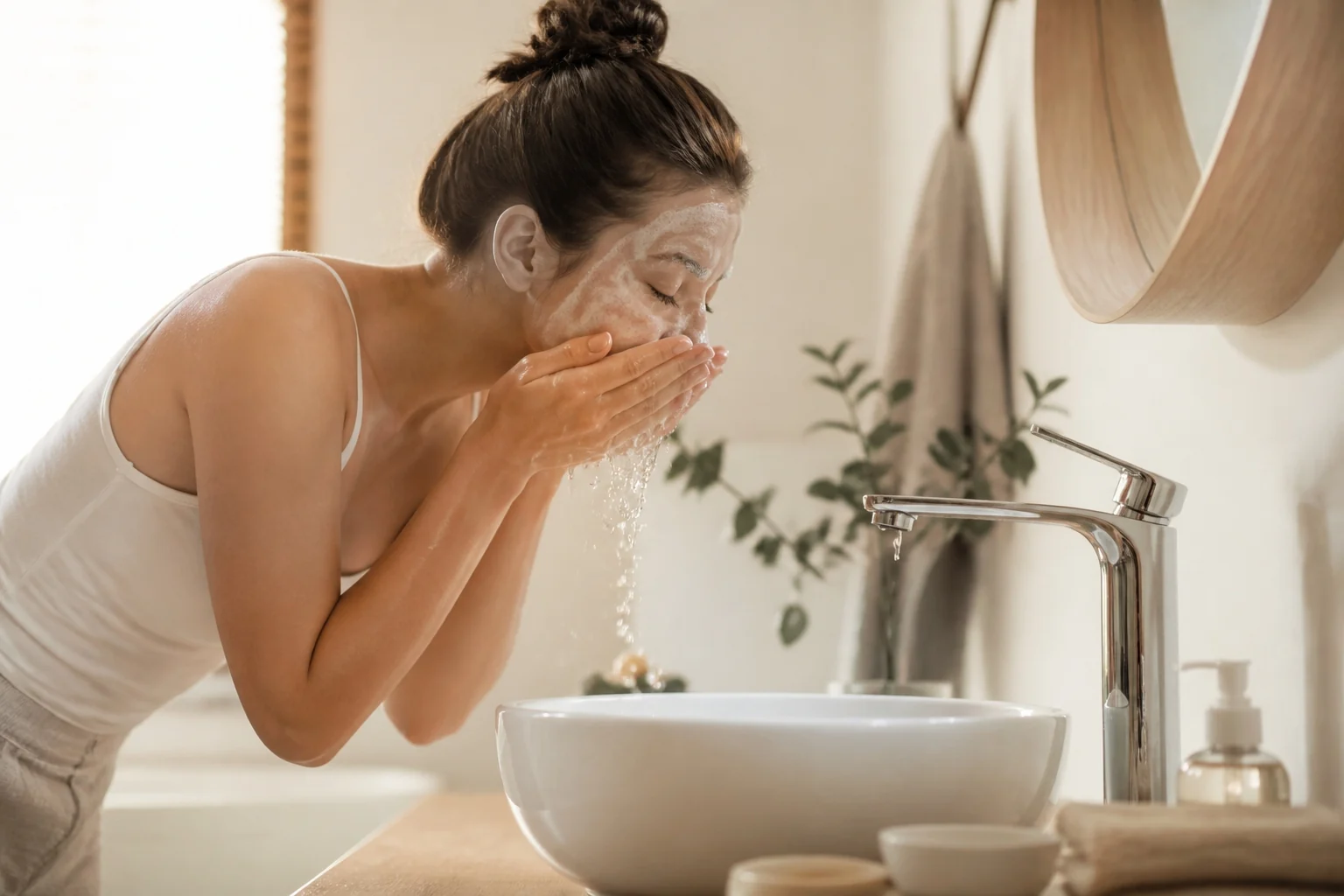
What is double cleansing and why will it transform your skin?
Cleansing the skin is the fundamental pillar of any effective skincare routine. However, simple and quick cleansing with foaming gel or micellar water is often insufficient to eliminate all the residue accumulated throughout the day. This is where double cleansing comes in, a technique which consists of successively using two cleansers with complementary textures and properties.
To understand its effectiveness, we must take an interest in the nature of the impurities present on our face. These are divided into two distinct categories:
- Lipophilic (fatty) impurities: sebum produced by the skin, makeup (often formulated with fatty substances or silicones), sun filters in protective creams and particles of atmospheric pollution.
- Hydrophilic (water-soluble) impurities: sweat, dust and dead cells accumulated on the surface of the epidermis.
A traditional water-based cleanser struggles to effectively dissolve oily substances, while a makeup remover alone often leaves a residual film. By combining an oily phase then an aqueous phase, double cleansing guarantees perfectly purified skin. The short and medium term benefits are numerous: reduction in imperfections (blackheads, microcysts), refined skin texture, more radiant complexion and, above all, much better absorption of your nighttime care products (serums with hyaluronic acid, retinol, moisturizing creams).
Step 1: Makeup removal and dissolution of impurities (The oily phase)
The first step in double cleansing is to apply an oil to the skin. Contrary to popular belief, oil does not grease the skin; on the contrary, it attracts fat like a magnet. This is the chemical rule of “like dissolves like”. This phase allows you to gently remove makeup, even waterproof ones, as well as stubborn sun filters and excess sebum, without ever altering the skin barrier.
The choice of texture: Oil or Balm?
The choice depends mainly on your sensory preferences and your skin type:
- Make-up remover oil: Fluid and light, it applies easily and is suitable for all skin types. Choose water-soluble vegetable oils (which emulsify on contact with water) to make rinsing easier.
- The makeup remover balm: Richer and creamier, it comes in solid form and melts in the heat of the fingers to transform into oil. It is particularly appreciated by dry, mature or sensitive skin for its enveloping and comforting side.
The technical gesture step by step
For this first step to be fully effective, compliance with the application protocol is essential:
- Work on dry skin: Take a pump of oil or a dab of balm in the palm of your previously washed and perfectly dry hands. Do not moisten your face. If the skin is wet, the oil will not be able to come into direct contact with the fatty impurities to dissolve.
- Massage gently: Apply the product to the entire face using gentle circular movements, from the center outwards. Focus on areas where makeup and sebum accumulate (the sides of the nose, chin, forehead). For the eyes, gently run your fingers from the roots to the tips of the lashes to dissolve the mascara without rubbing.
- Emulsify with lukewarm water: This is the key step. Add a small amount of lukewarm water to your face. On contact with water, the oil or balm will transform into a fluid milk. Continue to massage for a few seconds: this emulsion permanently removes all impurities from the skin surface.
- Rinse thoroughly: Rinse with lukewarm water. Your skin is free of makeup and oily impurities, ready for the second step.
Step 2: Deep cleansing of the skin (The water phase)
Once oily impurities are removed and rinsed, the skin is ready to be deeply cleansed. The second step uses a foaming cleanser, gel or water-based milk. Its role is to eliminate hydrophilic impurities (sweat, dust), to complete cleansing by eliminating the last residues of makeup remover oil, and to treat the skin using specific active ingredients adapted to its needs.
The choice of aqueous cleaner
For this step, the watchword is gentleness. It is absolutely necessary to avoid harsh cleansers which alter the hydrolipidic film and cause, through rebound effect, an overproduction of sebum or irritation. Choose a formula with physiological pH (close to 5.5):
- Cleansing gels: Ideal for combination to oily skin, they purify and provide a feeling of freshness.
- Cleansing foams: Airy and gentle, they are well suited to normal to combination skin as well as sensitive skin if they are formulated without aggressive surfactant sulfates.
- Cleansing milks or creams: Very rich in moisturizing agents, they are perfect for dry, dehydrated or mature skin, because they cleanse without feeling tight.
The technical gesture step by step
- Apply to damp skin: Take a dab of your cleanser and apply it to your still damp face after rinsing in step 1.
- Lather gently: Massage the product using light circular movements, avoiding the immediate eye area if the product is not specifically tested for this sensitive area. Take time (about 30 to 60 seconds) to let the gentle surfactants do their cleaning job.
- Rinse with lukewarm or cool water: Rinse thoroughly with clean water. Avoid water that is too hot, which dries the skin and dilates blood capillaries.
- Dry carefully: Pat your face with a clean towel dedicated only to this use. Never rub the skin, this creates mechanical micro-irritation.
What double cleanse for your skin type? (Selection guide)
Double cleansing is beneficial for all skin types, as long as you choose suitable textures and active ingredients. Here are our recommendations for composing the perfect duo according to your skin needs.
Oily acne-prone skin
Contrary to popular belief, oily skin greatly needs double cleansing. Sebum being a fatty substance, cleansing oil is the most effective and gentle way to unclog pores without excite the sebaceous glands.
- Step 1: A light cleansing oil based on non-comedogenic vegetable oils (such as jojoba, hazelnut or sunflower oil).
- Step 2: A purifying cleansing gel containing regulating or gentle exfoliating active ingredients, such as salicylic acid (BHA) to unclog pores, or zinc to regulate sebum.
Dry, dehydrated or mature skin
For these skin profiles, the objective is to provide comfort, nourish and prevent dehydration from the cleansing stage.
- Step 1: A rich and nourishing balm (based on shea butter, sweet almond or apricot oil) which will soften the skin and limit transient water loss.
- Step 2: A cleansing cream or moisturizing milk enriched with hyaluronic acid, glycerin or ceramides to restore the skin barrier and leave the skin supple and comfortable.
Sensitive, reactive or redness-prone skin
Sensitive skin should favor minimalist formulas, without perfume and essential oils, to avoid any skin reactions.
- Step 1: A soothing makeup remover oil (with calendula or chamomile oil) that emulsifies ultra-quickly to limit manual rubbing.
- Step 2: An ultra-gentle cleansing gel or foam, formulated without sulfates, enriched with soothing agents such as Allantoin, Panthenol or thermal water.
Combination skin
Combination skin has contrasting needs: purify the T zone (forehead, nose, chin) while preserving the comfort of the cheeks.
- Step 1: A universal balancing makeup remover oil.
- Step 2: A gentle foaming gel or foam cleanser that effectively cleanses without drying dry areas of the face.
The 5 common mistakes to absolutely avoid
To reap all the benefits of double cleansing without damaging your skin, be sure to avoid these common pitfalls:
- Use micellar water as your only step: Micellar water contains micelles (surfactants) that trap impurities. However, if not rinsed off, it can leave irritating surfactants on the skin. In addition, it does not offer the mechanical massaging action of oil, essential for dissolving stubborn makeup and deep sebum.
- Applying oil to damp skin: This is the most common mistake. If you wet your face before applying the cleansing oil, it will emulsify immediately on contact with water and will lose all its solvent power on oily impurities and makeup.
- Use pure, unformulated cooking oils: Using coconut or olive oil from your kitchen may seem economical and natural, but these pure oils do not contain emulsifiers. They are therefore very difficult to rinse with water and leave an occlusive film which can clog pores and encourage the appearance of blackheads, especially on combination to oily skin. Always choose cosmetic makeup remover oils formulated to emulsify when rinsing.
- Practice double cleansing morning and evening: Except in exceptional cases (excessive sweating during the night), double cleansing should be reserved exclusively for your evening routine. In the morning, a simple and very gentle cleansing (or even a simple application of a tonic lotion or a hydrosol) is more than sufficient to preserve the protective hydrolipidic film built by the skin during the night.
- Neglecting the water temperature: Using water that is too hot alters the skin barrier and excites the sebaceous glands. Conversely, water that is too cold will not allow the oil to emulsify properly. Lukewarm water is the ideal temperature for effective and skin-friendly cleansing.
How to incorporate double cleansing into your evening routine?
Double cleansing ideally prepares the skin to receive the rest of your treatments. By completely freeing pores and eliminating the barrier of impurities, it optimizes the penetration and effectiveness of your active ingredients. Here is the recommended order of application for your nighttime routine:
- Step 1: Makeup remover oil or balm (on dry skin, then emulsified and rinsed).
- Step 2: Gentle aqueous cleanser (on damp skin, massaged then rinsed and dried).
- Step 3: Tonic lotion or hydrosol. This action helps eliminate limescale residues present in tap water and rebalances the pH of the skin.
- Step 4: The eye contour. Apply your targeted treatment by gently tapping on the orbital bone.
- Step 5: The treatment serum. It’s time to apply your powerful active ingredients (vitamin C serum for radiance, retinol for wrinkles, or hyaluronic acid for hydration).
- Step 6: Moisturizer or night oil to seal in hydration and nourish the skin during the nighttime cell regeneration phase.
A word from the editor: take action this evening
Double cleansing is not an additional time constraint, but a real moment of well-being and reconnection with yourself. The oil phase massage relaxes facial features after a long day, while the aqueous phase provides unparalleled purifying freshness. By choosing formulas adapted to your skin sensitivity and applying the right technical gestures, you will quickly notice an improvement in the clarity of your complexion, a reduction in imperfections and visibly healthier and more receptive skin. It’s the secret to beautiful skin, accessible to everyone.
