
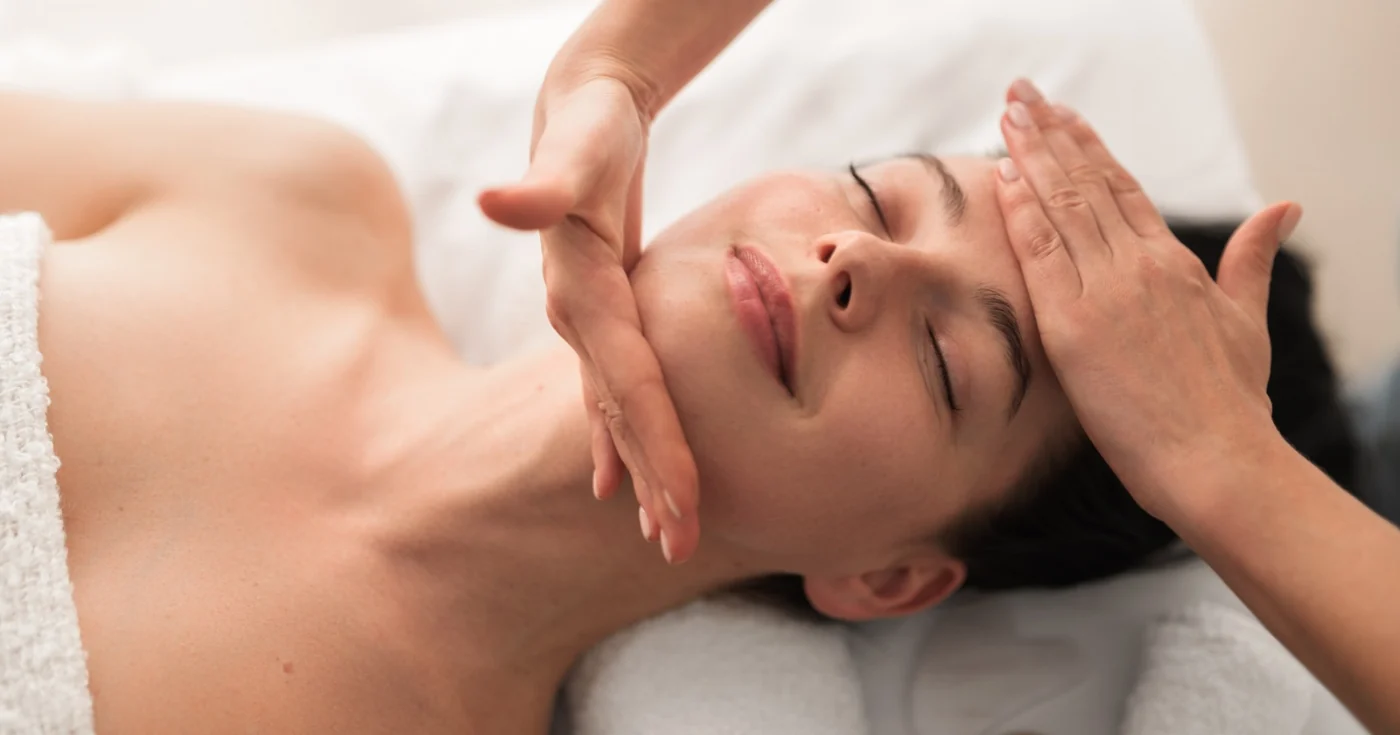
Between the temptation of a lifting effect without needles and the proliferation of viral videos promising express transformations, the question of the real effectiveness of facial massage comes up again and again. Many seek to understand if well-executed manual work can smooth out the lines, support the oval and support the evolution of the face without immediately resorting to aesthetic medicine.
In this launch of Edgar, the survey is based on the views of two professionals from LB Facialistes to establish a clear and pragmatic framework. The objective is not to maintain an anti-aging mirage, but to understand how the hand acts on the structures of the face and what gestures can be reproduced at home.
Facialist or beautician: what really changes in the approach
The first useful distinction concerns the method of observation and the level of intervention. While a beautician traditionally relies on a skin diagnosis and the application of cosmetic treatments in the cabin, the facialist carries out a morphofacial diagnosis focused on facial volumes, facial expressions and expressions.
This diagnosis guides tailor-made work which seeks to act beneath the surface of the skin, by engaging the muscular plane, the bony plane and the surrounding tissues. Where classic cosmetic treatment acts first on the epidermis and the quality of the skin, facialism considers the face as a dynamic architecture to be sculpted and softened.
What facialism can do about injections and preconceived ideas
Faced with common assertions on social networks, the experts and founders of LB Facialistes set a clear limit: manual massage does not replace an injection of botulinum toxin, the role of which is to block a muscle and therefore inhibit expression, nor does it replace hyaluronic acid. On the other hand, it can act on muscle relaxation, help to smooth out an expression wrinkle and slow down its progressive installation, while being either a natural alternative or a complementary approach depending on the desired objective.
On the practical level, other preconceived ideas deserve to be qualified. Regularity weighs much more than punctual duration: a few minutes, even a minute per day, provides more than a long isolated session on Sunday, while the intensity must remain progressive and oriented from the inside to the outside, without crushing the tissues or pushing downwards when the objective is not draining.
The one minute method and the figures put forward in the episode
To move from theory to practice, the speakers remind us that it is preferable to settle down in a calm moment, without rushing, on cleansed and makeup-removed skin. To target a wrinkle (compared to an accordion which folds and hollows with the repetition of facial expressions) they show how to hook the fingers in the hollow in order to exert a slow and deep stretch which relaxes the area.
The one-minute routine proposed at the end of the day is based on this same crochet principle, working in zones from the center outwards like in a rail: along the oval to the angle of the mandible in three passes, under the wing of the nose against the bone to structure the cheekbone, then on the forehead to relax it.
In the video, the experts highlight numerical results associated with the LB Facialistes method: more than 34% radiance of the complexion, more than 9% density of the dermis, more than 13% increase in the volume of the cheekbone (mentioned as the equivalent of a tablespoon per side) and approximately 24% reduction in expression lines. While presenting to adapt the gestures to each age group.
FAQ: key questions about facialism
Can facialism replace Botox or hyaluronic acid?
No, facial massage does not replace these aesthetic medicine procedures. It can, however, help to relax the muscles, smooth out certain expression lines and accompany the face in a natural or complementary way depending on each person’s expectations.
What is the difference between a facialist and an esthetician?
An esthetician typically focuses on a skin diagnosis and application of cosmetic treatments, while a facialist emphasizes morphofacial diagnosis and targeted manual work on the muscles, tissues and underlying structures of the face.
How much time should you devote to self-massage to see effects?
Regular, short practice is preferred: a few minutes a day, or even a well-executed minute every day, are more relevant than a single, long session only on the weekend.
Do you have to press very hard to lift or sculpt your face?
The intensity should not be brutal or overwhelming. You must dare to use a precise and progressive gesture to reach muscular depth and respect the direction adapted to the objective, working in particular from the inside out.
What simple actions can you do in the evening to relax your features?
You can practice a short routine from the center outwards on clean, makeup-free skin, using the index finger in a hook along the oval, under the cheekbone and on the forehead, or gently stretch the hollow of a marked wrinkle.
