
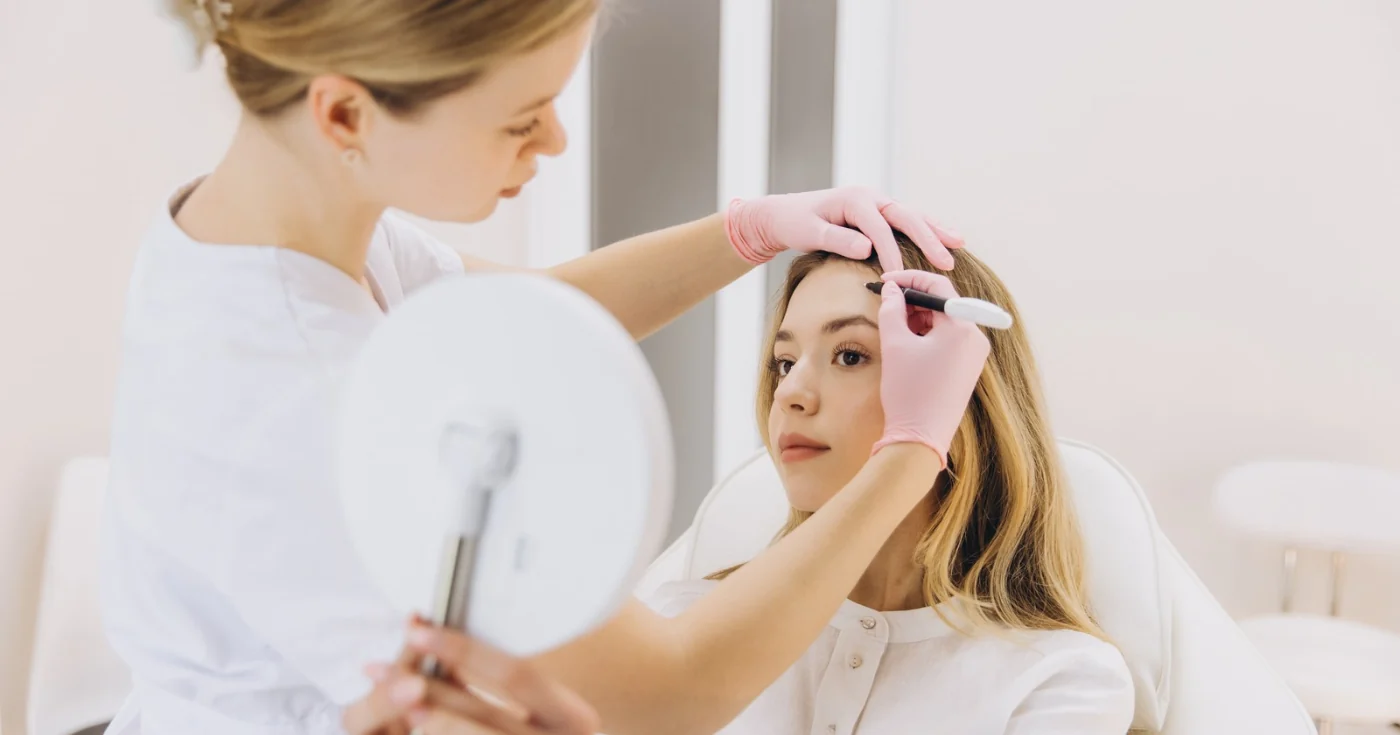
A wrinkle that is setting in, lips that we would like a little fuller, a forehead that we dream of smoothing with a shot of Botox: injections have entered the beauty landscape. But certain images are striking, such as those with inflated volumes or those which consist of tracking down the slightest retouching on known faces. What if, before the syringe, we also looked at what is happening in the head?
In the United Kingdom, this question is starting to take a very concrete form: NICE, the British equivalent of the High Authority for Health, is preparing recommendations to strengthen psychological screening before aesthetic procedures. For its part, Australia already requires an assessment of motivations and mental state before certain injections. In France, there is still no obligation to undergo a psychological test before Botox, but the idea is clearly gaining ground.
Dysmorphophobia and Botox: when the complex goes wrong
In an aesthetic medicine practice, not all requests are the same. Some are a simple complex, others are part of a real dysmorphophobia, where a real or imagined detail becomes an obsession. Recent meta-analyses estimate that around 20% of patients who consult for a cosmetic procedure present this type of disorder, compared to almost 2% in the general population. For the Globale Dermatologie site, this proportion could even approach 30%, with a very high risk of suicide.
It is in this context that NICE is proposing, in the United Kingdom, to systematize a short psychological questionnaire before accepting an injection or another aesthetic procedure. The principle is simple: question the time spent thinking about one’s appearance, the impact on social or professional life and the level of suffering. The stated objective is not to see a problem behind each desire for Botox, but to identify situations where the aesthetic request masks a deep discomfort.
Australia: the psych test before Botox, already integrated into the course
On the other side of the globe, the Medical Board of Australia and AHPRA have transformed this approach into rules of good practice. Since 2023, a medical consultation is mandatory before injections of botulinum toxin or hyaluronic acid, with questions about psychological history, motivations and expectations. If the practitioner suspects dysmorphophobia or another severe disorder, he or she must refer the person to an independent psychologist or psychiatrist and may refuse the procedure.
The first available figures temper fears of massive medicalization. According to an Australian study published in 2026 and cited by Elle magazine, 84% of surgeons surveyed said they referred less than 5% of their patients to a specialized psychological evaluation. The psychological test before Botox serves above all as a safety net for a minority of people at risk, while also protecting doctors from chronic dissatisfaction or litigation.
And in France: towards key questions before Botox injections
In France, the Public Health Code regulates aesthetic procedures and the High Authority for Health points out the risks for psychologically fragile patients. But no text imposes a psychological test before Botox or a standardized screening grid for dysmorphophobia. Many aesthetic doctors still take the time to discuss the motivations, the operations carried out and the personal context, some considering that an unstable psychological profile constitutes a contraindication.
Concretely, a brief interview already makes it possible to identify deeper discomfort. Among the questions suggested by NICE and taken up by Elle magazine, we find: , or . The idea is not to judge, but to avoid responding with an injection to suffering which would primarily require psychological support.
What is a psych test before Botox?
This is a short interview or questionnaire where the doctor explores your motivations, your expectations and the impact of your complexes on your daily life. The objective is to identify dysmorphophobia or significant discomfort before deciding to inject.
Is it obligatory to take a psychological test before Botox injections in France?
No, no French text today requires a formalized psychological test before aesthetic injections. However, some practitioners spontaneously ask questions similar to these questionnaires during the consultation.
Does screening in Australia send a lot of patients to the psychologist?
According to a 2026 Australian study, 84% of surgeons report referring less than 5% of their patients for a specialized psychological evaluation. Screening therefore targets a minority of cases deemed to be at risk.
How does body dysmorphophobia relate to Botox requests?
Studies show that around 20% of people consulting for a cosmetic procedure have body dysmorphic disorder, well beyond the general population. These patients risk multiplying injections without ever being truly satisfied.
