
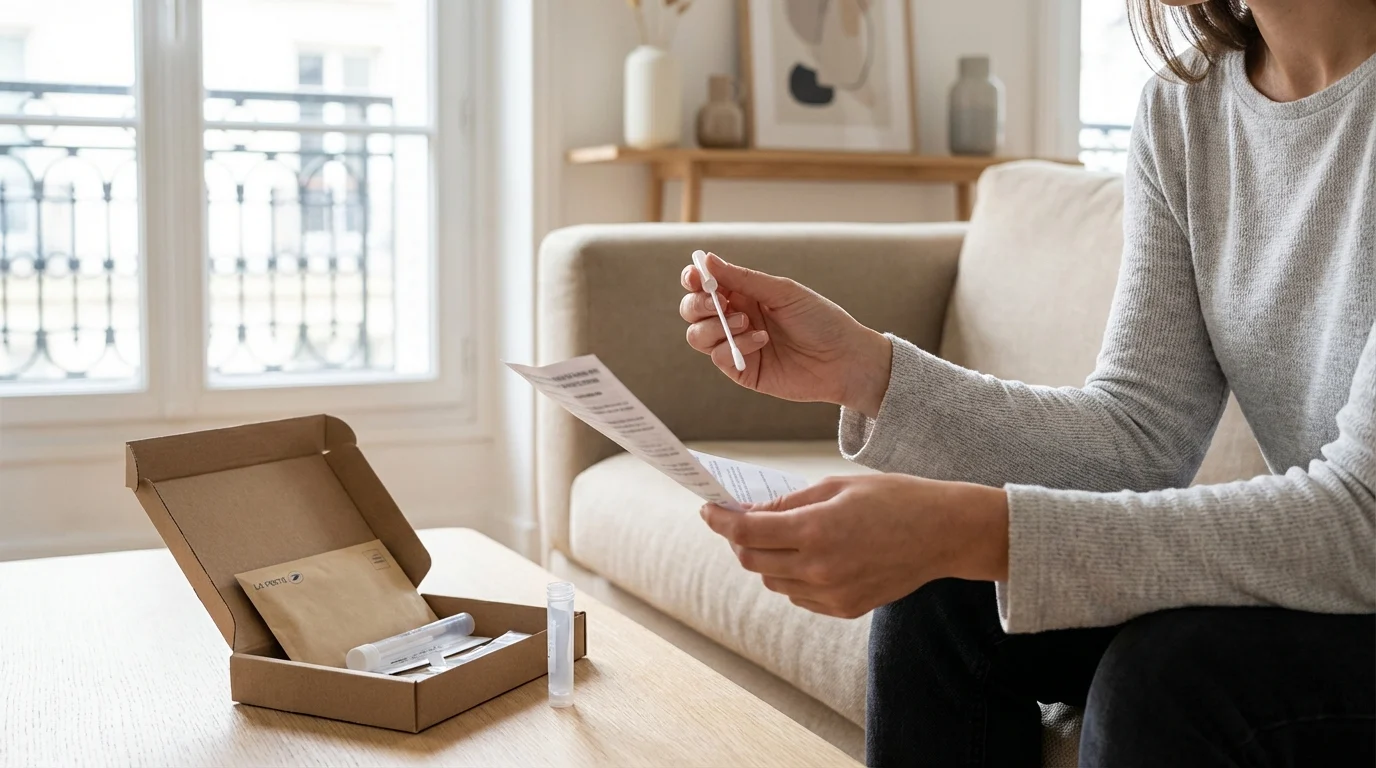
Speculum smears, complicated appointments to obtain, discomfort during the examination… Many women delay their cervical screening, even though early detection increases the chances of recovery. Since the beginning of January, a new option has changed the situation in the United States: home cervical cancer screening, validated by health authorities, is now accessible throughout the country.
The timing is no coincidence. January is Cervical Cancer Awareness Month, a disease almost entirely preventable through regular screening, when approximately 13,000 new cases and 4,000 deaths are still recorded each year in the United States. In this context, this home test aims to remove the practical, financial and psychological obstacles which still leave 1 in 4 to 1 in 3 women behind in screening.
Teal Health, Teal Wand and a historic FDA green light
Teal Health, an American telehealth company dedicated to gynecological prevention, obtained authorization from the Food and Drug Administration (FDA) in May 2025 for Teal Wand, the first and, to date, only home self-collection device for cervical screening. “Women have been asking for a better option and it’s finally here. We’re proud to bring at-home screening to women across the country, and we’ve worked quickly to get here, to a point where this option is now available to everyone who wants it in the United States,” explains , co-founder and CEO of Teal Health, as cited by NewBeauty.
On January 5, 2026, the US Department of Health and Human Services (HHS) and its agency HRSA updated their guidelines: self-collected HPV testing becomes an official screening option for average-risk 30–65 year olds. Two days later, on January 7, Teal Health announced the national expansion of its offering in all 50 states. The same recommendations recall the classic schedule: Pap test every 3 years from 21 to 29 years old, then high-risk HPV test or Pap + HPV co-test every 5 years between 30 and 65 years old.
How is cervical cancer screening done at home?
Concretely, everything starts with a short teleconsultation to check eligibility (absence of symptoms, no history of cervical cancer, so-called “medium” risk). If everything is OK, the patient receives a kit containing the Teal Wand at home. Vaginal self-sampling is done in privacy, without a speculum, with a gesture described as close to inserting a tampon.
The sample is then mailed back to a laboratory, where it is analyzed with the same FDA-authorized HPV tests used in the clinic. According to data from the SELF-CERV trial, Teal Wand detects precancerous lesions in 96% of cases, with performance equivalent to a sample taken by a caregiver, and 94% of participants say they prefer this method for its comfort and confidentiality. The result is available on a secure portal, which allows monitoring to be organized if necessary. The test costs 99 dollars (approximately 90 $) with partner insurance and 249 dollars (approximately 225 $) without coverage, but most private insurance companies will have to cover it without any additional charges by January 1, 2027 at the latest.
A lever against screening delays, even in isolated areas
For many women, the obstacles are concrete: difficulty finding a niche, absence of a gynecologist nearby, traumatic experience of a speculum examination. “It’s Cervical Cancer Awareness Month and our mission is to close the screening gap. A big reason people put off is confusion around vocabulary. Pap smear, HPV test, cervical cancer screening. Whatever you call it, you just shouldn’t put it off,” wrote on Instagram, still cited by NewBeauty. And then, for women living in rural areas, this type of kit can save hours of travel.
In France, organized screening targets women aged 25 to 65, with a frequency of 3 to 5 years depending on age, and is already being deployed via out-of-office solutions such as mobile screening units. The Teal Health model opens up an additional avenue: a home HPV test could, tomorrow, complement these devices to reach people furthest from centers, while remaining supervised by health professionals.
Is home cervical screening with Teal Health available in France?
No, Teal Wand and Teal Health’s offering are currently restricted to the United States, following FDA clearance.
Who can use an at-home HPV test in the United States?
Self-collection is recommended for women aged 30 to 65 at average risk, without symptoms or history of cervical cancer.
Is the home test as reliable as an in-office smear?
The SELF-CERV study shows 96% detection of precancerous lesions, equivalent to a sample taken by a clinician.
