
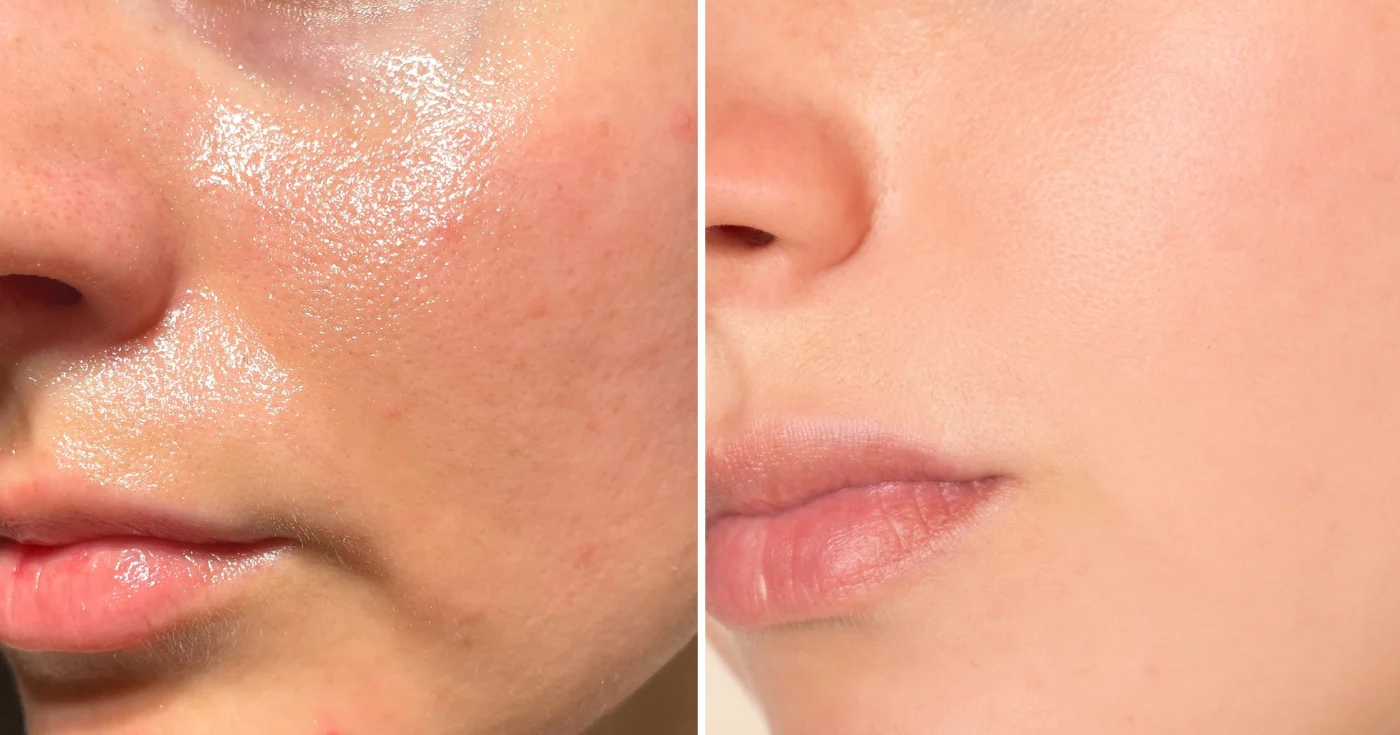
There are mornings when your face leaves you perplexed. One area shines as if you’ve applied too much cream, while elsewhere the skin feels tight or appears dull. Impossible to know if your skin is dry or oily.
This imbalance is more common than we think. Many people think they don’t know their skin type well, when they simply live with a very common reality: combination skin.
Combination skin, when your face doesn’t function as one skin type
Contrary to what many people think, combination skin is not a blurred category between oily skin and dry skin. Rather, it is a face that functions in zones, each with its own needs.
The central area of the face – the forehead, nose and chin – generally produces more sebum. This is what we call the famous T zone. It can have a shinier appearance, visible pores and sometimes some imperfections.
Conversely, the cheeks or temples may be normal or even slightly dry. Some people even feel tightness after cleaning or when the temperature drops.
This mixture can create a strange sensation, difficult to define. Facialist Joanne Evans often observes this phenomenon in her clients. She explains:
“I often hear clients say, ‘My skin never really looks good.’ »
She also specifies what really characterizes this skin type:
“Combination skin means your face doesn’t behave like just one skin type. Instead, different areas have different needs. »
In other words, treating the entire face in exactly the same way is not always the best solution.
Why combination skin is much more common than you think
We sometimes imagine that combination skin is a special case. However, it is far from rare.
Dermatologist Emma Craythorne explains that many people live with this skin type without necessarily identifying it correctly. She states:
“Most people have some degree of combination skin, with areas of the face that are oily and others that are drier. »
Several factors can explain this functioning. Genetics often play an important role. Certain areas of the face naturally have more sebaceous glands, leading to higher sebum production.
Hormones can also change the balance of the skin over time. The seasons also influence the behavior of the epidermis. In winter, for example, certain parts of the face can become drier while the T-zone remains shiny.
Lifestyle also comes into play. Stress, pollution, indoor heating or air conditioning can disrupt the skin’s natural balance.
But another factor is often underestimated: the care used on a daily basis. Products that are too aggressive can weaken the skin barrier. When the skin feels attacked, it can react by producing even more sebum in certain areas.
Simple actions that can help rebalance combination skin
The difficulty with combination skin lies in this fragile balance. A product that is too rich can accentuate the shine of the T zone. A treatment that is too drying can worsen the feeling of dryness on the cheeks.
For this reason, many experts recommend a gentler, more nuanced approach.
Cleaning, for example, must remain respectful of the skin. A cleanser that is too harsh can disrupt the skin barrier and cause a rebound effect, with more sebum produced subsequently.
Lightweight oils can also help, although it may seem counterintuitive when skin is already glowing. Some plant oils mimic natural sebum and can help stabilize sebum production.
Joanne Evans often observes this phenomenon in her practice:
“Many clients with combination skin are afraid of oils, especially if they are prone to blemishes. Yet the right oils can actually help regulate sebum production and support skin barrier health. »
Hydration also remains essential. Skin that lacks water can produce more sebum to compensate. Using a light cream containing moisturizing agents can therefore help maintain a better balance.
With a suitable and regular routine, combination skin often becomes much more predictable. It remains this unique mixture of different zones, but it can return to a more harmonious functioning.
What exactly is combination skin?
Combination skin is a skin type that combines several characteristics: certain areas of the face produce more sebum, while others may be normal or drier.
How do I know if I have combination skin?
Combination skin is often recognized by a brighter T zone (forehead, nose, chin), sometimes with visible pores, while the cheeks may be normal or slightly tight.
Can combination skin change over time?
Yes. Hormones, age, seasons or even lifestyle can modify the balance of the skin and accentuate or attenuate certain areas.
Should we use different products depending on the areas of the face?
In some cases, yes. Adapting care according to the specific needs of each area can help maintain a better balance.
Are oils suitable for combination skin?
Photo credit: @shutterstock
