
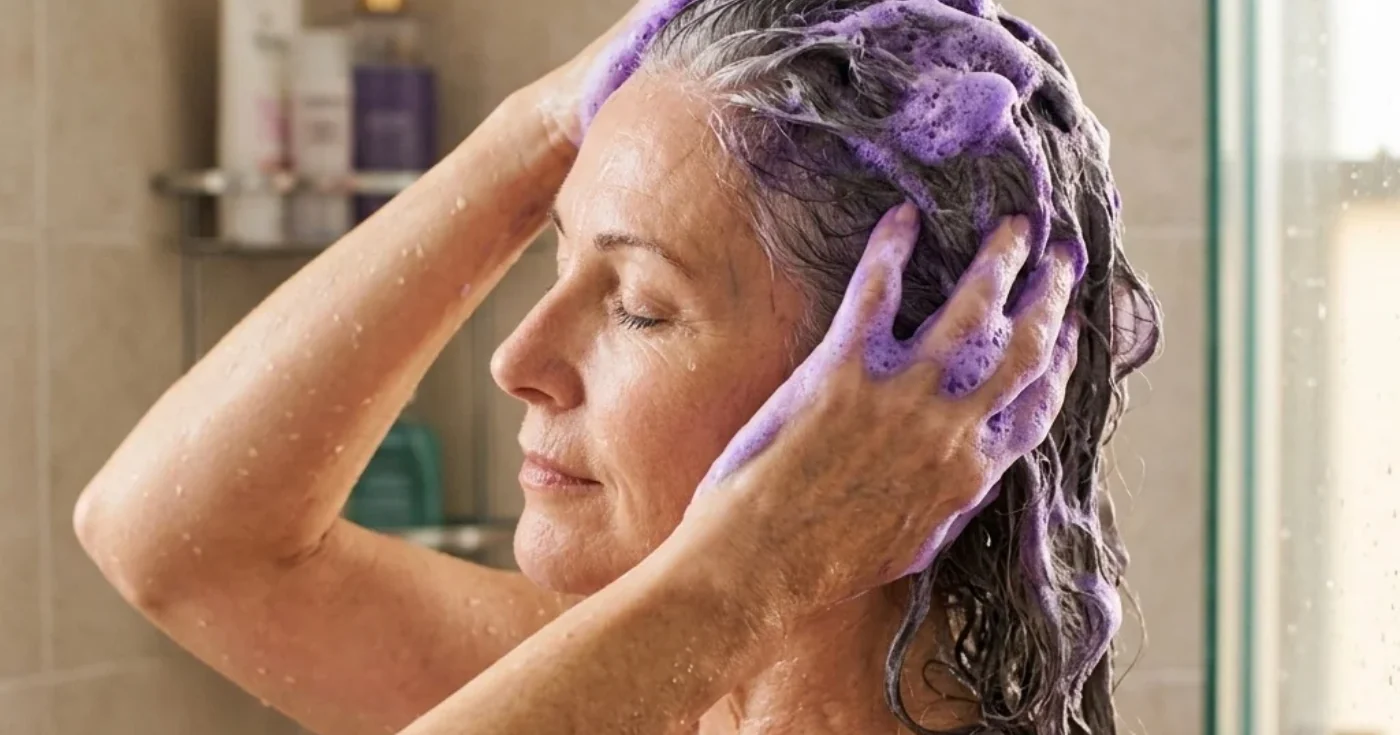
When you start to have gray or white hair, purple shampoo often becomes a reflex. And for good reason: thanks to its colored pigments, it neutralizes the yellow reflections that can appear on the hair and preserves a pretty silver tone. But this beauty gesture, which we imagine without risk, nevertheless deserves some precautions. Hairdressing professionals warn in particular of the consequences of too regular use, which could leave unwanted reflections on certain strands.
This is the advice of Jessica Ruby Spratt, American hair colorist, interviewed by the magazine in an article devoted to the best shampoos for gray hair, published in July 2026. According to the expert, gray hair can be particularly porous and absorb an excessive quantity of purple pigments when the product is too concentrated or used too often. A phenomenon which can give a mauve color to certain strands, when we are precisely seeking to obtain a luminous gray. So, should you really ban purple shampoo from your bathroom?
Why do hairdressers warn against using purple shampoo on gray hair?
To understand this warning, we must first go back to how purple shampoo works. Its role is to visually correct yellow reflections thanks to the principle of colorimetry: purple being the complementary color of yellow, its pigments help to attenuate its appearance. This is why this product is regularly recommended for bleached, highlighted, white or gray blonde hair that tends to turn yellow. It is therefore not a shampoo which lightens the hair, but rather a pigmented treatment which temporarily modifies the perception of its color. Glamor magazine also points out that these formulas can be useful for maintaining a cool and luminous shade, provided that certain precautions are followed.
The problem occurs when the pigments are deposited in too large quantities on the fiber. In her interview with , Jessica Ruby Spratt explains that gray hair can absorb more pigment due to its porosity. When the shampoo is highly concentrated or used too frequently, certain strands can take on purple highlights, especially when they are very light. The hairdresser therefore recommends not to exceed one use per week and to always complete the wash with a conditioner or a moisturizing mask.
White and gray hair: why do they need more softness?
With the appearance of white hair, the hair fiber can change texture. Some hair becomes drier, rougher or more difficult to manage. The age-related decrease in sebum production can also contribute to this feeling of dryness, since the lengths are less naturally protected by the lipid film produced by the scalp. Result: hair can lose its suppleness, become more fragile and show more frizz. This is why professionals generally recommend focusing not only on color correction, but also on fiber maintenance.
However, the primary function of purple shampoo is not to moisturize or nourish the hair. It is primarily used to deposit pigments to neutralize certain reflections. Depending on its formulation, it can also leave a feeling of dryness, particularly on already weakened lengths. In its article dedicated to shampoos for gray hair, Glamor recommends in particular favoring moisturizing formulas and completing washing with a conditioner. Colorist Tiffanie Richards also emphasizes the benefit of conditioners rich in moisturizing agents, weekly masks and leave-in treatments to preserve the suppleness of gray hair.
Should you stop using purple shampoo completely when you have gray hair?
Not necessarily! It would be excessive to completely ban this product from your routine. Purple shampoo remains of real interest when white or gray hair takes on yellow highlights. It then allows you to visually find a cooler shade, without the need to systematically resort to coloring or a patina in the salon. The key is to use it at the right time, when yellowing becomes visible, rather than automatically incorporating it into every wash. The frequency must also be adapted to the pigment concentration of the product and the reaction of the hair.
Another interesting point: not all unwanted reflections necessarily require a purple shampoo. Colorist Jessica Ruby Spratt points out that the choice of pigment depends on the shade you want to correct. Purple is suitable for yellow highlights, while blue helps neutralize orange highlights, which can particularly appear on salt and pepper hair or during the transition to natural gray hair after brown coloring. An important distinction to avoid using a product unsuitable for the color of your hair.
What routine should you adopt to maintain beautiful gray hair without damaging it?
The first reflex is to choose a gentle and moisturizing shampoo for regular washes. It should allow the scalp to be cleansed without leaving the lengths rough or difficult to detangle. Formulas suitable for dry or sensitized hair can be interesting, provided they do not weigh down the hair. The purple shampoo can then be used occasionally, when yellow reflections really appear. It is preferable to respect the exposure time indicated by the manufacturer and not to try to prolong its action to obtain a more intense result.
After washing, hydration becomes an essential step. A conditioner applied to the lengths makes detangling easier and limits breakage caused by handling. Once a week, a nourishing mask can complete the routine, especially if hair is dry or brittle. Leave-in treatments and thermal protections are also interesting to limit attacks linked to hair dryers and heating appliances. Finally, if the hair takes on a purple color or remains dull despite treatment, it is better to space out the pigmented shampoo and ask your hairdresser for advice rather than multiplying applications.
FAQ: Questions We Ask About Purple Shampoo and Gray Hair
Why shouldn’t you use purple shampoo too often on gray hair?
Too frequent use or a very concentrated formula can then leave mauve or purplish reflections on certain strands.
Does purple shampoo damage white hair?
It does not systematically damage them. However, certain formulas can accentuate the feeling of dryness, especially on already weakened hair. It is therefore preferable to alternate it with a gentle and moisturizing shampoo.
How often to use purple shampoo on gray hair?
Colorist Jessica Ruby Spratt recommends no more than one use per week. The ideal frequency, however, depends on the formula, the porosity of the hair and the intensity of the yellow reflections to be neutralized.
What shampoo should I use instead of purple shampoo on white hair?
For regular washing, it is better to choose a gentle and moisturizing shampoo, adapted to the nature of the scalp and lengths. Purple shampoo can remain a one-off corrective treatment.
Should you use blue or purple shampoo on salt and pepper hair?
It all depends on the reflections to be neutralized. Purple is suitable for yellow highlights, while blue helps correct orange highlights, sometimes present on salt and pepper hair or during a transition to gray.
