
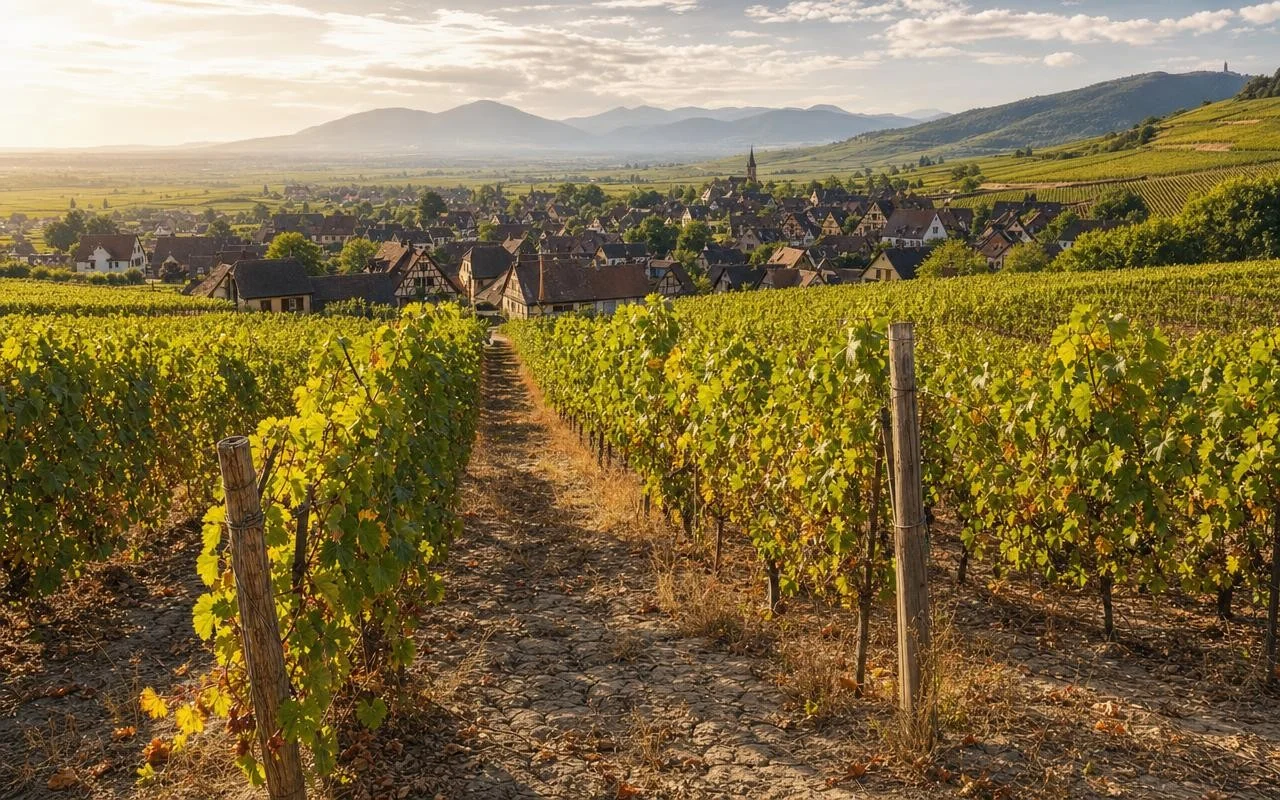
When opening a recent Riesling, some already notice a fuller mouthfeel, a more present degree of alcohol, and less sharp acidity. In Alsace, it’s not just an impression: the warming climate is now reflected in the glass.
Projections predict hotter and drier summers, while the harvest advances. At the Colmar Wine Fair, scientists and winegrowers now share the same conviction: the taste of Alsace wines cannot remain the same.
An Alsatian climate which drifts towards the south and shakes up the vines
Regional data shows a clear rise in temperatures and a drop in summer rainfall, with summers now close to those of the Rhône valley. In Colmar as in Strasbourg, the harvest begins much earlier than a few decades ago.
Phenologically, everything has shifted: budburst, flowering, veraison and harvest arrive earlier, and the end of ripening takes place during hot and dry periods. This new water and thermal situation has a direct impact on the sugars, acids and aromatic compounds of the grapes.
Aromas, acidity, alcohol content: a changing taste profile
As a result in the glass, the hotter Alsatian summers have already led to an increase in the alcohol content of around one point in thirty years, while the acidity has declined. The wines gain volume and warmth, but lose some of the freshness that was the signature of many Rieslings and Pinot Gris.
According to a 2023 study carried out in Bordeaux and Toulouse, vegetal and peppery aromas decline with drought and high heat, while notes of cooked fruit increase. , summarizes Serge Zaka, quoted by France 3 Grand Est; and, on the whites, bitterness has set in to the point that it becomes, writes the daily L’Alsace, .
Adapt the vineyards of Alsace without losing their identity
To adapt, the sector is already working on the long term: choice of grape varieties that are more resistant to heat, new rootstocks, evolution of practices in the vineyard. Serge Zaka wants to reassure fans: , while reminding that
Water management becomes central: grassing, hedges and fruit trees to provide shade, rows planted perpendicular to the slope to slow runoff, rootstocks capable of drawing deeper. Irrigation, now possible but strictly supervised, remains seen as a last resort, because over-watered vines root less and do not tolerate restrictions well.
Will global warming make Alsace wines disappear?
No, but styles will evolve significantly.
How is global warming changing the taste of Alsace wines?
More alcohol, less acidity, more ripe aromas.
What are Alsace winegrowers doing to adapt?
They adjust grape varieties, vineyard practices and water management.
