
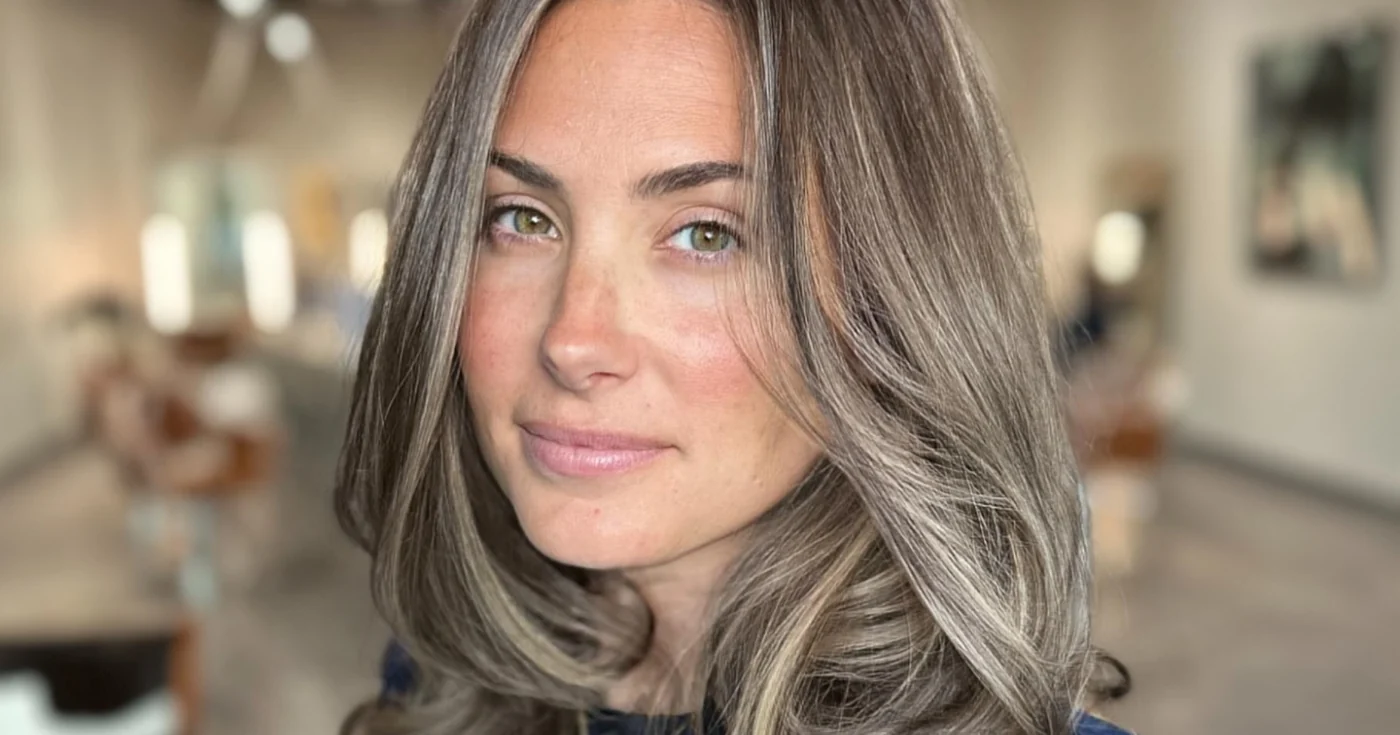
Gray hair is no longer hidden, it is sculpted. After French blending, root tapping or “greige” highlights, a new technique is making waves: silver framing, which plays with silver strands. By simply framing the face, these highlights transform salt and pepper hair considered dull into sophisticated material. And this play of light is much more subtle than it seems.
For many women, these highlight techniques are the chic alternative to full-on coloring. Colorist Siobhan Haug recalls that, cited by Harper’s Bazaar. Playing with fine veils, she talks about locks that let the natural color filter through, the regrowth blending in without demarcation. It remains to be seen how silver framing gray hair brings, with a few strands around the face, a tailor-made shine.
Silver framing: how this technique brightens gray hair
Concretely, silver framing consists of lightening strands which frame the face, then patinating them in silver to create a halo effect. , explains Christel Barron-Hough, colorist and founder of the STIL salon. Depending on the desired intensity, these strands can remain very fine, almost invisible, or become wider, like face-framing strands close to a money piece effect. Everything comes down to placement: temples, forehead contours, start of the part.
On uniform gray hair, a few lighter strands around the face brighten up the complexion, like on Andie MacDowell. , adds Christel Barron-Hough, who recommends reverse blending. , she specifies. For brunettes or colored people whose first gray hairs are just arriving, Siobhan Haug recommends .
Gray hair: for whom silver framing works best
As with any coloring, the starting point matters. Lightening a dark brown or black base to a platinum silver remains tricky, while Christel Barron-Hough points out that . On a light brown, it is also possible, but she warns that.
The technique adapts to the way your white hair appears. When they are concentrated at the temples and along the parting, this is where the result is the most discreet: , summarizes Siobhan Haug, for an almost imperceptible transition. On curly hair, she says she works, so that the light accompanies the movement.
Four Ways to Try Silver Framing Gently
Concretely, you can choose a very discreet framing with honey or teak highlights to blend in the first white threads, a luminous silver halo on already gray hair, a “salt and pepper” effect thanks to reverse blending or a thicker and assertive money piece version around the face. These variations all play on the same idea: highlighting the naturally whiter areas, rather than erasing them, by simply modulating the intensity and width of the strands.
In terms of maintenance, an appointment every 10 to 12 weeks, plus a silver shampoo at home, is sufficient. Colorists also recommend nourishing treatments and, if necessary, a toner in the salon between two visits to keep highlights clean and shiny without making the routine heavier.
What is silver framing for gray hair?
Silver framing consists of lightening and then patinating in silver the locks that frame the face to create a luminous halo. The highlights blend with existing gray or white hair to add shine and depth without completely masking the natural color.
How long does silver framing last before retouching?
Siobhan Haug indicates that appointments can be spaced out up to 10 to 12 weeks, with the regrowth remaining gentle. The technique is designed to limit visible demarcations on gray hair.
Is silver framing suitable for dark brown hair?
Christel Barron-Hough points out that lightening a very dark brown or black base to a pale silver can be difficult. She considers the technique more suitable for dark blonde bases or hair that is already very gray.
What treatments should I use after silver framing?
Colorists recommend a silver shampoo and conditioner to limit yellowing and preserve color. A toner applied in the salon between two appointments also helps to revive the shine of the locks.
