
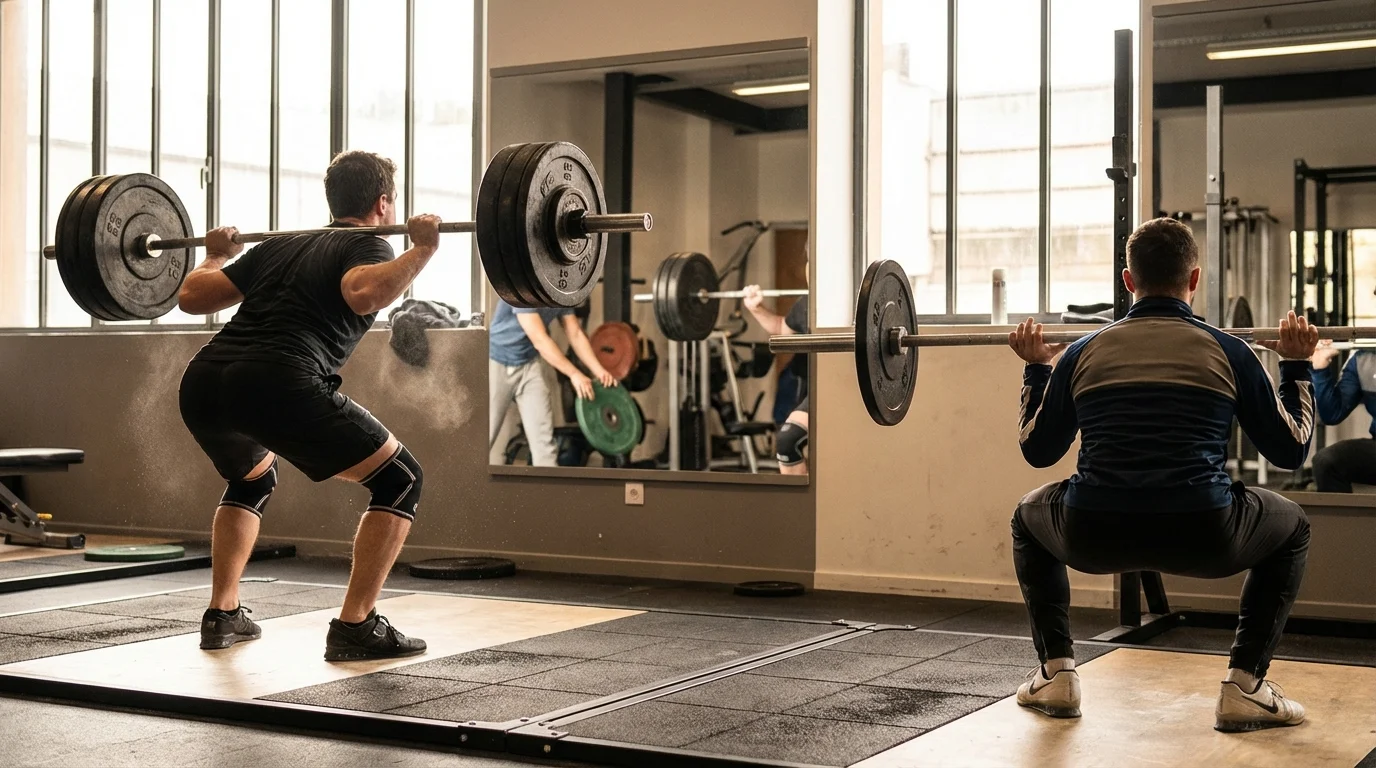
You tick all the boxes: unlimited subscription, three sessions per week, charges that rise visibly. Yet, in front of the mirror, your figure barely changes, if at all. The fault does not always come from the program or genetics. What if it was rather your ego that carried the bar?
This phenomenon has a name well known to coaches and weight room regulars: the ego lifting. Lifting too heavy, too fast, with poor technique can make you feel strong, but sabotages progress, increases the risk of injury, and often ends up depleting motivation.
Ego lifting: what is hidden behind bars that are too heavy
In ego lifting, the goal is no longer to work a muscle, but to prove something. We choose tasks beyond our real capabilities, to impress others or fit the image of a stronger version of ourselves. The repetitions become incomplete, the amplitude is reduced and the technique deteriorates.
This reflex affects everyone, beginners and experienced athletes alike, in classic bodybuilding or CrossFit. The pressure of the group, the videos of records on the networks or simply the way you look at yourself is enough to push you to load too heavy. At the moment, the ego is delighted, but the body follows less.
How ego lifting blocks your progress in the gym
When the load exceeds your true strength, the targeted muscle works less. Amplitude is reduced, you cheat with momentum, other muscles take over and time under tension drops. Work shows that a full amplitude movement can generate several times more hypertrophy than a very heavy partial, for equal weight.
As a result, progressive overload is distorted. You increase the kilos, but not the volume or the quality of the work, whereas adding a few clean repetitions at the same weight already stimulates the muscle much more. And then, the joints suffer, nervous fatigue increases and injuries lie in wait.
Get out of the ego lifting to finally progress
To really move forward, you have to agree to load less on paper. Film yourself or ask a friend to observe your movements, then choose a load that allows 8 to 12 controlled repetitions while maintaining full range of motion, without bouncing or randomly arching your back.
A simple guideline to avoid ego lifting is to regularly check these signals:
• you mainly feel your joints, not the targeted muscle;
• your amplitude decreases as soon as the bar becomes heavy;
• you fail from the third or fourth repetition without control;
• your performance and physique have stagnated for several weeks despite constant investment.
Ego lifting: how do I know if I’m affected?
If you have to cheat to move the bar, your amplitude is reduced and you especially feel your joints, you are probably in the middle of an ego lift.
Does lifting lighter make you progress less?
No, provided you stay close to muscular failure with clean technique. Moderate loads in full amplitude stimulate the muscle more than a poorly controlled huge weight.
What weight should I choose to avoid ego lifting?
In bodybuilding for aesthetics, aim for a load that allows 8 to 12 controlled repetitions, the last two or three of which are difficult but without cheating or joint pain.
