
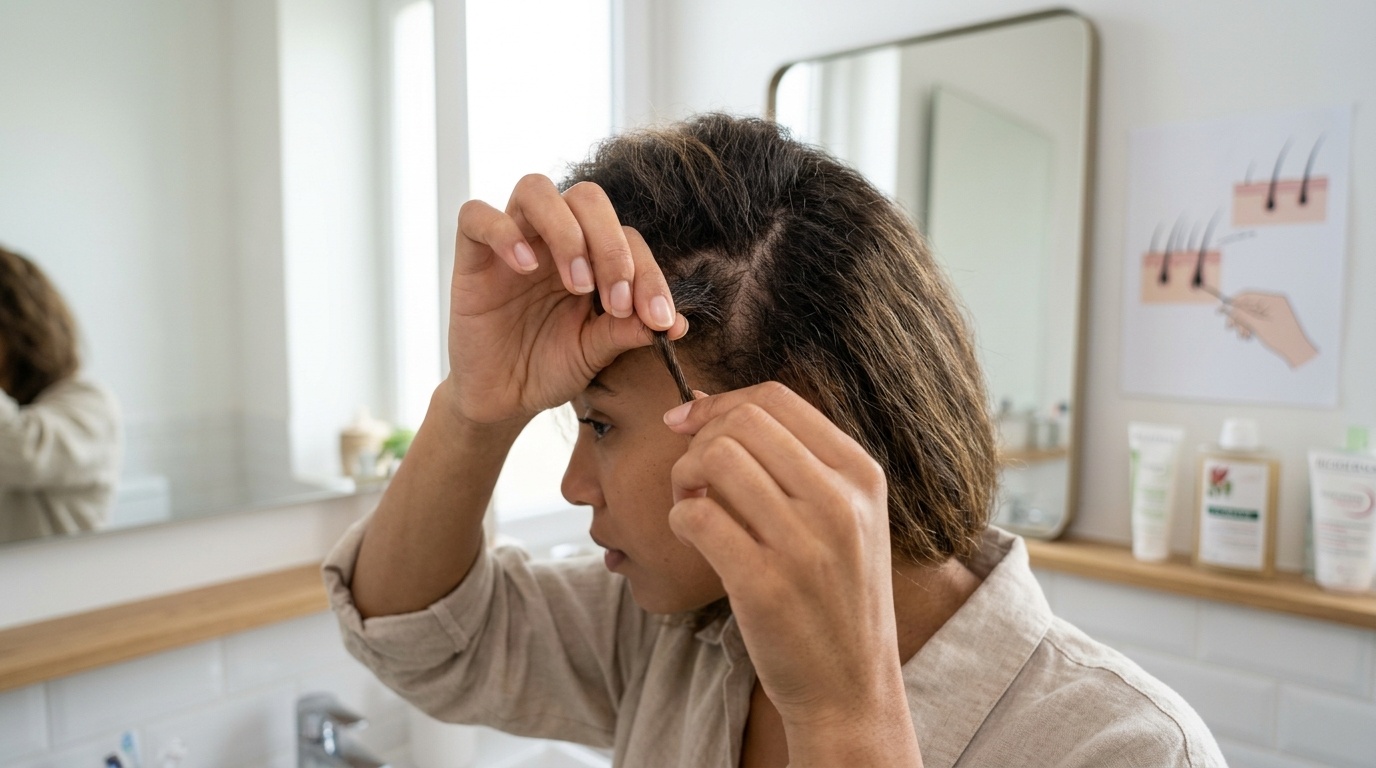
Hair loss is one of those little anxieties that shows up in the shower or on the pillow. A few strands on the brush pass, but when the bathroom looks like a hair salon after a busy Saturday, doubt sets in. We know that losing hair is normal, without really knowing the boundary between physiological loss and the start of a hair problem.
It is precisely this vagueness that Aamna Adel, dermatologist, wanted to clarify by sharing a very concrete method on her networks: three signals to monitor on a daily basis and a simple hair loss test, which can be carried out in two minutes at home. A gesture inspired by the hair traction test used in consultation, to find out if the loss is becoming excessive.
Hair loss: what remains a normal physiological loss
A healthy scalp follows a precise cycle: growth, rest, then shedding. Specialists estimate that so-called physiological hair loss is, depending on the initial density, between approximately 50 and 150 hairs per day. Aamna Adel also reminds us that losing around 150 hairs a day remains normal, even during a change of season or a period of fatigue.
For the dermatologist, the important thing is not to count each hair, but to observe the whole. , explains Aamna Adel to the media ELLE. In other words, as long as hair density does not visibly decrease, the loss most often remains physiological.
Warning signs before the hair pull test
First very concrete indicator: what accumulates in the shower siphon or on the brush. A small ball of sparse hair after shampooing is nothing to worry about. When entire handfuls come off with each wash, the signal becomes more serious and can reflect telogen effluvium, this diffuse loss often triggered by stress, childbirth or illness.
Another key benchmark, often overlooked: the thickness of the ponytail. If it required two turns of elastic and it now takes four, the mass has clearly decreased. A widening part or a more visible scalp on the top suggest a gradual decrease in density, typical of certain forms of androgenetic alopecia. When these signs set in, a dermatological consultation becomes useful, even without spectacular clumps in the bathtub.
Hair traction test: the homemade gesture to find out if you are losing too much
The heart of Aamna Adel’s method is based on a very simple test, inspired by the hair traction test carried out in the office. On dry hair, ideally not washed for 24 hours, simply grasp a section of approximately 40 to 60 hairs near the scalp between your thumb and fingers, twist it slightly, then gently pull towards the ends. We repeat the gesture on several areas to have an overall vision and we count the hairs that remain in the hand.
If none or one or two hairs fall out, the loss generally remains within values considered normal. When several hairs come with each pull, dermatological references describe a positive test beyond approximately 6 hairs out of 40 to 60, a sign of active shedding. Aamna Adel suggests a stricter threshold: if two or more hairs come off each time, the situation already merits vigilance. In the event of a repeated positive test, especially if the density drops, specialist advice is required to explore the causes (telogen effluvium, androgenetic alopecia, others) and, if necessary, complete with a trichogram, trichoscopy or blood tests.
How much hair can you lose per day without it being abnormal?
Dermatological data place physiological loss between approximately 50 and 150 hairs per day. Losing this volume, even with a small ball in the siphon, remains compatible with a healthy scalp if the overall density does not change.
How to perform a hair pull test at home?
On dry hair, not washed for 24 hours, grab a section of 40 to 60 hairs near the scalp, twist lightly then pull gently towards the ends, and count the hairs remaining in your hand.
When does the tensile test become a concern?
A result with 0 to 2 hairs pulled out per strand is rather reassuring. When several hairs appear each time, and especially beyond approximately 6 out of 40 to 60, the loss is considered excessive and warrants medical advice.
Is the traction test enough to diagnose androgenetic alopecia?
No, this test mainly evaluates the intensity of the hair loss at the time T. The diagnosis of androgenetic alopecia is based on the clinical examination, the evolution of hair density and, if necessary, examinations such as trichoscopy or the trichogram.
When to consult a dermatologist for hair loss?
If the traction test is positive several times in a row, the loss has lasted for more than three months, or you notice a clear reduction in density, itching or bald areas, it is recommended to make an appointment.
