
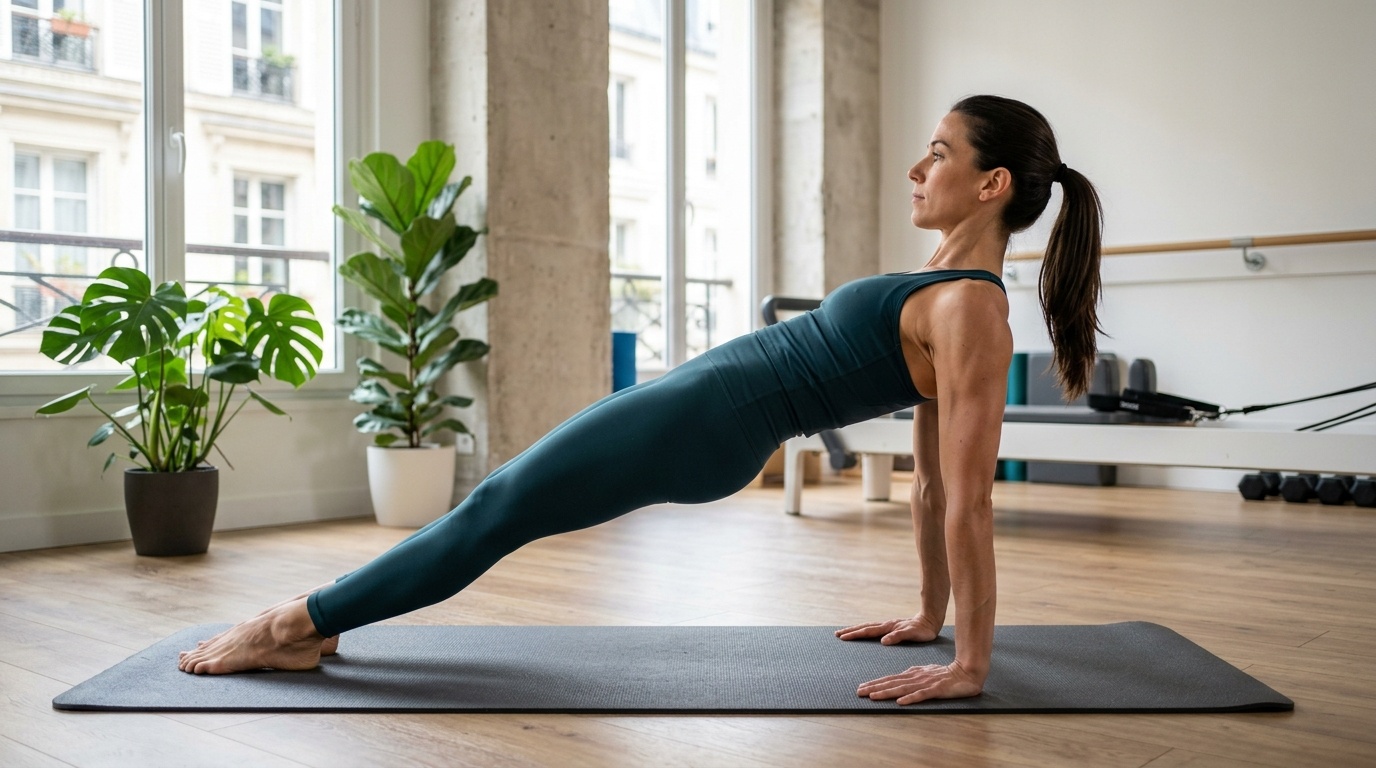
Do you dream of firmer arms without spending your evenings doing push-ups or lifting heavy dumbbells? At the heart of Joseph Pilates’ method, the Leg Pull Supine promises much more than a simple core exercise.
And then, it’s not just a story of visible biceps. This Pilates-style inverted plank work also works on the abdominal muscles, glutes and posture. The idea is to tone everything in a single movement, as long as you master it well.
Leg Pull Supine: the reverse plank version Pilates
In the floor repertoire, the Leg Pull Supine appears as an advanced intermediate exercise. You start seated, legs stretched out in front of you, hands placed behind your hips, fingers turned backwards, then you raise your pelvis above the ground.
The body then forms an inverted plank, supported on the palms and heels, looking towards the ceiling. The key instructions remain simple: align the shoulders, pelvis and heels, engage the abs and keep a slight retroversion of the pelvis to protect the lower back.
Leg Pull Supine: why it really transforms the arms
In this position, pushing the hands into the ground becomes the main driving force. The triceps, the backs of the shoulders and the entire shoulder girdle carry the weight of the pelvis and trunk, which quickly causes the backs of the arms to heat up.
Compared to classic pumps, the movement remains more fluid, without impact, while offering other interesting benefits for the figure:
• Tone the back of the arms, often a sensitive area.
• Gently strengthen the shoulders.
• Sculpt the glutes and back of the thighs at the same time.
• Engage deep abs and improve posture.
Leg Pull Supine: how to do it and adapt it safely
For the classic version, sit down, legs together and straight, hands behind your hips. Inhale, push through your hands and heels to raise your pelvis to a reverse plank. Then, keeping your pelvis high, raise one straight leg towards the ceiling and lower it without your trunk moving.
The Joseph Pilates manuals describe five raises per leg, with inhaling during the ascent and exhaling during the descent. To begin, you can limit yourself to holding the posture for a few breaths, knees slightly bent or buttocks a little lower, or even on the forearms if the wrists are sensitive, avoiding raised shoulders and sagging pelvis.
Is the Leg Pull Supine suitable for Pilates beginners?
Yes, provided you start with bent knees, lower pelvis and short durations.
Does the Leg Pull Supine also strengthen the abs and glutes?
The reverse plank strongly engages the deep core, glutes and back of the thighs.
How many Leg Pull Supine should you do per leg?
The Joseph Pilates repertoire recommends five repetitions per leg in full version.
