
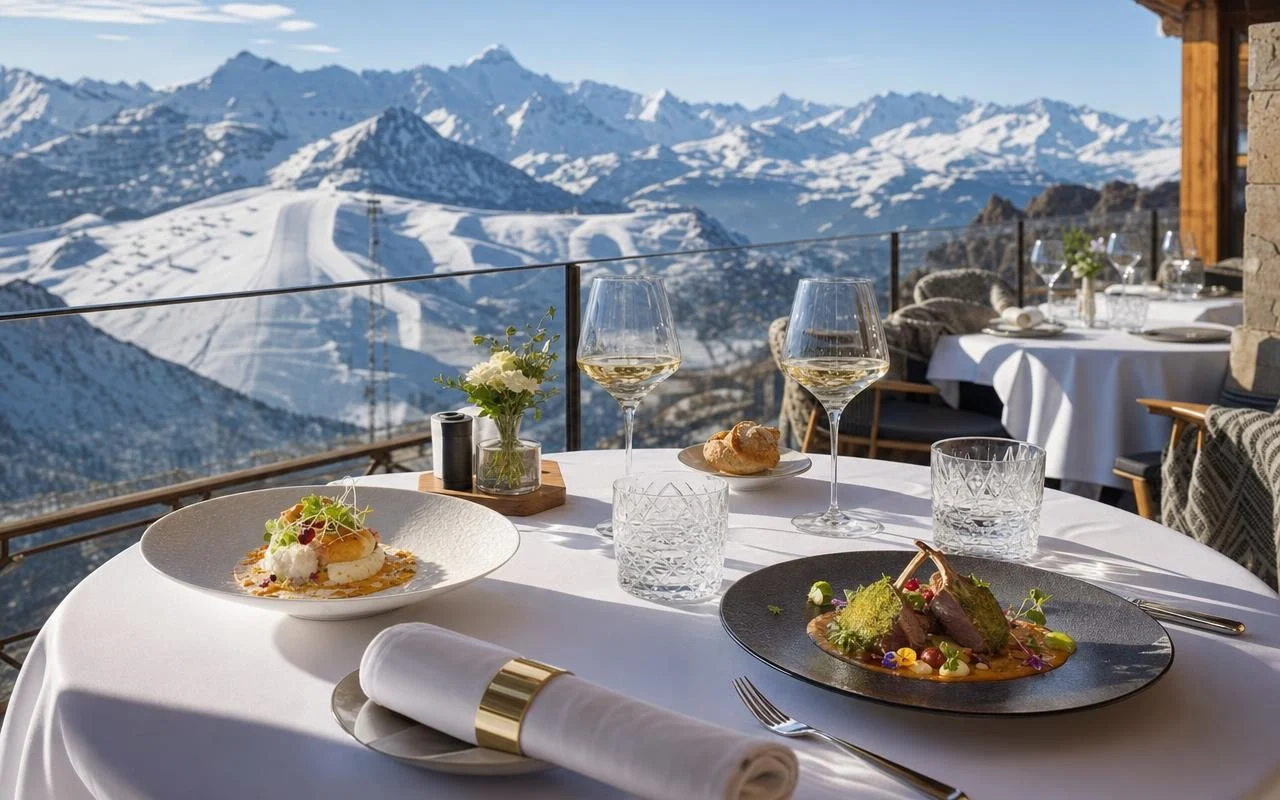
All summer, the series imagines very concrete duels between big houses. When the setting shifts to the Alps, the poster is radical: two of the very rare 3-star restaurants face each other above the slopes.
Behind this image, a numerical reality appears. In 2026, Isère, Savoie and Haute Savoie will have a total of 41 starred restaurants, including 27 stars for Savoie alone and two 3-star addresses. How did these 3 Michelin star chefs in the Alps tame high altitude?
The Combat des Chefs in the Alps, a high altitude duel
The Alpine version of the series, signed by critic Stéphane Durand Souffland, compares two triple-starred restaurants emblematic of mountain cuisine. The exercise uses the codes of a close match, but above all serves to tell two ways of experiencing high altitude.
On the one hand, palace gastronomy like the 1947 Cheval Blanc hotel in Courchevel, a highly sought-after 3-star hotel. On the other, more intimate houses like the one in Megève or the old one of Marc Veyrat in Manigod, perched at 1,650 meters.
Alpine gastronomy, 3-star restaurants which are multiplying
The Alpine territories of Auvergne Rhône Alpes today bring together more than 50 distinguished restaurants in the guide. In Isère, Savoie and Haute Savoie, there are 41 starred restaurants, and the 3 Valleys alone have 17 stars for 11 tables. In Savoie, two 3-star restaurants, 1947 and Les Morainières in Jongieux, raise the constellation.
Around these 3 stars revolve 2-star houses like La Bouitte in Saint Martin de Belleville or the Auberge du Père Bise in Talloires. Chefs like Marc Veyrat, Emmanuel Renaut and Jean Sulpice combine herb picking, lake fish and dairy products. Despite this excitement, only 7% of French starred chefs are women and none yet manages a starred restaurant in the Alps.
Cooking at more than 1,500 meters, the challenge for star chefs
Above 1,500 meters, physical rules complicate the work of the kitchens. Water boils around 95°C, which extends cooking times and makes poaching or certain pastries more delicate. Drier air accelerates evaporation, so chefs favor slow cooking, braising, smoking or pressure cooking to maintain control.
These technical constraints also modify the in-room experience. In the resorts, 3-star menus now go well with hiking as well as skiing, and several tables remain open for a large part of the summer. Between shows like the and resort strategies, Alpine haute cuisine has become a central asset of tourism.
What are the main 3 Michelin star restaurants in the Alps?
Le 1947 in Courchevel, Les Morainières in Jongieux and Le Flocon de Sel in Megève are among the very rare three-star restaurants in the Alpine region.
Why does cooking at altitude require specific techniques?
In the mountains, water boils around 95°C and the air is drier, which changes cooking times and complicates baking and poaching.
How many starred restaurants are there in the French Alpine region?
In 2026, Isère, Savoie and Haute Savoie will bring together 41 starred restaurants, in a group which exceeds 50 distinguished restaurants in the Alpine territories.
