
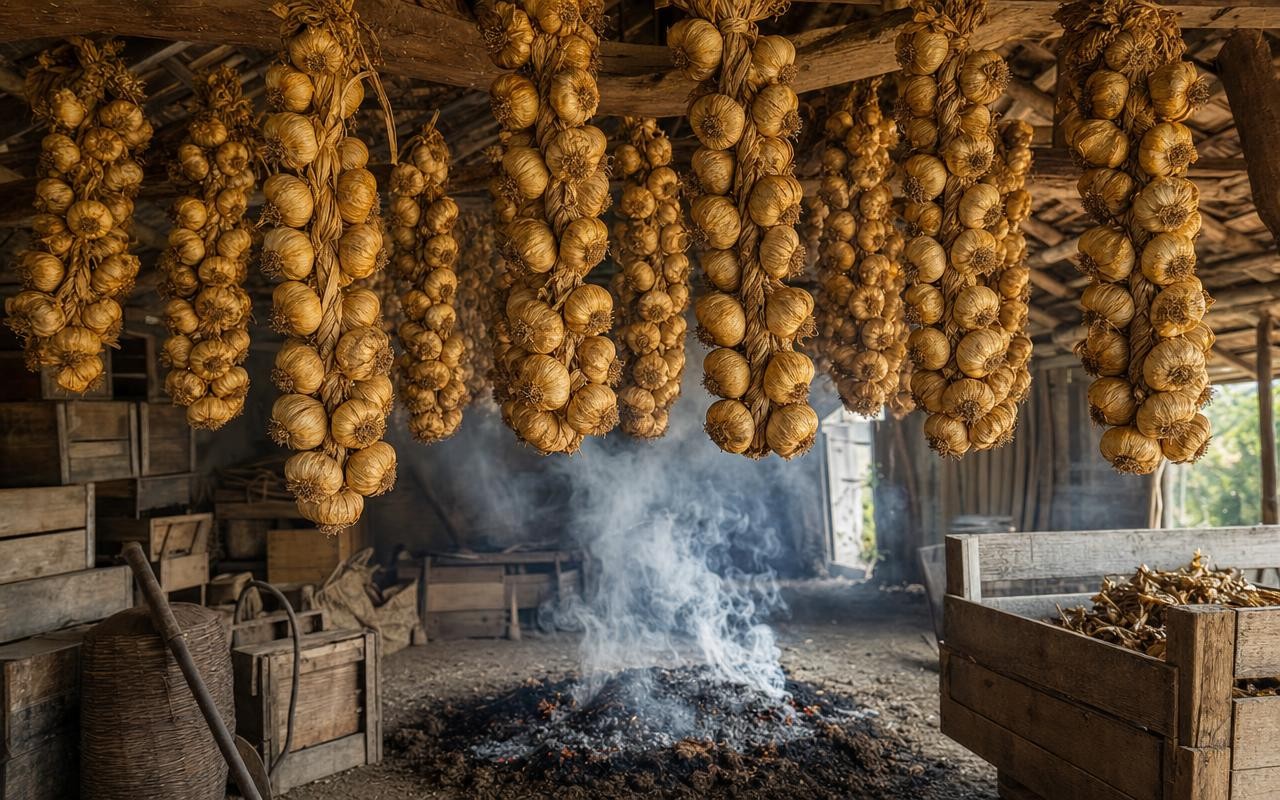
In Arleux, in the Val de Sensée, summer has a very particular smell: that of garlic drying and then smoking in the barns. For more than two centuries, this northern village has lived to the rhythm of hanging garlic braids, ready to be smoked, while families repeat the same gestures year after year.
The northern garlic harvest begins around July 20; heads still earthy, they dry for a few days in the fields before entering the workshop. There, sorting, braiding then smoking take place to prepare for the Arleux Smoked Garlic Fair, organized every first weekend of September. This moment of celebration, however, only shows part of the work, passed down from generation to generation.
In Arleux, Arleux smoked garlic in the heart of the marshes
Nestled in the middle of the Arleux marshes, on silty-clay soils rich in peat, the town has built its reputation on this smoked garlic from Arleux, unique in France. Garlic cultivation has been documented there since the beginning of the 19th century, and peat smoking was described there at the end of the same century, making Arleux the only French region where garlic is traditionally smoked.
In 2013, the Protected Geographical Indication recognized this know-how: Arleux smoked garlic is now recognized by the National Institute of Origin and Quality (INAO). The area covers 62 municipalities in the Nord and Pas-de-Calais, supervised by the Arleux Smoked Garlic Producers Group. At the heart of the system, a local variety, Northern garlic, a pink spring garlic planted between mid-January and mid-March.
From the field to the smokehouse: highly codified ancestral know-how
Once the cloves have been planted in the ground in winter, you must wait until July for uprooting. The heads then dry for around five days in the field, before being sorted and graded. Then comes the bonjetage, this braiding which brings together from 3 to 120 heads per link; a gesture learned young, watching parents and grandparents tie the tops like braiding hair.
Just after the harvest, around ten seasonal workers participate each year in this essential stage, supporting families with sorting, braiding and preparing the braids before smoking. In small, closed rooms, the garlic is suspended over a very low fire of peat, lignite, sawdust (often oak, beech or ash) and short straw. Seven to ten days later, the buds have taken on a reddish-brown color, a characteristic scent and can be kept for several months, up to a year.
Arleux Smoked Garlic Fair, collective emotion and everyday gestures
Since 1962, the Arleux Smoked Garlic Fair has brought together nearly 60,000 visitors every first weekend in September. In two days, around 5,000 liters of garlic soup are served, the Confrérie de l’Ail Fumé d’Arleux inducts new members, a garlic queen is elected and braiding competitions highlight the skill of the producers. And then, the event was also at the center of debate: a local petition was brought together, according to the newspaper La Voix du Nord, to demand the deprogramming of a singer. In a press release, Mayor Bruno Vandeville wrote: These reactions show how much the image of the fair matters to residents.
At home, Arleux smoked garlic is preferably chosen in braids bearing the IGP logo, with firm heads and a uniform color. It should be kept hanging, dry and away from light, where it retains its fragrance for several months. In cooking, it enhances soups, stews or sauces, without completely dominating the dish:
- in a garlic soup or stew,
- grated in a puree or cream sauce,
- rubbed on toast with a drizzle of oil.
What makes Arleux smoked garlic unique?
Its origin in the marshes of Arleux, the Northern garlic variety and traditional peat smoking give it a unique taste and preservation.
When is the Arleux Smoked Garlic Fair held?
The Arleux Smoked Garlic Fair takes place every first weekend of September and has existed since 1962.
How to use and store Arleux smoked garlic?
We keep it in braids, hanging dry, and use it like classic garlic, in soups, sauces or stews.
