
When pimples appear on the skin, morale takes a hit. If wrinkles (or what we now call skin longevity) often take center stage in beauty, spots and imperfections tell another story, less visible but just as important: that of how we look at ourselves. A breakout, a few persistent marks and sometimes your confidence wavers. A phenomenon that the figures are now bringing to light.
Unveiled in November 2026, the first Skin Barometer cross-references 791,045 skin diagnoses carried out online in the first half of 2026 with a survey conducted by Ifop on October 7 and 8 among 1,000 adults representative of the French population. Objective ? Decipher skin concerns and beauty habits. And behind the care routines lies a particularly revealing observation.
Pimples and imperfections: when self-confidence takes a hit
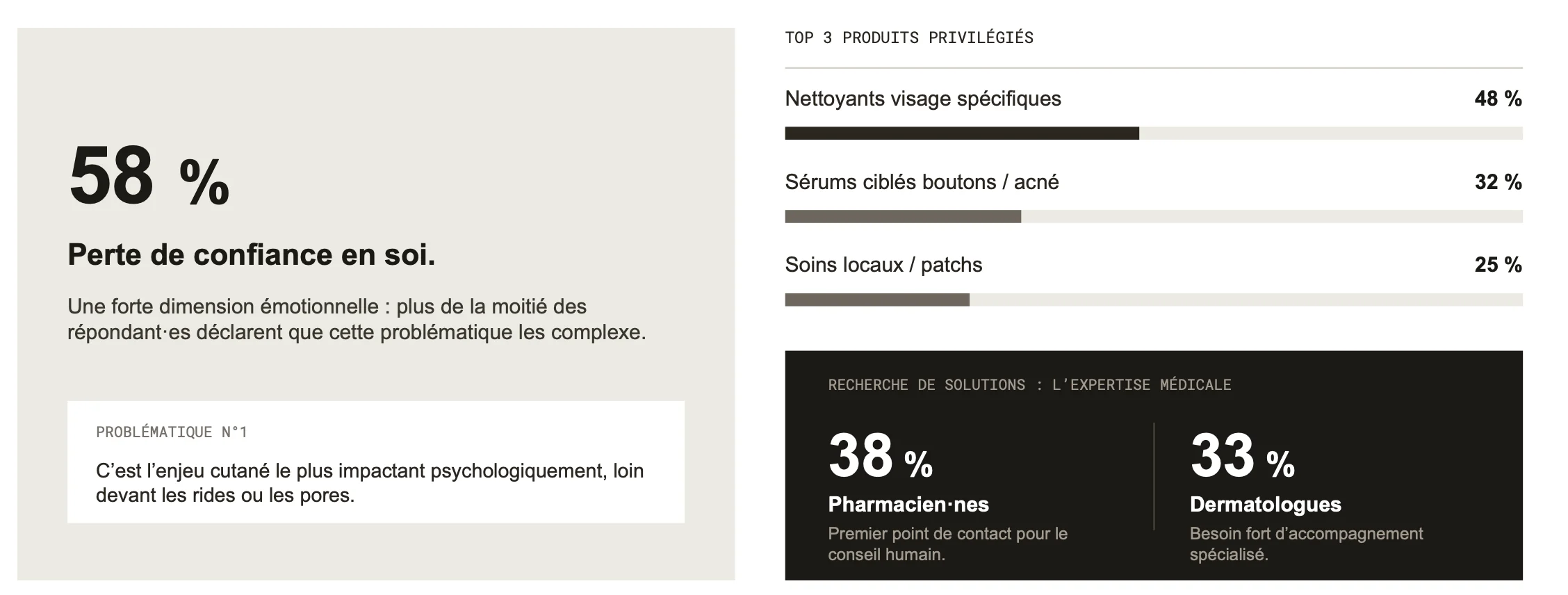
A button is never just a button for everyone. According to the 2026 Skin Barometer, 58% of facial care users concerned about their imperfections say that they affect their self-confidence. More than half also say they are self-conscious. A result which places pimples at the top of the skin concerns having the strongest impact on personal esteem, ahead of pores and wrinkles.
Who feels particularly concerned? Among those questioned on this issue, 66% are women, 60% are under 35 and 59% have oily skin. To try to regain control, targeted treatments are increasing: 48% favor specific cleansers, 32% anti-blemish serums and 25% local treatments or patches.
But when the skin acts up, the advice remains valuable. For information, 38% turn to pharmacists and 33% to dermatologists. Social networks (16%) and artificial intelligence (14%) also find their place in this quest for solutions.
 © Typology × Ifop
According to the 2026 Typology × Ifop Skin Barometer, spots and imperfections are the skin concern that has the greatest impact on self-confidence.
Wrinkles, visible pores: skin complexes do not only affect young people
Although fine lines and wrinkles top the list of beauty concerns, with 32% of respondents citing them as a priority, they are not the ones that weigh the most on morale. According to the Ifop analysis, 31% of those affected experience them as a complex, compared to 43% for pores and skin texture, and 56% for imperfections.
Visible pores are a particular concern among young women. Of those concerned about their appearance, 81% are women and 52% are under 35 years old. Result: 72% adapt their care routine. Serums, purifying masks and exfoliants then enter the dance, sometimes at the risk of multiplying products.
Sensitive skin and skincare routine: do we really need to increase the number of treatments?
Another lesson from the barometer: 63.9% of French users of the Typology diagnosis report having reactive skin, compared to 60.7% in 2023. Paradoxically, beauty routines are gaining momentum. The French use on average three to four treatments per day, compared to five products among women under 35. However, 34% of facial care users do not know what active ingredients are in their products. , explains Chloé Brunet, dDirector of Quantitative Studies within the Beauty Wellbeing division at Ifop Marketing.
So, should we do less to do better? , explains Stéphanie Soulé, researcher and head of scientific communication at Typology. As a reminder, Typology favors a minimalist approach to care, with essential formulas of fewer than 20 ingredients, a transparent composition to better identify active ingredients and a personalized routine rather than an accumulation of products.
An invitation to favor a thoughtful routine rather than an accumulation of products. Because behind the quest for perfect skin, the most important thing is perhaps to learn to make peace with your own.
FAQ: Pimples, Blemishes and Self-Confidence
Can pimples affect self-confidence?
Yes. According to the Typology × Ifop 2026 barometer, 58% of people questioned who are concerned about their imperfections report a loss of self-confidence.
Who is most affected by imperfections?
In the subgroup studied, 66% are women, 60% are under 35 years old and 59% have oily skin.
What treatments are most used against pimples?
Specific cleansers come first (48%), ahead of targeted serums (32%) and local treatments or patches (25%).
Are visible pores also a source of complexes?
Yes. Among people concerned about their pores, 43% say they are self-conscious about it.
Who should you turn to for advice on imperfections?
Pharmacists and dermatologists are among the preferred contacts for those affected. In the event of persistent pimples, dermatological advice can help choose appropriate treatment.
