
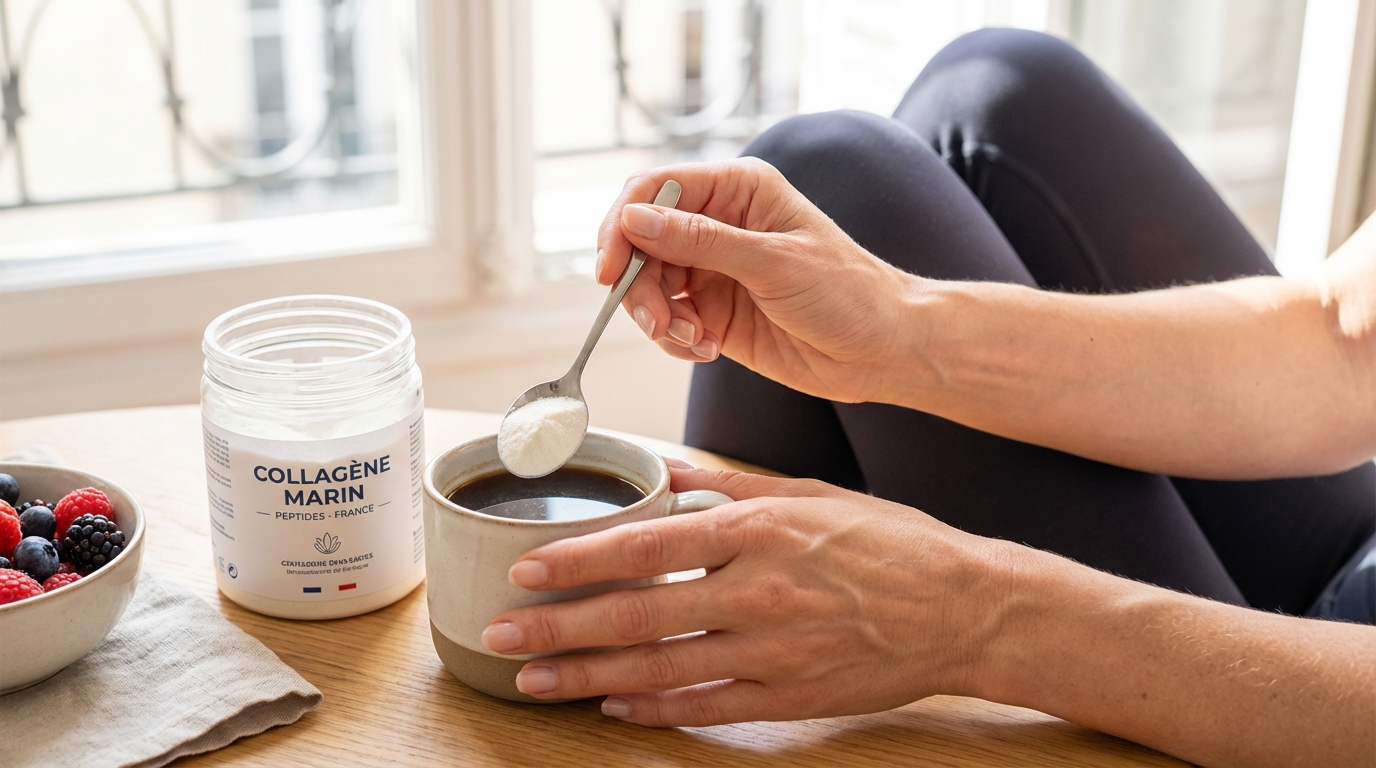
At the age of 50, many women describe the same awakening: stiff knees and less clear facial oval. In their cup of coffee, a powdered marine active ingredient has slowly established itself as a new reflex.
Behind this gesture is the marine collagen in coffee, popularized by Jennifer Aniston and adopted during menopause. When the skin loses around 30% of its collagen in five years and joint pain increases, 10 g of hydrolyzed collagen daily becomes an additional help.
Menopause and marine collagen: what happens in the skin and joints
Hydrolyzed marine collagen provides peptides very rich in glycine and proline, major building blocks of the dermis and cartilage. When natural production falls, arms and stomach relax, the oval becomes blurred and the skin marks wrinkles more quickly.
In the joints, the drop in collagen is accompanied by less abundant synovial fluid, which accentuates the sensations of stiffness when getting up or after a day of sitting. The marine peptides then function as a joint “lubricant” and a skin “tutor”, targeting both mobility and combating sagging.
From clinical data to Beauty Test testimony on collagen coffee
A trial conducted at Penn State followed 147 athletes receiving 10 g of hydrolyzed collagen or a placebo each day for 24 weeks. In the 97 participants analyzed, the supplementation significantly reduced joint pain when resting, walking, standing or carrying loads, especially in cases of painful knees.
In women over 50, this dose of 10 g per day echoes the recommendations when targeting the joints, where 5 g is sufficient for the skin. On Edgar, a reader sums up her marine collagen coffee as: , she says.
Instructions for use: a truly joint-friendly marine collagen coffee
Concretely, the routine is simple: pour the hydrolyzed marine collagen powder into a lukewarm, not boiling, coffee or tea, and mix well. Many women choose to take the entire dose in the morning, sometimes 10 g to target the joints, or 5 g if the objective remains mainly the skin.
An important reflex is to keep this collagen coffee as neutral as possible: without added sugar, because the glucose attaches to the proteins and “caramelizes” them, accelerating glycation. Many complete this In and Out gesture by massaging their arms or stomach with a firming oil and, in the event of a fish allergy or heavy treatment, by seeking advice from a health professional.
Does hot coffee destroy marine collagen?
No, collagen peptides are designed to remain stable at typical coffee or tea temperatures.
How much marine collagen in coffee for joints?
The work and recommendations use 10 g of hydrolyzed collagen per day for the joints, compared to 5 g for the skin alone.
How long do you take marine collagen to see an effect?
In the 24-week trial, improvement in joint pain appeared over time; in practice, many women speak of a gradual evolution.
