
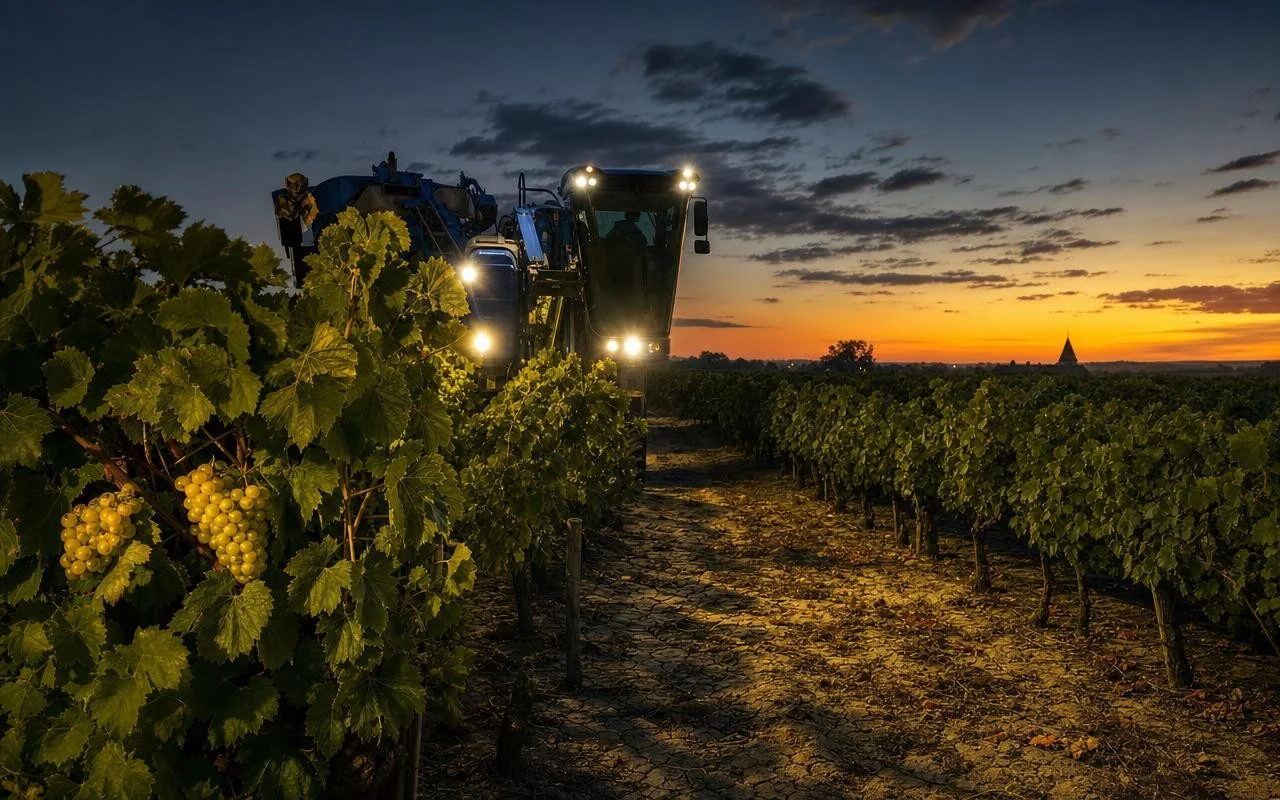
On August 12, in Reuilly, tractor headlights cut through the night over the rows of pinot gris. The date, in the heart of summer, could pass for a dress rehearsal; However, it is the official start of the harvest in Reuilly. Never had the pruners been drawn so early in this Indre appellation, even during the heatwave of 2003 when the harvest began around August 16. And there, in the vineyards, many have the impression of having entered a new normal.
The years go by and break the benchmarks. Pascal Dethune summarizes this impression: , comments collected by France 3. For this vintage, a harsh winter followed by a historic drought hastened the maturity of the grapes, against a backdrop of already well-documented global warming.
Harvests in Reuilly which shift into the heart of summer
Historically, Centre-Loire wines are harvested between the last week of September and the beginning of October. For the AOC Reuilly, the harvest ban was set for September 12 in 2014, and the first cuts of pruning shears took place on August 21 in 2020, already announced as very early. With a start on August 12 in 2026, Reuilly is almost a month and a half ahead of this usual schedule, a shift that the Indre prefecture now estimates at 2 to 3 weeks on average compared to the early 2000s.
As is the local tradition, it is the Pinot Gris which opens the ball, before the Pinot Noir and the Sauvignon Blanc. In the ranks facing north, Pascal Dethune notes that. On southern exposures, the scene changes: the grains. The winemaker already knows that the volume will not follow:
Mild winter, drought and surging sugar
From spring, the rapid appearance of buds put the vine ahead. Then the rain became rare. summarizes Pascal Dethune. On a national scale, the Ministry of Ecological Transition observes that the average harvest date in France has already advanced by around 24 days since the 1970s, an indicator now closely monitored by climatologists.
For winegrowers, the challenge is not only to pick earlier. Possible result in the glass: higher degrees and lower acidity, a phenomenon that state services also describe for the Indre AOCs.
Starting at 4 a.m.: a new rhythm of life
Another very concrete change is the schedule. That Wednesday, tractors and pruners started at 4 a.m. and stopped around 10 a.m., when the thermometer already showed 25 degrees. The instructions are clear: To limit oxidation and maintain freshness, tanks and cooling units become as strategic as pruning shears.
This rush disrupts the organization of the teams. Agricultural worker Alain Lainey underlines: In the middle of August, he also noticed that, certain work being postponed until the following year. In this context, the adaptation options tested elsewhere – night harvests, grass cover, choice of more drought-resistant rootstocks – are of increasing interest to the Reuilly estates.
When did the 2026 harvest start in Reuilly?
The 2026 harvest in Reuilly began on Wednesday August 12, a date which constitutes an absolute record of precocity for the appellation, even earlier than during the heatwave of 2003 when the harvest began around August 16.
Why did the harvest in Reuilly become so early?
The combination of a very mild winter, which brought forward bud break, and a marked drought at the end of the cycle accelerated ripening. In a warming climate, sugar now accumulates more quickly in the berries, which pushes winegrowers to harvest earlier to maintain freshness.
What impact does this precocity have on Reuilly wines?
Bunches roasted on southern exposures result in less juice, therefore lower yields. Increasing sugar and lowering acidity can result in wines that are higher in alcohol and less lively, although winemakers adjust their harvest dates to preserve aromatic balance.
