
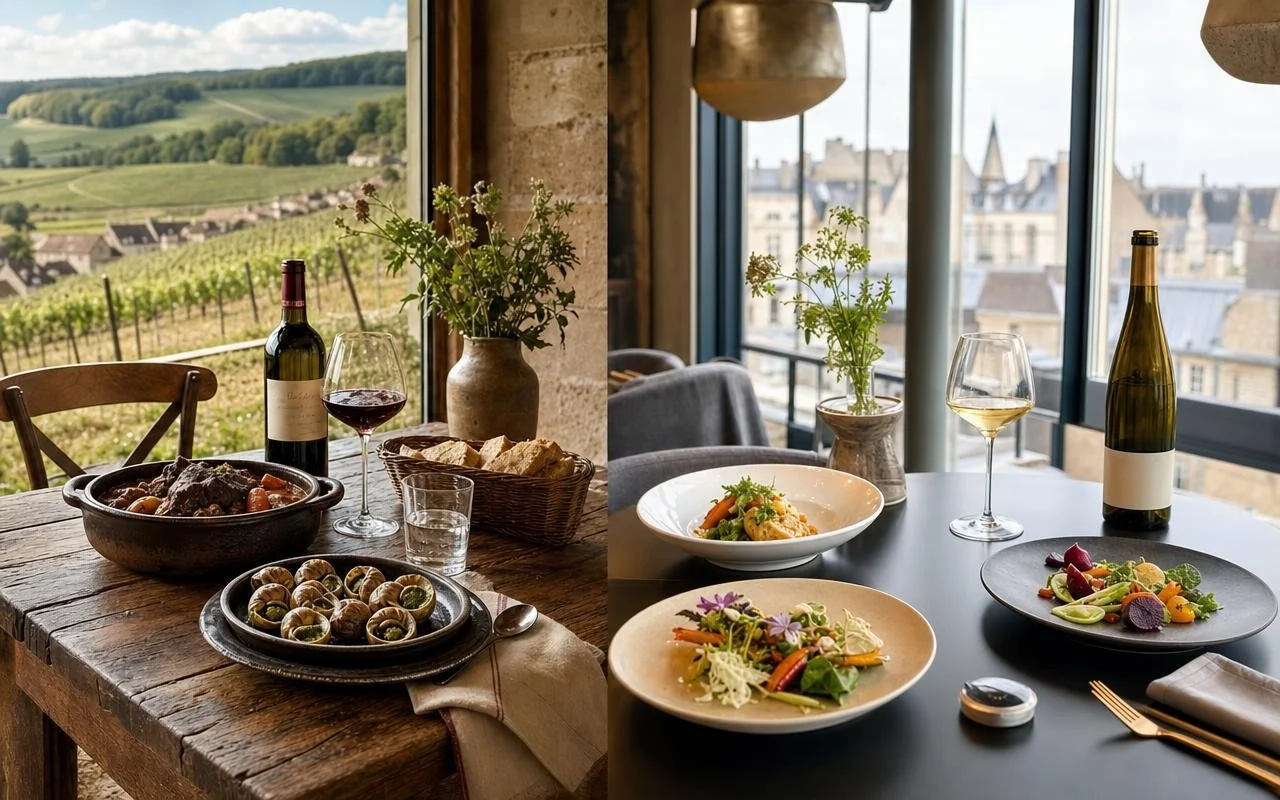
Two addresses, two atmospheres and the same promise: telling Burgundy on the plate. In Côte-d’Or, only two 2-star restaurants display this distinction, the Relais Bernard Loiseau in Saulieu and William Frachot in Dijon. Both claim a strong link with the vineyards, forests, rivers and producers of the department, each with their own culinary grammar. The question then arises, almost inevitably: who most intensely embodies this coveted terroir?
To see clearly, you have to look beyond the stars and observe the context, the cuisine, the wines, but also the overall experience offered. Because ultimately, choosing between these two restaurants amounts to choosing a certain idea of the Côte-d’Orien terroir, more heritage or more contemporary.
2-star restaurants in Côte-d’Or: a region in the spotlight
The Côte-d’Or is seen as a major gastronomic department, supported by the Grands Crus route, appellations like Bourgogne Côte-d’Or, and favorite products: snails, Burgundy truffles, eggs in meurette, poultry simmered in wine. Local authorities list between 13 and 16 starred restaurants depending on the vintage, all linked to the ecosystem of producers highlighted by the Savoir-Faire 100% Côte-d’Or label.
In this very dense landscape, only two houses achieve 2 stars: the La Côte d’Or restaurant at the Relais Bernard Loiseau, in Saulieu, and the William Frachot restaurant at the Hostellerie du Chapeau Rouge, in the historic center of Dijon. Their 2 stars are confirmed for 2024 and 2025, making this duo the most visible showcase of the local terroir.
Relais Bernard Loiseau – La Côte d’Or: Burgundian terroir in a historic house
In Saulieu, in the heart of Morvan, the Relais Bernard Loiseau remains an institution of Burgundian haute cuisine. After Bernard Loiseau then Patrick Bertron, the cuisine of La Côte d’Or is now signed by chef Louis-Philippe Vigilant, who took the reins in 2023 with the clear ambition of retaining the 2 stars and aiming for a third. The house’s message emphasizes a restaurant anchored in its territory, which collaborates closely with local artisans and places the product at the center of the plate.
In the menus, this positioning translates into very readable French cuisine, which highlights meats, vegetables and herbs from the Morvan, but also the great sauces linked to Burgundy wine. Another strong argument on the terroir side: a cellar of around 15,000 bottles for nearly 900 references, mainly Burgundian, which allows you to browse the wines of the Côte de Nuits and the Côte de Beaune without leaving the dining room.
William Frachot in Dijon: a locavore and urban Burgundy
In Dijon, chef William Frachot, double-starred since 2013, offers another interpretation of the terroir. At the Hostellerie du Chapeau Rouge, a 4-star hotel-restaurant, its cuisine is described as locavore and refined, with systematic use of local products. The menu highlights freshwater fish from neighboring rivers, but also snails, Burgundy truffles and very modern interpretations of eggs in meurette.
The decor also plays the contemporary Burgundy card: woodwork inspired by vineyards, touches of mustard color in a nod to the Dijon identity. The urban setting changes the relationship with the land: here, the meal can be part of a city break weekend, between a visit to the Cité Internationale de la Gastronomie and a walk in the medieval streets, rather than a green retreat like in Saulieu.
For gourmets, the choice is therefore built around a few key criteria:
- desire for a large historic house, with a monumental cellar and immersion in the Morvan;
- or preference for an urban, locavore and very contemporary experience in the heart of Dijon.
Both remain deeply linked to winegrowers, market gardeners, breeders and stamped artisans. Which one “celebrates best” the local terroir will depend above all on the way in which each person wishes to experience this terroir: in a destination heritage house or in a city table looking to the future.
Which 2-star restaurant should you choose in Côte-d’Or to discover the local region?
The Côte d’Or in Saulieu highlights a historic and very vinous vision of the terroir, with an immense cellar and classic French cuisine. William Frachot in Dijon offers a more urban, locavore and refined approach, always focused on Burgundy products.
Relais Bernard Loiseau or William Frachot: what are the main differences in experience?
Saulieu offers a stay in the countryside, in a large gastronomic lodge with spa and view of the Morvan. Dijon offers a city break: restaurant integrated into a 4-star hotel, easy access by train and possibility of combining meals, cultural visits and tastings in town.
Do the two 2-star restaurants work with 100% Côte-d’Or products?
The two houses boast strong regional roots and collaborate with local producers highlighted by the Savoir-Faire 100% Côte-d’Or label. Depending on the seasons, menus and arrivals, the exact share of products from the department may vary.
