
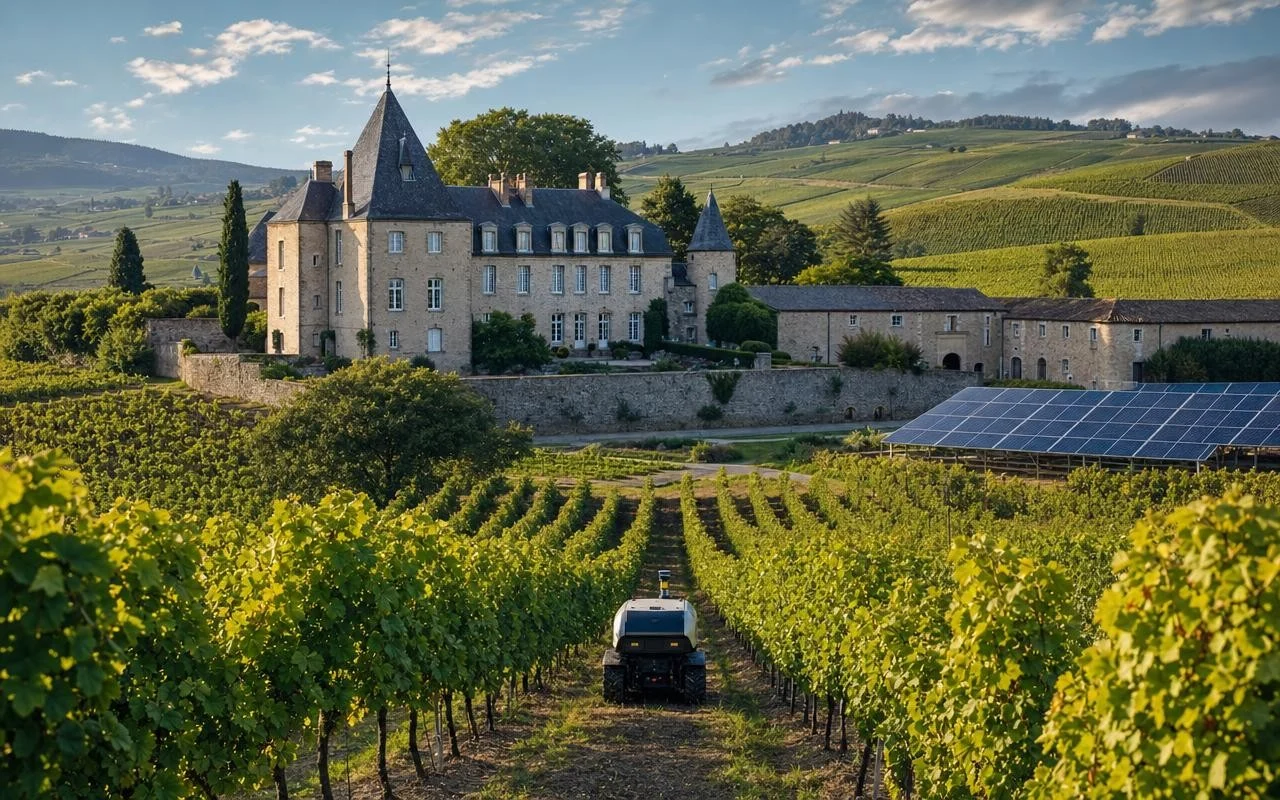
In Odenas, in the heart of Beaujolais, Château de La Chaize lines up a 17th century castle, Brouilly vines… and a robot that circulates between the rows. Behind this contrasting image lies an ultra-equipped vineyard.
Like everywhere, expensive energy, climatic hazards and scarce labor force the field to reinvent itself. According to the Vin et Société barometer, the sector only reaches 47 points out of 100, and 40 for viticulture.
Château de La Chaize, a high-tech wine estate
This historic estate covers approximately 450 hectares, including 110 hectares of vines converted to organic. Owned by the Gruy family, it rethinks energy, water and vineyard work.
For mechanical weeding, the tractor gives way to a lightweight vineyard robot. , explains Naelle Dalais, tractor driver on the La Chaize estate, interviewed by France 3.
Robot, solar and geothermal energy serving the vineyard
Naelle Dalais summarizes: . Finally, she recalls that.
For energy, 650 photovoltaic panels produce nearly 85% of the area’s electricity. A geothermal power plant manages hot and cold: explains Thierry Buriller, maintenance manager. .
Water recycling and global sustainable vineyard project
The castle also has its own wastewater treatment plant, which recycles water for irrigation and tree planting. This equipment, for several million euros, must restore the vineyard, according to the new owners.
Boris Gruy, general manager, sums it up like this. . In a sector that is still little digitalized, this castle acts as a technology laboratory serving viticulture.
Why a wine robot in La Chaize?
A lightweight robot weeds mechanically between the vines, with very precise settings which limit injuries and soil compaction.
How does the estate produce its energy?
The castle has installed 650 photovoltaic panels and a geothermal power plant, covering nearly 85% of its electrical needs.
What happens to the water used at the castle?
An internal wastewater treatment plant treats the effluent, then the water is reused for irrigation and tree planting.
