
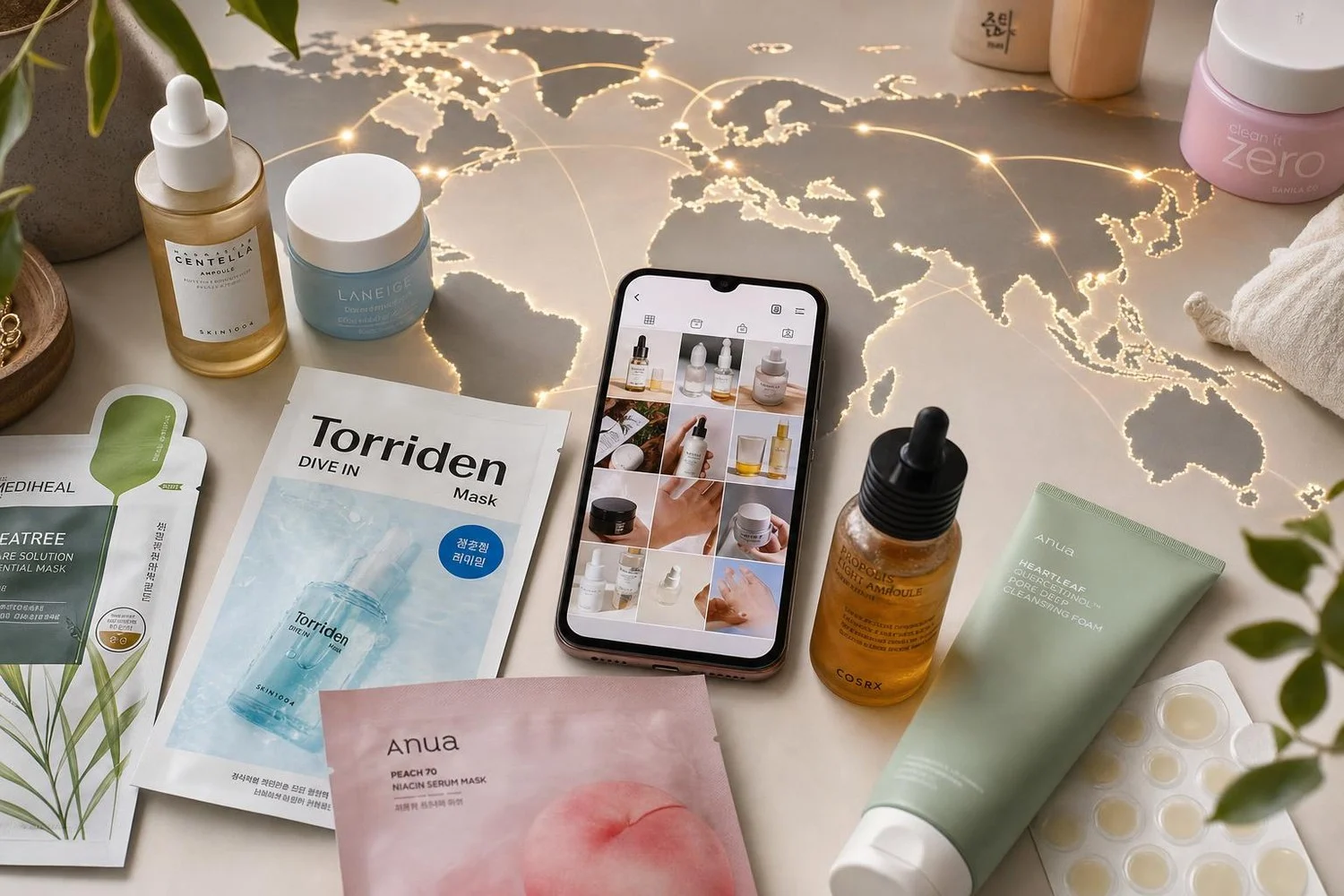
Sheet masks, anti-acne patches and snail mucin serums are no longer just for fans of Korean dramas. In two years, K-Beauty has left the niche section to establish itself as one of the most powerful drivers of the global beauty market, driven by TikTok and a new way of consuming skincare. And this movement shows no signs of slowing down.
According to the NIQ report, K-Beauty has become a growing segment, with sales value up 53% from the previous year and 131% over the past two years. Behind these three-digit figures lies a fundamental transformation of routines, sales channels and territories that are now driving beauty growth.
K-Beauty growth of +131% that changes the scale of the market
For NIQ, this surge is no longer a passing fad but proof that an innovation born in South Korea can redraw the map of global beauty. K-Beauty sales are growing much faster than the rest of the market, to the point of already representing around 10% of online sales of skincare products in Europe, with a share climbing between 15 and 20% in key markets such as Italy, Spain and France.
“,” said Tara James Taylor, senior vice president of Global Beauty Personal Care at NIQ, as quoted by Premium Beauty News. She adds: “”.
Where K-Beauty is exploding: social commerce, Americas and the Middle East
The NIQ report highlights the central role of social commerce. According to TikTok Shop data, K-Beauty-related searches on the platform increased by 125% in the UK in 2025, and the revenue of Korean brands on TikTok Shop in the UK, US, Spain and Germany jumped 430% in one year. In North America, e-commerce already accounts for 76% of K-Beauty sales, with Canada at 164 million US dollars in 2025 (around 151 million euros), an increase of 57% over one year.
The thrust is just as clear to the south and east. In Brazil and Mexico, the value of sales increased by 135%, a strong signal for Latin America. In Western Europe, growth reached 58% in value. NIQ also sees a 27% increase in K-Beauty sales in Asia-Pacific excluding Korea and China, and a 76% increase in e-commerce sales in the Middle East, where highly connected consumers are already shaping the next wave of growth.
New rituals to the next frontiers of well-being and hair
The rise of K-Beauty can also be explained by a change in daily actions. Once niche formats, such as facial sheet masks, anti-acne patches, essences, serums and ampoules, have become ingrained bathroom rituals. And then certain very targeted ingredients, such as snail mucin, Centella Asiatica or PDRN, left the circle of experts to appeal to a much wider audience.
Because basically, the K-Beauty proposition combines affordable and high-performance products, rapid innovation cycles and a fluid journey between discovery and purchase, whether it is a TikTok live or an e-commerce site. For NIQ, this textbook case shows how a regional trend can take on a global dimension, and why retailers like Western brands are closely scrutinizing this category to anticipate the rise of well-being and hair care inspired by Korea.
What is the global growth rate of K-Beauty according to NIQ?
NIQ indicates that global K-Beauty revenue increased by 53% compared to the previous year and by 131% over two years, confirming an international boom largely driven by digital.
Which regions are driving the global K-Beauty boom today?
The report cites an increase of 135% in Brazil and Mexico, 58% in Western Europe, 27% in Asia-Pacific excluding Korea and China, and 76% for online sales in the Middle East, not to mention Canada at 164 million US dollars in 2025.
What K-Beauty formats and ingredients have established themselves in routines?
NIQ highlights sheet masks, anti-acne patches, essences, serums and ampoules, as well as ingredients like snail mucin, Centella Asiatica and PDRN, which have moved from specialist care to mainstream demand.
