
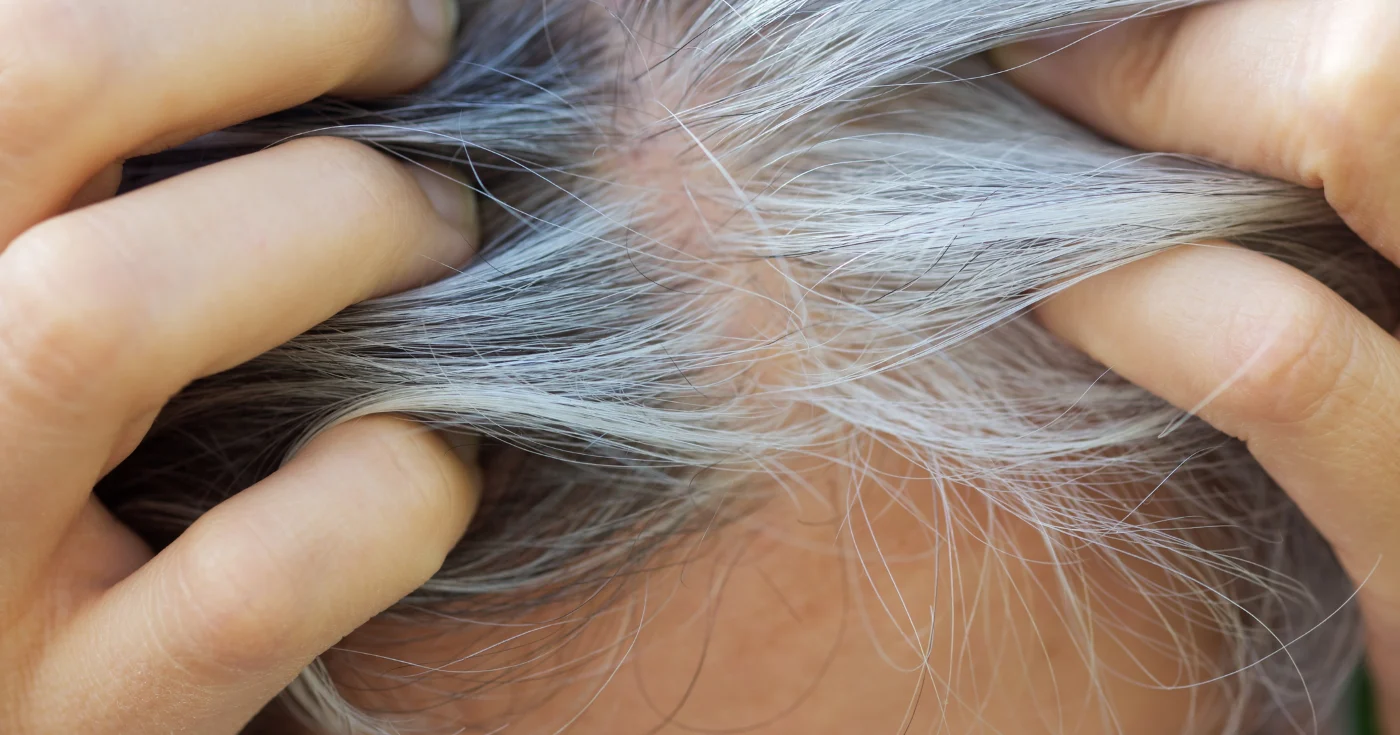
Seeing your first silver threads often means thinking of stress or the years that pass. We less imagine that these gray hairs can reveal how our skin protects itself. However, a Japanese study has shaken up this idea.
Researchers from the University of Tokyo have shown, on mice, that a certain type of graying reflects the activation of a defense mechanism against skin cancers. It’s all about the stem cells that make the pigment in our hair.
Gray hair, melanin and early links to cancer
These stem cells, nestled deep within the hair follicle, normally renew melanin-producing melanocytes. When this reservoir becomes depleted with age or certain stress, canities appear and the hair gradually becomes white or gray.
The team observed that, when the DNA of these cells is damaged, some engage in a so-called “senodifference” pathway: they differentiate once and for all, then disappear. Consequence: the hair grows gray and cells deemed too risky leave the game. Justin Stebbing, professor of biomedical sciences, explains this in an article relayed by BBC Africa.
When gray hair becomes a defense mechanism
Researchers have also seen the opposite. Exposed to powerful carcinogens or certain UV rays, these same cells can ignore the warning signal, continue to divide despite DNA breaks and contribute to a tumor.
This work remains for the moment carried out in mice. In humans, we especially know that hair reacts strongly to internal attacks, sometimes with sudden loss in the event of toxins or heavy medical treatments.
Gray hair, skin health and what it changes
To say that gray hair is good news for your health is therefore to say that a monitoring system eliminates certain weakened pigment cells behind the scenes. This means neither absolute protection against cancer nor better overall health in people who go gray early.
On a daily basis, the reflexes remain the same: protecting your skin from the sun, monitoring your moles and consulting in the event of a lesion that develops remains the basis. Dying your hair does not interfere with this deep mechanism, because the coloring acts on the surface.
Gray hair and cancer: link?
They reflect a mechanism that eliminates certain cells at risk, without replacing medical prevention.
Hair coloring and risk?
The dye works on the hair shaft, not the pigment stem cells.
Early graying: should you be worried?
Often familial, it merits medical advice if there is concern about an underlying cause.
