
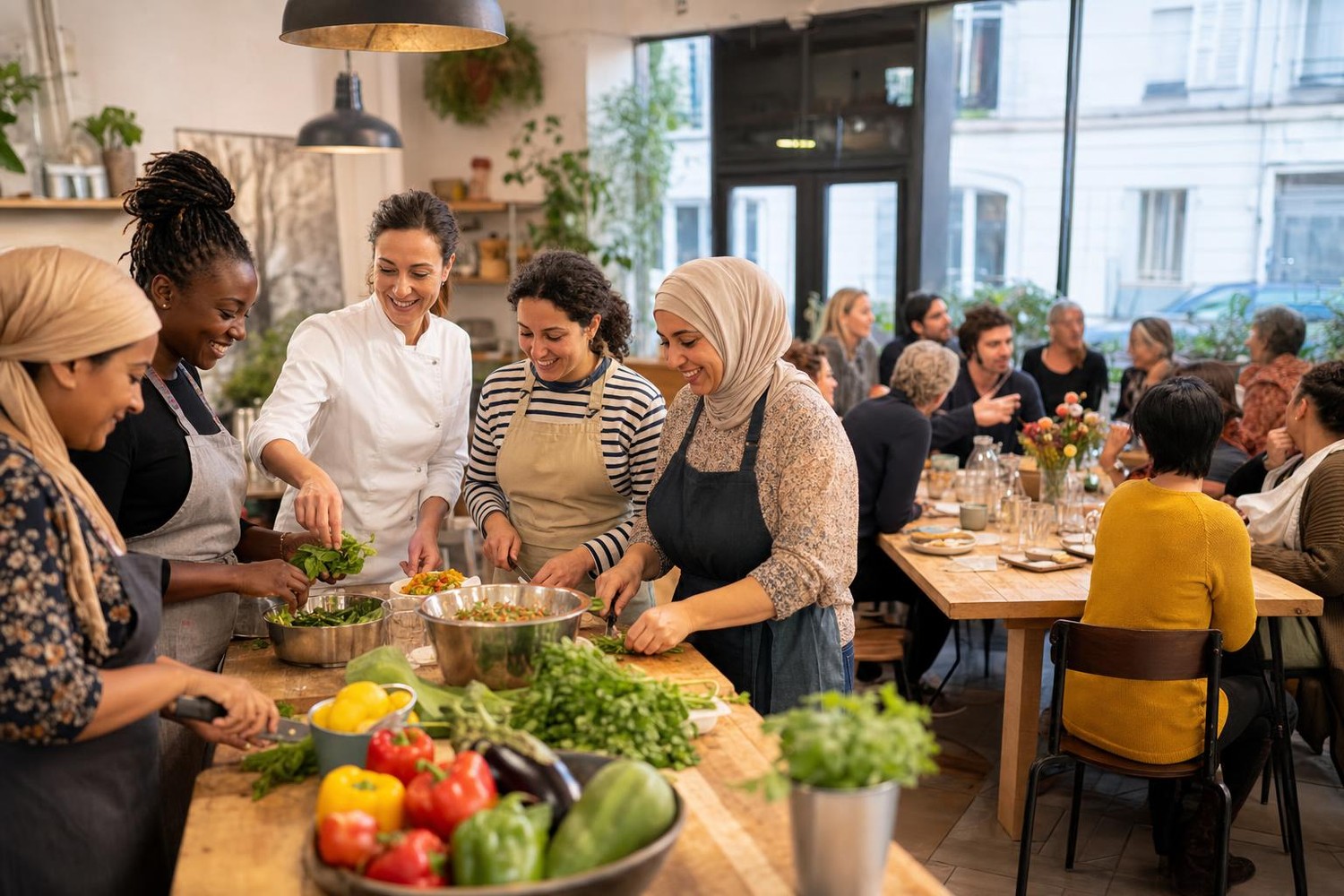
At the foot of the buildings in the priority district of Griffeuille, in Arles, a small door only opens one day a week. Every Monday for three years, this room, which has become a solidarity kitchen, is filled with laughter, the smell of spices and thoughtful gestures. The residents arrive, apron under their arm, to prepare a meal open to everyone, at a price adjusted according to the customers’ income. Here, during a service, the boundaries of the neighborhood seem to move.
Behind the stoves, a real female culinary brigade is busy. Some come every week, others only from time to time, but all find their place. Because ultimately, it’s the idea that holds this place together: when we peel, cut, taste together, social statuses gradually fade away.
A solidarity kitchen in the heart of the Griffeuille district
Among the regulars, one sums up the atmosphere in a few words: , she confides to France 3. The neighbors meet up, help each other, tell each other about their week between two pots, in this local association managed by Petit à Petit.
Other women push the door without really knowing how to cook. One of them says, laughing: , testifies this volunteer. Every Monday, a chef from an Arlesian restaurant comes to guide the brigade; the chef of the Oleti restaurant, Coline Leenhardt, explains: .
A female culinary brigade that builds connections and diversity
Around the work surfaces, local residents, passing volunteers and catering professionals meet side by side. They all prepare a meal together, the price of which varies depending on resources, so that everyone can sit at the table. For Anne Drilleau, director of the Petit à Petit association which supervises the system, the kitchen is central: .
This weekly meeting creates a real social mix: residents of Griffeuille, Arlesians from other neighborhoods who come for lunch, guest chefs… Everyone shares the same table. And then, this collective framework provides a reassuring framework for daring to speak, testing a recipe, or simply leaving the house for a few hours.
From solidarity cooking to the professional integration of women
Behind the pots, the Petit à Petit association also carries out professional integration work through cooking. In three years, nearly a hundred women have been supported through this program. Among them, Jamila Lahboub, a former stay-at-home mother, ended up launching her own business. She says: .
On another level, the principle of kitchen brigades also exists via the Culinary Brigades program: ten workshops led by a professional chef to learn healthy eating, technical basics and hygiene rules, with three challenges including an anti-waste challenge where young people must use all of an ingredient. The organization La Tablée des chefs also organizes Hotel Schools Week, during which students from hotel high schools produce meals for food aid associations from agricultural surpluses. Here again, cooking becomes a concrete lever of solidarity.
How does the solidarity kitchen in the Griffeuille district of Arles work?
For three years, the kitchen has opened every Monday at the foot of the buildings. Volunteers prepare a solidarity meal with a guest chef, sold at prices adapted to customers’ income.
Who leads Griffeuille’s female culinary brigade?
The system is supervised by the Petit à Petit association. She runs the solidarity kitchen, coordinates the volunteers and welcomes a chef from Arles every week.
How does this cuisine create social diversity?
Neighborhood residents, external volunteers, Arles restaurateurs and customers with varying incomes come together around the same meal, prepared and shared together.
How does solidarity cooking contribute to the integration of women?
The association uses cooking as a means of integration: nearly a hundred women have been supported, some going so far as to create their own business like Jamila Lahboub.
What are Culinary Brigades and Hotel Schools Week?
The Culinary Brigades are a program of ten culinary training workshops with challenges, including an anti-waste challenge. Hotel Schools Week mobilizes students to cook meals for food aid.
