
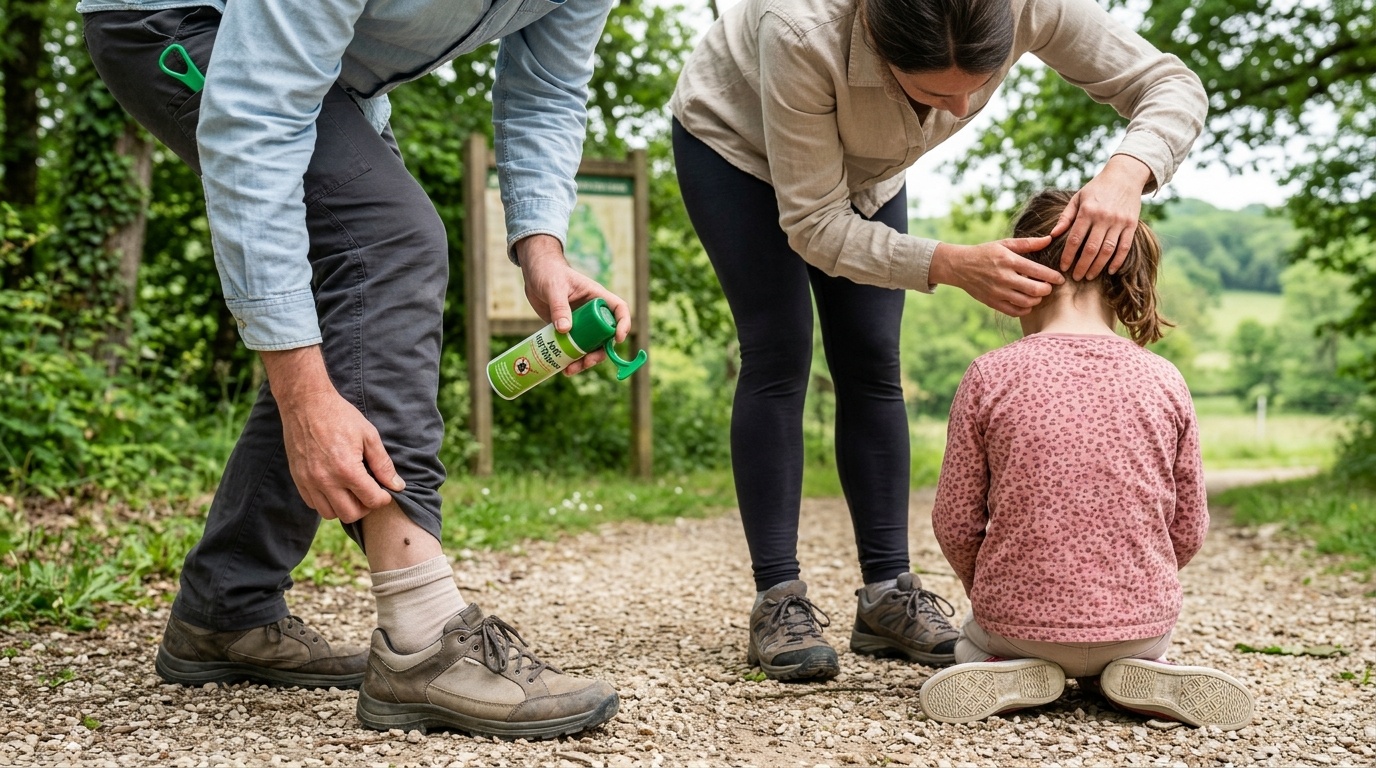
With the return of sunny days, ticks wake up in forests, parks and gardens. This blood-sucking mite can transmit diseases like Lyme disease. How to enjoy nature without worrying about each tall grass?
Ticks are active especially from spring to fall, with vigilance starting in April. Mild winters prolong this season and favor their presence in private gardens. In France, 2 to 30% of ticks are infected by the Borrelia bacteria depending on the region.
Ticks and Lyme disease: understanding the risk to better protect yourself
An adult tick measures barely a few millimeters and lives in moist vegetated areas. It waits at the end of a grass or bush for a human or animal to brush past it, then clings and searches for a patch of bare skin.
When it bites, the tick attaches itself mainly to warm, moist areas of the body: behind the knees, scalp, armpits, navel, behind the ears. It can transmit Lyme disease and other infections, making good protection against ticks essential.
Before and during the outing: good anti-tick reflexes
The first barrier remains clothing. Long, tight-fitting, light-colored clothing to spot a tick, closed shoes and pants tucked into socks limit contact with the skin. A hat protects the scalp, and it is better to stay on the trails than through tall grass.
Repellents complete this protection, provided you choose a product approved against ticks and adapted to your age. They are based on active ingredients such as DEET, icaridin or citriodiol, from lemon eucalyptus essential oil. An anti-tick spray based on lemon eucalyptus essential oil concentrated at 30% showed 6.5 hours of protection, with good tolerance from 6 months. Uncovered areas should be sprayed evenly for 11 seconds, without more than two applications per day.
After exposure and Lyme vaccine: complete your protection
When returning from a walk in a risk area, a quick shower and a careful examination of the body are essential. We inspect the backs of the knees, the armpits, the scalp, the navel and behind the ears, in both adults and children. Dogs and cats should also be checked, as they can bring ticks into the house.
The VLA15 vaccine developed by Pfizer and Valneva is being tested in phase 3 on nearly 10,000 volunteers. In a vaccinated person, the tick ingests antibodies that block the Borrelia burgdorferi bacteria in their stomach. According to Annaliesa Anderson, head of vaccines at Pfizer, cited by Slate. This vaccine targets six strains of the bacteria and could be submitted to the authorities, in addition to prevention measures.
Ticks in the city, possible?
Yes, urban parks and gardens.
Repellent recommended for children?
Approved product, suitable for age.
Consult after tick bite?
Yes if signs occur.
