
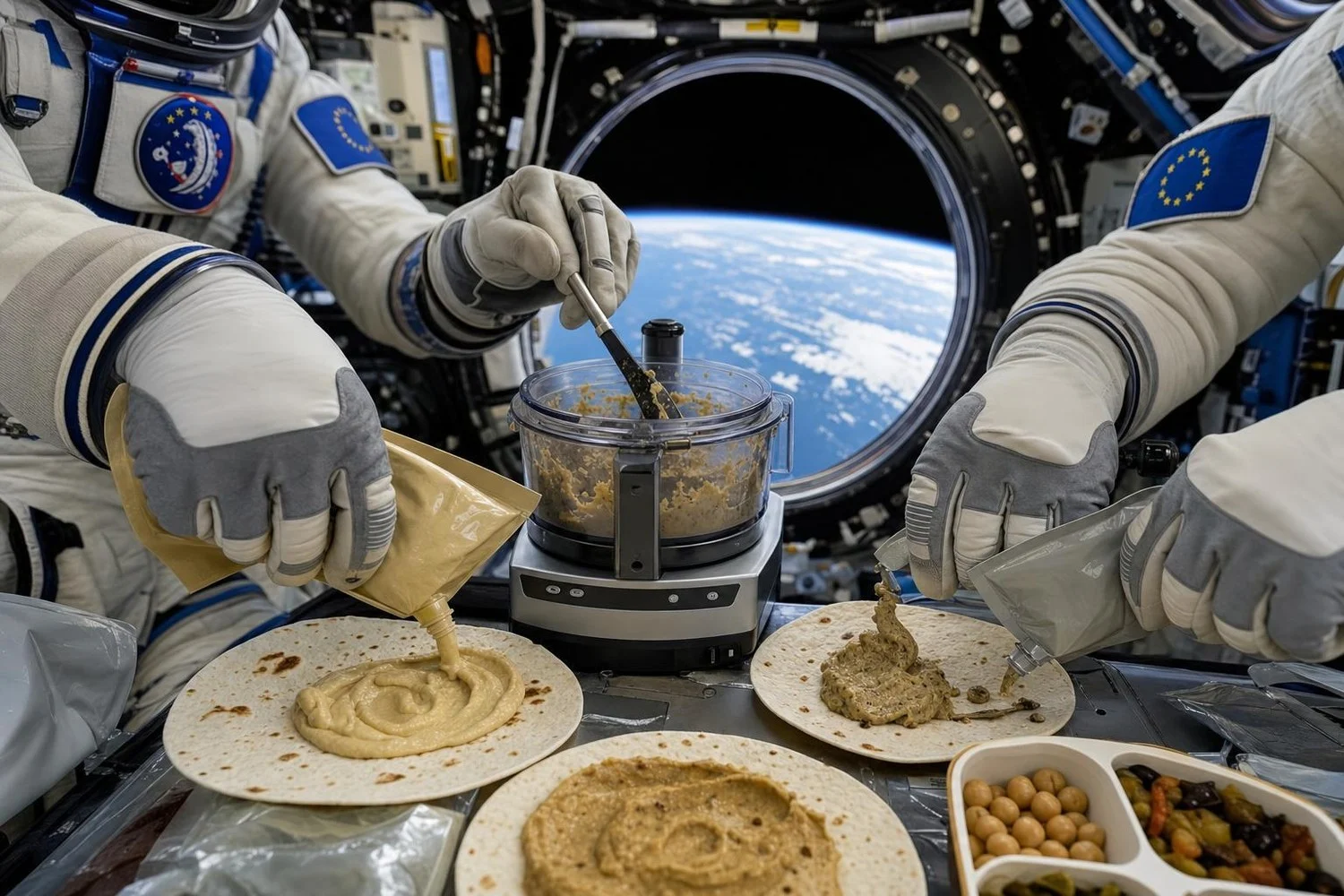
A Corrèze aperitif 400 km from Earth: that’s the challenge of Space hummus. On the International Space Station, the snacking ritual no longer has much to do with a café terrace, but the idea remains the same: sharing a moment together.
This Friday, June 12, French astronaut Sophie Adenot must prepare the very first “homemade” savory dish on the ISS, a Mediterranean hummus / eggplant caviar duo imagined in Corrèze by the Andros group. An orbital aperitif signed Altillac, somewhere between Brive and… space.
Space hummus: a French aperitif aboard the ISS
At Andros, the project immediately got the teams on board. , told Pascal Schneider, director of innovation, to France 3. For this experience integrated into the CNES food processor program, he summarizes the mission: .
In the ISS, this food processor like no other allows astronauts to cook as little as possible. , he explains. The device itself remains very familiar: .
How Corrèze cooked the first Space hummus
What is really changing is the role of meals in life on board. Pascal Schneider recalls the daily life of the crews: . Hence the idea of a real aperitif, even without gravity.
In the Altillac R&D lab, the teams worked on a base of hummus and eggplant caviar. , he describes. And to lift it all up in weightlessness:
Pasteurization, lemon juice and astronaut morale
To board the ISS, this “Space hummus” had to pass a battery of drastic tests. Andros has focused on pasteurization, at 85°C, in order to best preserve the flavors. , underlines the director of innovation. And in terms of health, the requirements are very high: .
From now on, the gourds of eggplant caviar, peanut hummus and green sauce are in orbit, ready for this first aperitif in the space imagined from the Dordogne valley. The teams remaining in Corrèze are watching for the images:
What is Space hummus prepared by Sophie Adenot?
It is a spread made from eggplant caviar, chickpea hummus and peanut paste, and a green herb sauce.
Why use peanut paste in Space hummus?
Peanuts are rich in protein, fatty acids, fiber and vitamins, and could be grown on board for long-duration space missions.
What is the role of the food processor in this experience?
The food processor is a closed bowl where the astronauts screw in the preparation bottles; an on-board drill drives the system to mix everything in zero gravity.
How does this Space hummus change the daily lives of astronauts?
It introduces a real moment of aperitif and sharing, where crews usually eat freeze-dried or sterilized products consumed quickly.
