
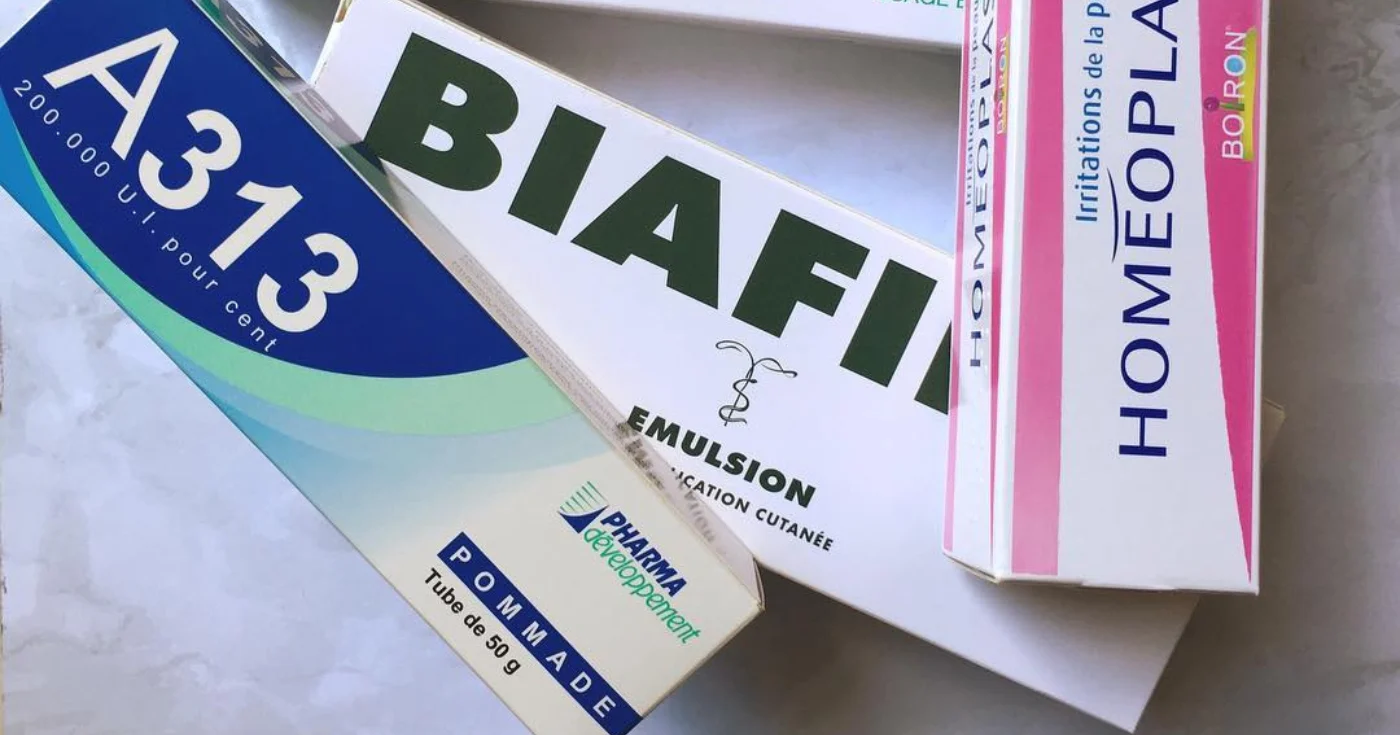
In almost every French bathroom, a green and white tube sits next to the first aid kit: Biafine. Both a holiday madeleine for reddened skin and the object of desire for American beauty addicts, this pharmacy emulsion embodies the idea of the inexpensive miracle product. Except that behind this flattering reputation hides a more nuanced reality, which doctors and health authorities look closely at.
The success story goes far beyond our borders. In 2021, the French cosmetics industry exported more than $16.2 billion worth of products, and the hashtag #frenchpharmacyskincare generated more than 75 million views on TikTok. In this flood of tubes and bottles, Biafine has become a symbol of “French-style” care adored by Americans, while remaining, for us, the almost automatic reflex after a sunburn.
Biafine, cult product of French pharmacies and favorite of Americans
In a ranking of pharmacy products popular across the Atlantic, writes Vogue France. With its recognizable smell and its retro packaging, the cream born in the early 1970s is described as a transgenerational beauty reflex, which the United States “envy us” and rush to buy online or during a visit to France.
A journalist from , a fan of the French pharmacy, says that after five tubes, Biafine has become an essential in her bathroom. Dermatologist Alexis Granite describes it as follows: , before presenting it as a good remedy for irritations, damaged skin after laser, burns and scratches, a sort of multi-purpose cream to keep in the medicine cabinet.
Biafine, a trolamine medicine for burns and sunburns
Behind this image, however, hides a very precise status: Biafine is a medicine, based on trolamine 0.67%, associated with fatty substances such as paraffin, squalane or avocado oil, as well as preservatives and a perfume. The official instructions reserve it for post-radiotherapy erythema, first and second degree burns and uninfected superficial skin wounds, while BIAFINEACT is intended for small superficial burns, including localized sunburn. It is neither a sunscreen nor a daily moisturizer.
The High Authority of Health also concluded in 2007 to justify reimbursement by Health Insurance, pointing to old and methodologically limited studies. In the field, doctors like Gérald Kierzek still consider trolamine to be a great classic that is effective for light to moderate sunburns: the formula hydrates, soothes the feeling of tightness and supports the repair of the epidermis, provided that it remains on superficial burns.
Biafine in practice: cross-opinions, good uses and limits
Experts converge on several practical points. In case of moderate redness without blisters or fever, it is advisable to refresh the area with water, dry gently then apply Biafine in a thin layer, two to four times a day, avoiding re-exposure to the sun. The cream should not be placed on a wound that is bleeding or appears infected, nor on large areas in infants. The presence of perfume, propylene glycol and parabens also requires you to remain vigilant in the event of allergic conditions or very reactive skin.
Other dermatologists, like Claudine Blanchet Bardon interviewed by TF1, are surprised by the central place given to Biafine in burns, even though there are creams specifically formulated for these situations. The authorities also point out that sunburn with blisters, intense pain or general signs requires urgent medical consultation. Between the enthusiasm of social networks, French family tradition and imperfect scientific data, Biafine’s reputation therefore oscillates between a useful SOS product and a slightly too idealized tube, which is best used within the strict framework of its instructions.
Is Biafine effective on sunburn?
Yes, Biafine is indicated for superficial burns, including mild to moderate sunburn. It soothes, hydrates and helps the skin repair itself, but does not replace a consultation in case of blisters, intense pain or fever.
Can you put Biafine on your face every day?
No, the instructions specify that Biafine should not be used as a treatment cream on healthy skin. Its occlusive, perfumed formula containing preservatives can pose a problem in daily use, especially on sensitive skin or skin prone to imperfections.
What is the difference between Biafine and BIAFINEACT?
Biafine is historically indicated for post-radiotherapy erythema, first and second degree burns and superficial wounds. BIAFINEACT is intended for small superficial burns, in particular localized sunburns.
