
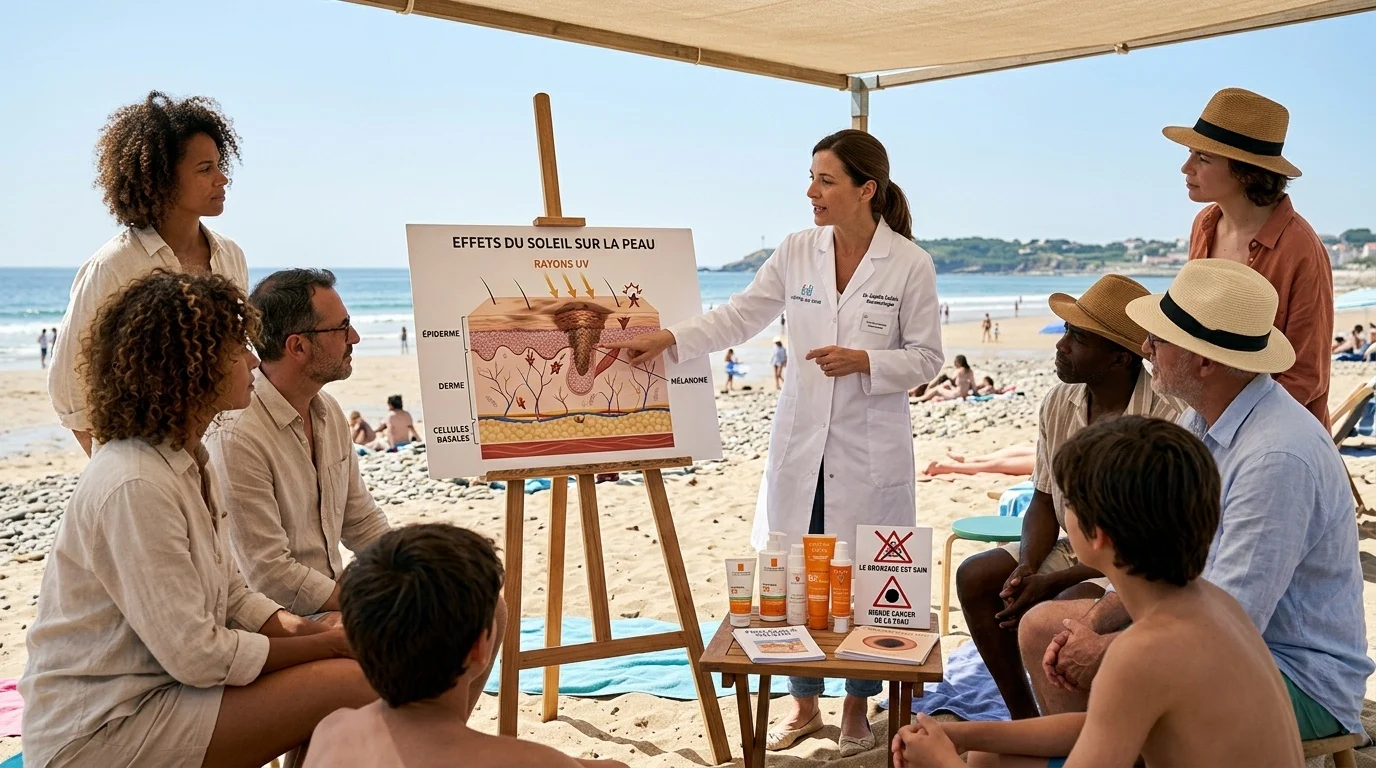
On Instagram as at the beach, a tan remains a beauty ideal. However, in France, between 140,000 and 245,000 skin cancers are diagnosed each year, around 85% of which are UV-related. Behind the golden complexion hide very stubborn beliefs.
Dermatologists describe the same scenario: a false sense of security pushes one to expose oneself for longer, without proper protection. And then everyone has their own little sunshine tip, often inherited from a friend or a social network. Some of these phrases are downright dangerous.
Why preconceived ideas about tanning remain so dangerous
Tanning is not a shield, it is a defense reaction. Under the effect of UVB, the skin burns, UVA penetrates deeper and promotes aging and cancer. Melanin rises to limit the damage, but the DNA already affected remains altered.
The World Health Organization classifies ultraviolet rays as a definite carcinogen. In France, the National Cancer Institute attributes around 380 new melanomas per year to tanning beds. The problem comes from the dose, often three to five times more intense than the sun, and the repetition of sessions.
Five misconceptions about tanning put to the test
In consultations, five preconceived ideas about tanning come up almost word for word.
- “Already tanned skin protects me”: a natural tan is equivalent to an SPF 2 or 3, much too low.
- “Getting sunburned at the start prepares you”: a sunburn is a burn with irreversible damage to the DNA.
- “UV cabins are safer and provide vitamin D”: a session before the age of 35 increases the risk of melanoma by 59%.
- “I am dark or black, I risk nothing”: dark skin burns less quickly but can also develop skin cancer.
- “With an SPF 50 cream, I can stay on for hours”: you still tan, and the protection drops if you use too little product.
These sentences have one thing in common: they lengthen the exposure time. We think we are covered because we tanned, paid for a cabin or chose a high index. UV rays continue to attack cells, even when the skin no longer turns red.
Tanning without putting yourself in danger, the specialists’ plan
To limit the damage, specialists recommend a simple trio: sunscreen, clothing, shade. SPF 30 or 50 protection should be applied in generous quantities and renewed regularly. And since we use on average four times less product than in the laboratory, it is better to aim high.
Exposure times also matter, with increased vigilance when the sun is at its strongest. Hat, glasses, t-shirt on the beach become allies, even for dark skin. And at the slightest mole that changes, an appointment with the dermatologist is necessary.
Are UV cabins safe?
No, they increase the risk of melanoma.
Should tanned skin be protected?
Yes, her tan only equates to low SPF.
Does sunscreen block vitamin D?
No, moderate exposure is enough for vitamin D.
