
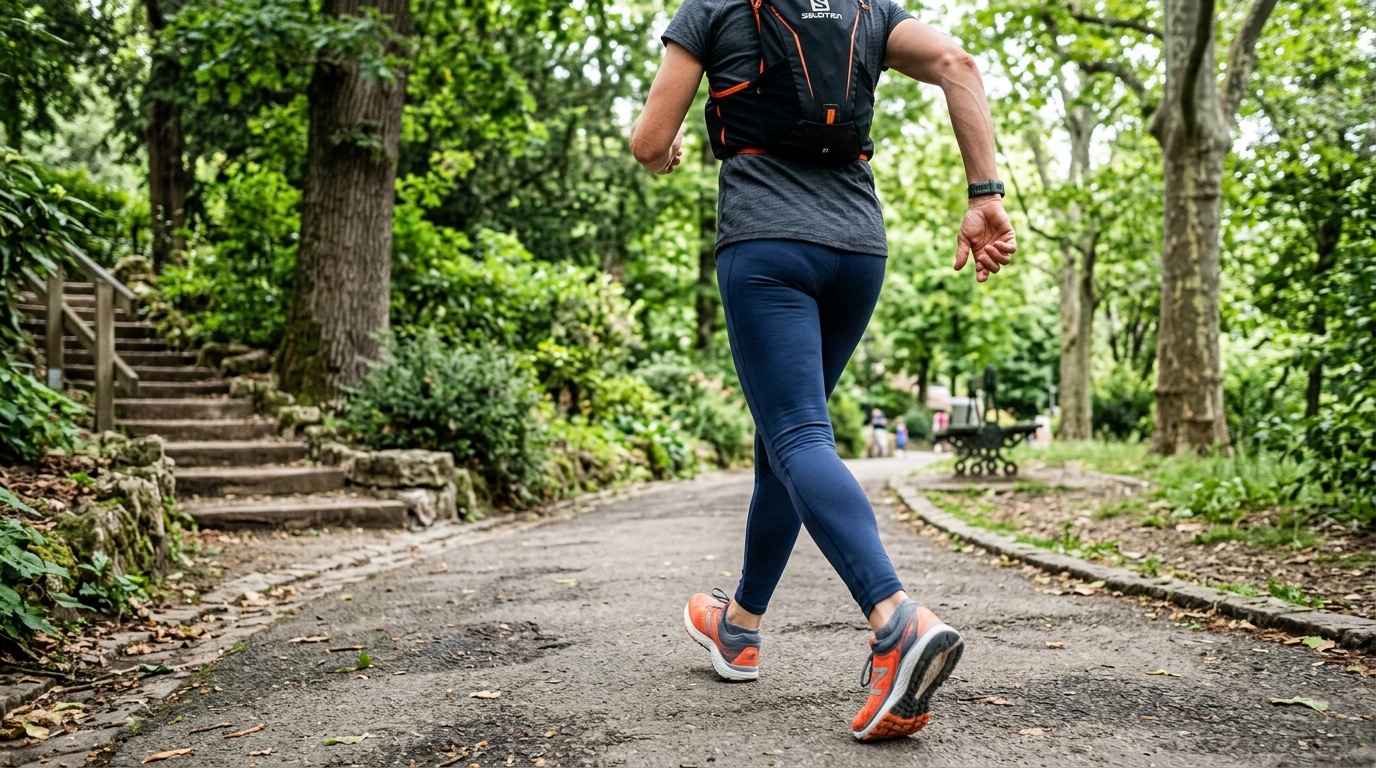
What if your evening walk could rival a gym session, without the treadmill or dumbbells? Walking remains the most accessible activity to get back in motion, get your heart working and burn calories, while preserving your joints. By simply adjusting your pace, your backpack or the terrain, a leisurely stroll quickly transforms into a sporty walk. It remains to be seen how to make it really more energy-intensive.
Because ultimately, the benefits of walking do not only concern the figure: it supports the cardio-respiratory system, facilitates digestion, strengthens the muscles and helps stabilize weight. A study published in the , carried out on more than 13,500 women aged around 71.8 years followed for 11 years, showed that walking at least 4,000 steps per day 1 to 2 days per week was associated with a 26% reduction in mortality and a 27% reduction in cardiovascular disease.
Brisk walking: play on your pace to burn more calories
The authors of this study recall that , and that , they write in the . In other words, increasing the energy expenditure of your walks a little already counts for more than the number of strictly “perfect” days.
To actually transform your ride, pace remains the most effective variable. At 5 km/h, a 70 kg person expends approximately 200 to 250 kcal per hour; at 6 km/h, more like 300 to 350 kcal. A brisk walk of 8 km/h can approach 610 kcal per hour, while jogging at 10 km/h is around 690 kcal. Concretely, aiming for a pace of around 5 to 6 km/h, where you are a little out of breath but still able to speak, is already enough to transform a stroll into a real brisk walk.
Weighted backpack: the simple technique to increase your energy expenditure
The weighted backpack is a real game changer. In a video entitled, sports coach Lucile Woodward explains: , before adding: , she indicated in a video relayed by Here. To get started, she advises:
In practice, start lighter than this 10% rule. Fans of rucking, this walking with a weighted bag, recommend around 5% of body weight to start, then 10 to 15% when you feel comfortable. Adding 5 kg to your back already increases calorie expenditure by around 10 to 15%, especially if you combine this with hilly terrain, while remaining attentive to your back and knees.
Terrain, poles and mini-exercises: boost without losing the pleasure of walking
Playing with relief is another simple way to increase your energy expenditure. At 5 km/h on flat ground, we are around 250 kcal per hour; with a slope of 5%, the expenditure rises to around 400 kcal. Sliding a few hills or stairs in a 30 to 40 minute walk therefore makes a real difference, as does choosing irregular forest paths or sand, which further increase the effort.
You can also use more of your upper body. Swinging your arms freely, or trying Nordic walking with poles, increases the expense by 20 to 40% compared to classic walking. And then, every 5 to 10 minutes, add 30 seconds of heels-buttocks, a few knee raises or a small series of squats during a stop: these mini-peaks of intensity remain compatible with a relaxing walk and increase your total steps, to reach these 30 daily minutes of so-called NEAT activity.
How long to walk to burn more calories?
Aim for at least 30 minutes of brisk walking, ideally 40 to 60 minutes, 3 times a week, in addition to your daily commute.
What speed should you adopt for truly efficient walking?
A pace of 5 to 6 km/h, where you are slightly out of breath but still able to speak, already allows you to burn significantly more calories.
How much should a weighted backpack weigh when walking?
Start around 5% of your body weight, then gradually increase to 10% if your back and joints tolerate it well.
Does Nordic walking really make you use more energy?
Yes, the use of poles increases the engagement of the upper body and can increase calorie expenditure by 20 to 40% compared to traditional walking.
