
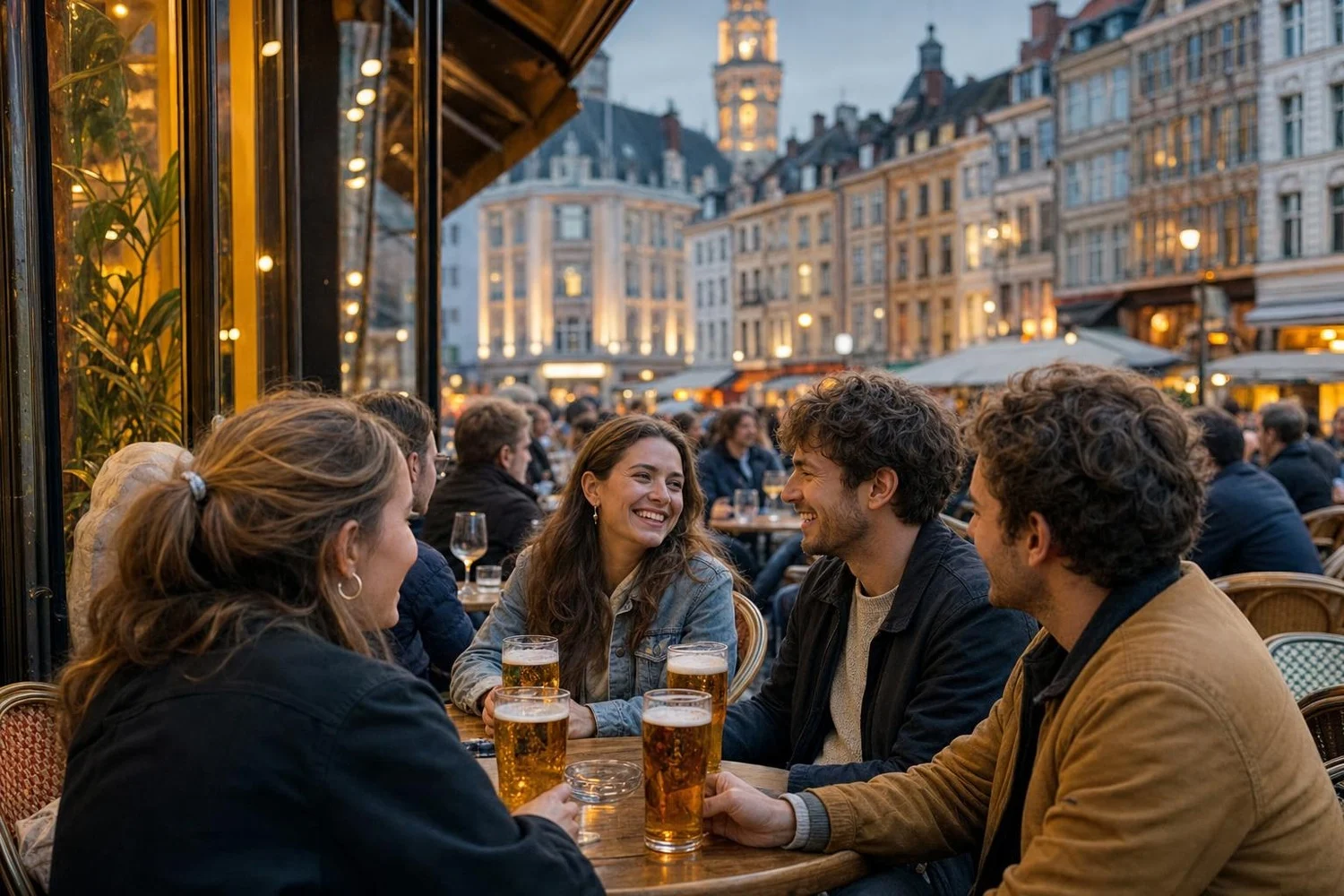
It’s a small earthquake for a country that readily defines itself as a land of great wines: in cafes, on terraces and even at the table, the glass that is required is no longer always the one you think. In Lille as elsewhere, the taps are running at full speed, while the wine lists are slowly shortening. In Hauts-de-France, where brewing culture is almost a reflex, this shift seems natural, but it tells much more than a simple change in drink. Because behind this discreet movement lies a historic shift.
In 2025, beer consumption will, for the first time, exceed that of wine in France. According to the International Organization of Vine and Wine (OIV), the French drank 22 million hectoliters of wine, a drop of 3%, when the Brewers of France estimate beer consumption at 22.1 million hectoliters. A small but symbolic change, which finds a very particular echo in the North, where the pint has long taken pride of place.
In 2025, beer will overtake wine: the figures that will shake up France
This crossing of curves is mainly due to the decline in wine. The OIV speaks of a market which is contracting, while beer volumes remain solid. The 100,000 hectoliters difference between the two drinks has little economic impact, but a lot in people’s minds, as wine remains a pillar of French culture. In the figures as in the glasses, the idea of ”wine country” is gradually becoming more nuanced.
In Hauts-de-France, this turning point comes as no surprise. Proximity to Belgium, numerous local breweries, boom in craft beers: the offering has greatly diversified, from IPAs to triples and fruity beers. This wealth makes beer omnipresent, from aperitif to meal, and positions the region as a laboratory of this new hierarchy of drinks.
In the North, an ideal terrain for this new beer culture
In Lille, Ziad Ghosn, owner of the Ghosn bar, describes a clientele, he tells France 3 Hauts-de-France, but sees young people frankly switching to foam. For him, the key remains the wallet: , he explains. In a context of constrained purchasing power, beer appears to be a more accessible pleasure.
At the Comptoir des Copains, where around ten beers are offered on tap, Rémi, bar employee, points out another difference, this time customary. According to him, . This modular side, easy to share, sticks to shorter evenings, impromptu meals, and afterwork drinks that punctuate urban life.
Breweries, alcohol-free and the end of “everyday wine”: what the pros of the North say
In breweries, this shift does not come from the sky. Louis Pourbaix, marketing director of Brasserie Goudale, speaks, driven by a price-conscious consumer. He recalls that. Certain bottles are now processed like grand crus, with careful attention to aromas, he explains.
At the Vaucelles Brewery, Benjamin Dalmas sees it as a sign of modernization. Beer became richer in taste and innovation, while wine remained more frozen. Result, he says. He also emphasizes that beer is, with a price and an alcohol level which work in its favor, he specifies.
Distributors are observing the same dynamic. Laurent Pecqueur, CEO of Sodiboissons, notes a slight drop in sales in restaurants, but creativity intact: . He insists on the expansion of non-alcoholic beer:, he anticipates, driven by younger generations and phenomena like Dry January.
Faced with this rise, the wine repositions itself. The wine merchant Aurélien Chutaux sees customers who buy less but better: , he assures, before noting that . For him, three factors combine:
- he recalls;
- the palate evolves and;
- Lifestyles have changed since Covid, which penalizes wine, drinks, habits.
Why has beer overtaken wine in 2025 in France?
Figures from the OIV and Brasseurs de France show a 3% decline in wine and beer that is stable but better established in everyday life. The more accessible price, more flexible uses (aperitif or meal) and the rise of alcohol-free beer are driving the trend.
What role does the North play in this beer vs. wine evolution?
In Hauts-de-France, the proximity to Belgium, the density of local breweries and the offer of craft beers have prepared the ground. In Lille, bars, breweries and wine merchants have noticed that beer now largely dominates orders.
Does beer really replace wine at the table?
According to Louis Pourbaix, . Without making wine disappear, beer is gaining ground at the table, driven by more gastronomic recipes and carefully crafted pairings.
Do non-alcoholic beers influence this shift?
For Laurent Pecqueur, the rise of alcohol-free products is a real trend, with better-crafted and more varied products. It responds to consumers, especially young people, who wish to limit alcohol without giving up the conviviality of beer.
Has everyday wine disappeared?
Wine merchant Aurélien Chutaux summarizes this change by stating that. Wine remains central to French culture, but it now focuses on pleasure, more occasional and higher quality purchases.
