
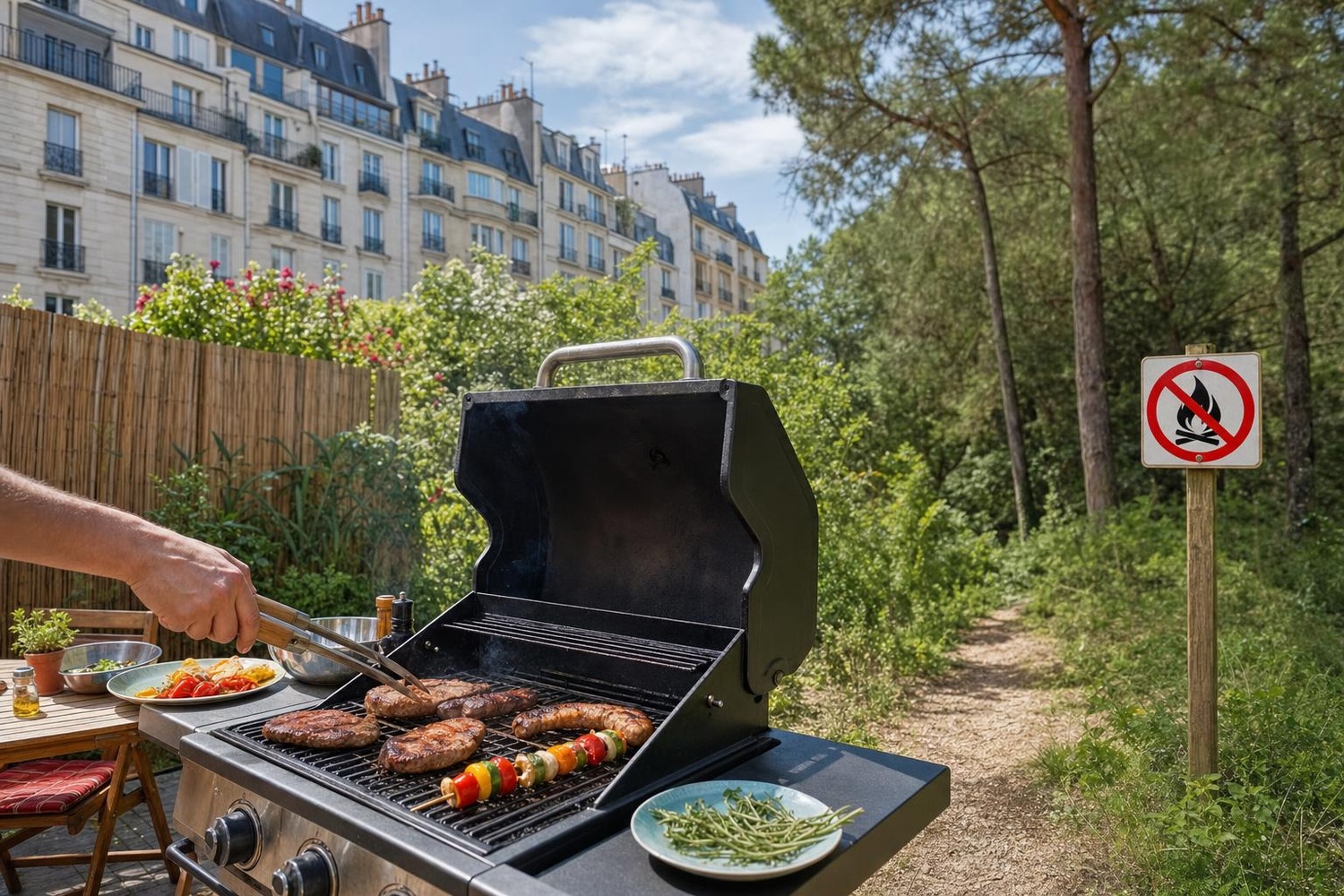
The sunny days are returning, the temperatures are rising, and the smell of grilled meats is already starting to float in the air. The barbecue season seems to have officially started, in the city and in the countryside. But between shared pleasure and the risk of fire, the line can be thin: not everything lights up, not everywhere, not just anyhow.
On the one hand, the law increasingly regulates the use of fire, especially with the increase in episodes of drought. On the other hand, everyone wants to enjoy their garden, their balcony or a corner of greenery. Where can you actually light a fire for your barbecue, and under what exact conditions?
Barbecue in your garden or on your balcony: what the law authorizes
At home, in a house with a garden, barbecues are generally permitted. The Service-Public site recalls that the law only prohibits “abnormal neighborhood disturbances”. And he specifies: “This means that the inconvenience caused (for example smoke, smell of grilled meat or fish) is episodic and involuntary (for example linked to weather conditions such as wind)”. In short, grills yes, but no smoking harassment.
If the use of the barbecue serves to harm, the sanction falls: “If the use of the barbecue is done with the aim of harming one’s neighbor (for example by deliberately producing smoke while the neighbor is at the table) or causes damage to neighboring property (for example a blackening of the facade caused by smoke or by the projection of ashes), it can be sanctioned.” In buildings, the basic rule is similar, but the co-ownership regulations often limit or even prohibit barbecues on balconies or terraces: check before lighting the first ember.
200 meter rule, prefectural decrees and fire safety
As soon as we approach a wooded area, the regulations on the use of fire clearly change their tone. The forest fire prevention site recalls that the rule applies “for barbecues less than 200 m from a wooded area (i.e. woods, forests, plantations, as well as heaths, scrub and scrubland)”. In these areas, wood or charcoal barbecues are particularly monitored.
The recommendation is clear: “Gas barbecues should be preferred over wood or charcoal barbecues, as they do not produce sparks.” Another essential reflex: consult the prefectural decree of your department which can, in periods of drought or “very severe” risk of forest fires, prohibit all fires, including on private land. Municipal bylaws can also target certain neighborhoods, streets or parks to limit street barbecues or gatherings.
Street barbecues, public parks, forests and the great outdoors: the prohibitions you should know
In the city, in public spaces, freedom melts like embers in the rain. Many municipalities prohibit street barbecues in certain streets and gardens. A town hall explains that “such practices generate significant risks of fire and propagation and situations of gatherings of people in unsuitable places” and also points out the risks to public health linked to “the use of food products without any particular protection in spaces which are in no way designed for this purpose”. Result: only barbecues installed in dedicated areas (developed parks, lakes, picnic areas) remain authorized.
In nature and forests, the tone hardens further. The National Forestry Office recalls in its walker’s charter that “smoking, lighting a campfire or having a barbecue in the forest is punishable by a fine and/or imprisonment in the event of a fire”. The Forest Code goes in the same direction and “prohibits any person other than the owner of land, whether wooded or not, or other than the occupants of this land under the authority of their owner, to carry or light fire on this land and up to a distance of 200 meters from the woods and forests”. Nature reserves, sensitive natural areas or Natura 2000 sites add total bans on fires, camping and bivouacs.
Installing and using a barbecue safely: good reflexes
For a fixed, permanent barbecue in the garden, the recommendations are very concrete. Specialists point out that “like any source of flame, barbecues must be used with the greatest caution”. The basic rules: the barbecue must be attached to a wall of the house, have a cover, be installed in the center of a non-combustible area, with a chimney equipped with a grill to retain incandescent particles. Having a water supply nearby remains strongly recommended to control an outbreak of fire.
And then, a reminder that can save lives: never light a barbecue inside your home. Burning charcoal releases carbon monoxide, a toxic and odorless gas that can cause serious poisoning. For balconies or small terraces, gas or electric appliances, which generate fewer flames, remain the most suitable, while of course respecting the co-ownership regulations and safety instructions.
Where can you have a barbecue in France?
In principle, you can have a barbecue in your private garden, provided you do not create any abnormal disturbance in the neighborhood and respect fire rules, particularly within 200 m of a wooded area. On a balcony, everything depends on the co-ownership regulations or the lease which may prohibit it. In public spaces or nature, only equipped barbecue areas are authorized, fires in the forest or on unoccupied land being prohibited by the Forest Code.
Is barbecue allowed on a balcony?
The law does not systematically prohibit it, but in practice co-ownership regulations or rental leases often limit the use of barbecues on balconies or terraces, especially charcoal. It is therefore necessary to check these documents before any use and favor devices that generate little smoke, remaining in an occasional setting.
Can we have a campfire or barbecue in the forest?
No. The ONF charter indicates that smoking, lighting a campfire or having a barbecue in the forest is punishable by a fine and, in the event of a fire, by imprisonment. The Forest Code prohibits any person other than the owner or occupant from lighting fires on land, whether wooded or not, and up to 200 meters from woods and forests.
What does the 200 meter rule around forests mean?
The regulations on the use of fire apply to barbecues located less than 200 m from a wooded area, that is to say woods, forests, plantations, moors, scrub or scrubland. In these areas, the use of fire is strongly regulated, or even prohibited by prefectural decree during periods of risk of forest fires, even on private land.
What type of barbecue is safest near wooded areas?
Near sensitive areas, prevention organizations recommend favoring gas barbecues rather than those with wood or charcoal, because they do not produce sparks. Whatever the technology, the device must be installed in a non-combustible area, far from any dry vegetation, with a means of extinguishing within reach.
