
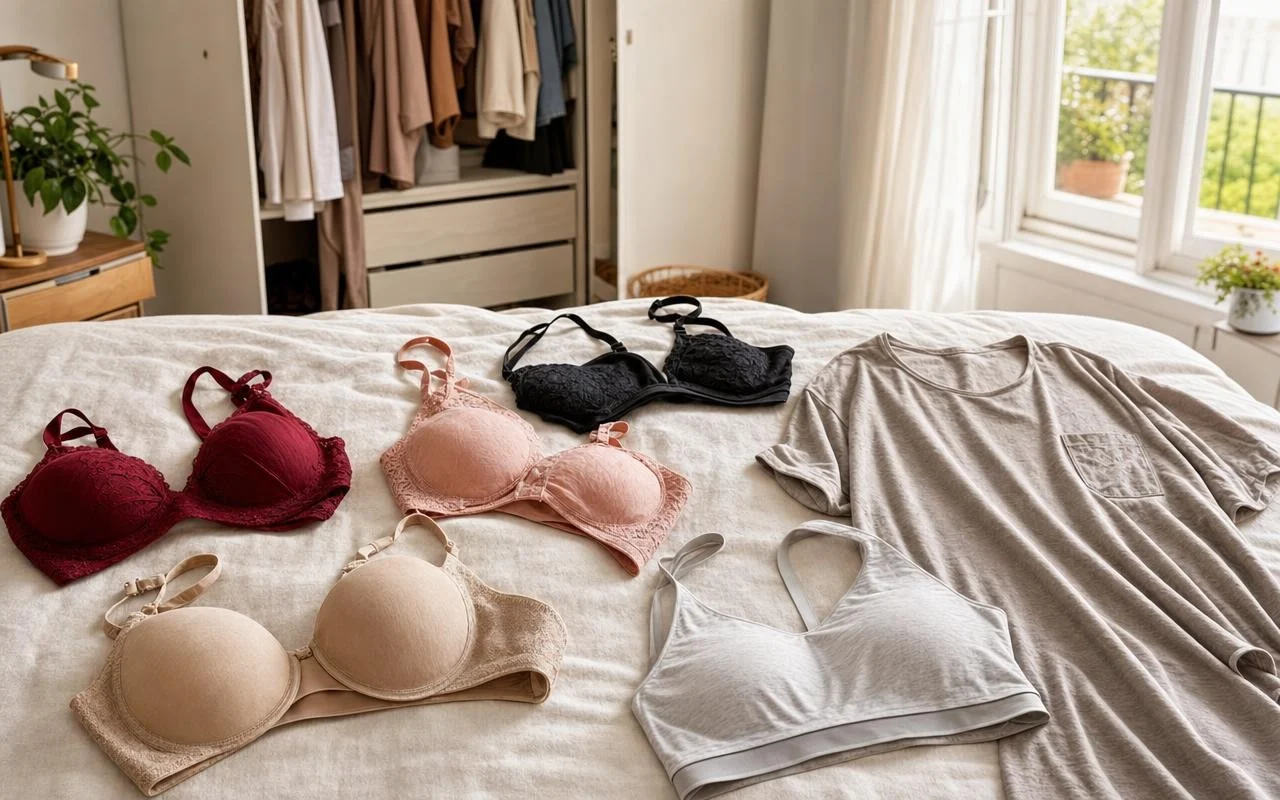
Since confinements and the rise of teleworking, many have given their lingerie drawer a rest. According to several IFOP surveys, the proportion of French women who never wear a bra has increased from around 3% to 7%, and rises to almost 20% among those under 25. The no bra movement is no longer anecdotal, it shakes up the codes of everyday life. The question then comes up regularly: should we give up the bra for good?
Behind this simple piece of lingerie are issues of health, comfort, money, but also emancipation and social outlook. Between sometimes contradictory scientific studies and very engaged discourses, the debate can quickly become messy. Because ultimately, is this underwear still essential to the chest or especially to our habits?
No bra and brassiere: how did we get here?
The bra has not always been seen as a straitjacket. In 1899, the French corset maker Herminie Cadolle presented her “corselet-gorge” at the Universal Exhibition in Paris, designed to free women from the corset which compresses the bust and hinders breathing. For a good part of the 20th century, this new form of support accompanied movements for female emancipation, while reshaping the silhouette.
Over the decades, the bra has become a symbol of aesthetic injunctions, between rigid underwires, push-ups and Wonderbra-type models. Conversely, the no bra movement asserts itself as a refusal of this hypersexualization of breasts and imposed clothing standards. IFOP studies show that this practice remains in the minority but is increasing especially among young women and in teleworking situations, where social pressure is less strong.
What does science say about bras, no bra and breast health?
A study carried out over fifteen years by sports doctor Jean-Denis Rouillon among 330 women has largely fueled the debate. According to the results reported, the absence of a bra promotes firming of the chest, an average rise of the nipples of around 7 mm per year and a reduction in stretch marks, especially in small breasts. He sums it up by explaining that without a bra, reports Vogue. The effects would be less favorable for heavy breasts, more subject to gravity.
On the medical side, specialists like Dr. Camille Ozil point out that support remains recommended for cups C, D and beyond in order to limit traction of the skin and ligaments in the long term. Large epidemiological studies have also found no demonstrated link between wearing a bra and risk of breast cancer. On the other hand, an ill-fitting model can cause pain, redness, maceration under the breast and back pain, while a well-adapted size or a soft bra can, on the contrary, provide relief.
Should you ditch the bra: how to find your own balance?
The available data above all outline a nuanced answer. For small to medium busts, life without a bra seems possible on a daily basis, outside of sport, provided you accept a different feeling and a sometimes insistent look in public spaces. For larger breasts, many women report better comfort with good support, even if it means reserving the no bra at home or for certain more structured outfits.
There is consensus on one point: there is no medical obligation to wear a bra all the time, nor is there an obligation to do without one. Testing the no bra for a few hours at home, observing the possible appearance of pain, tightness in the back or shoulders, alternating between soft bras, models without underwire and free days allows you to gradually build your own comfort zone, between health, intimacy and social context.
Does the no bra make your breasts sag?
The study by Jean-Denis Rouillon suggests that the absence of a bra would firm the chest in small breasts, while the effect could be less favorable for heavy breasts. Doctors therefore continue to recommend support for more generous cups.
Does stopping the bra increase the risk of breast cancer?
The large studies available do not show a link between duration of bra wearing, type of model or size and risk of breast cancer. Rumors of a protective or harmful effect of the bra are not confirmed.
Is the no bra suitable for large busts?
For cup sizes C, D and above, good support limits traction on the skin and ligaments and can reduce back pain. Many women opt for a compromise: comfortable bralettes, models without underwire and no partial bra at home.
How to test the no bra gently?
The simplest option is to start at home for a few hours a day, then gradually increase the duration. It is advisable to monitor the appearance of pain or tension in the neck or back and, in the event of persistent discomfort, to speak to a healthcare professional.
