
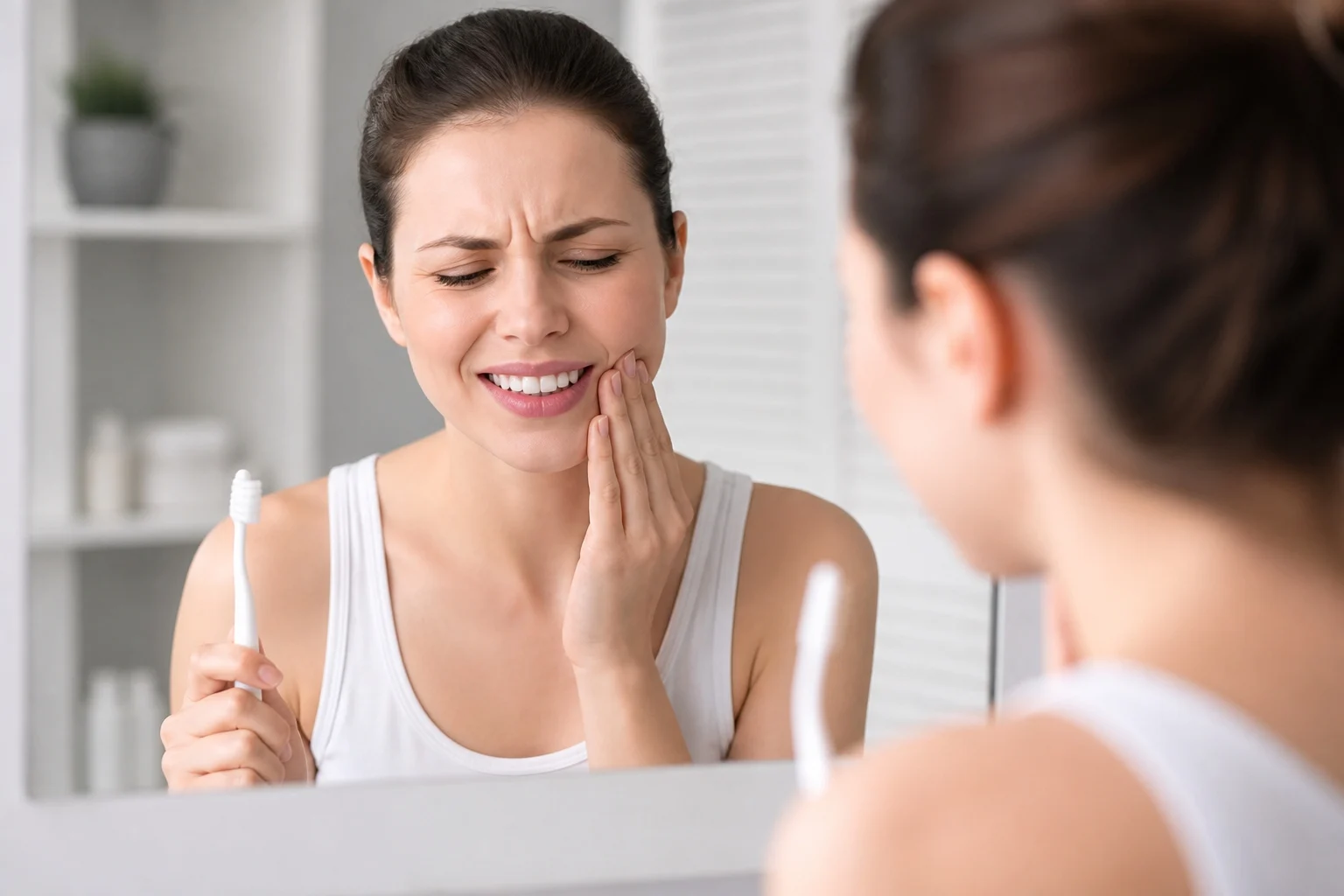
Pro-Argin technology: what you need to understand first
Tooth sensitivity often appears when dentin is no longer sufficiently protected. Beneath the enamel and cementum, the dentin contains tiny canals, called dentinal tubules, which communicate with the pulp. When these tubules are exposed, stimuli such as cold, heat, air or certain acidic foods can trigger brief, sharp pain. Pro-Argin technology targets precisely this mechanism by promoting the blocking of these tubules to reduce the transmission of stimuli.
This logic of action is especially of interest to adults who experience repeated discomfort on a daily basis, without knowing whether it is a simple hypersensitivity or a deeper dental problem. Tooth sensitivity should not be confused with continuous, throbbing or localized pain, which may suggest decay, cracking, pulpal inflammation or other damage requiring dental advice.
Why exposed dentin becomes painful
Dentin becomes sensitive when its natural protection diminishes. Wear of enamel, erosion linked to acidic drinks, excessive brushing, grinding of teeth, certain cosmetic treatments such as whitening or even gingival recession can expose the dentinal tubules. Once open, these channels allow variations in pressure and temperature to circulate towards the internal nerve endings of the tooth.
In practice, the pain linked to tooth sensitivity is often short, triggered by a precise contact and reversible when the stimulus disappears. Pain that worsens at night, persists for several hours, or feels throbbing merits clinical evaluation. This distinction is important because toothpaste for sensitive teeth may accompany hypersensitivity, but it does not replace the diagnosis of a structural lesion.
How Pro-Argin Technology Works
Pro-Argin technology is based on a simple idea: to reinforce a barrier to exposed dentin. Arginine is an amino acid naturally present in the body. Combined with mineral compounds, it is used to promote the deposition of material in the open dentinal tubules. The objective is not to anesthetize the tooth, but to limit the passage of the stimuli responsible for the pain.
In this context, the protection sought is mechanical and surface. When the tubules are better sealed, the tooth reacts less to thermal differences or contact. For the reader, the essential point remains the mechanism: the less the tubules are open, the less likely pain is to be triggered.
What criteria to look for before choosing a toothpaste for sensitive teeth
The choice of a toothpaste for sensitive teeth depends less on a slogan than on the type of discomfort felt, its frequency and the oral context. Diffuse sensitivity after cold drinks does not necessarily call for the same response as pain localized to a single tooth. It is also necessary to take into account the possible presence of erosion, weakened gums, recent whitening or excessively abrasive brushing.
The following table summarizes the main useful benchmarks before comparing the available formulas.
|
Criteria |
What to observe |
Why it is useful |
|---|---|---|
|
Type of pain |
Briefly cold, hot or brushing |
Directs towards dentin hypersensitivity |
|
Location |
One tooth or several areas |
Helps distinguish diffuse discomfort and localized problem |
|
Context |
Whitening, erosion, receding gums |
Specifies the probable cause of dentin exposure |
|
Daily use |
Regular brushing and gentle technique |
Conditions effectiveness over time |
|
Warning signs |
Nocturnal, throbbing or persistent pain |
Warrants a quick dental consultation |
How elmex fits into this oral health topic
On the topic of tooth sensitivity, editorial interest is in how a formula can target exposed dentin rather than a general promise of comfort. This approach responds to a common expectation: to understand why pain appears and what mechanism a toothpaste can act on.
The approach associated with Pro-Argin is part of a logic of relief linked to the filling of the dentinal tubules. It targets people who feel discomfort when in contact with cold, heat or when brushing. The expected benefit must, however, be placed in a realistic framework: toothpaste can help reduce hypersensitivity, but it does not treat deep decay, fracture or infection.
Good practices to limit dental sensitivity on a daily basis
Reducing tooth sensitivity does not depend solely on the choice of a formula. Daily habits play a direct role in exposing dentin and maintaining results. Too aggressive hygiene can lead to discomfort, even with suitable toothpaste. Conversely, a consistent routine helps protect tooth surfaces and prevent recurrence.
The following benchmarks are generally useful to limit aggravating factors:
-
Use a soft toothbrush to reduce friction on the enamel and dental neck.
-
Avoid excessive horizontal brushing, often associated with mechanical wear.
-
Limit the frequency of very acidic foods and drinks when sensitivity is established.
-
Wait a little after taking an acid before brushing your teeth, so as not to accentuate erosion.
-
Consult a dentist if the pain becomes persistent, nocturnal or very localized.
What limits to keep in mind before expecting relief
Tooth sensitivity is a symptom, not a diagnosis in itself. A formula based on tubule sealing may be relevant if the pain is indeed linked to exposed dentin. On the other hand, pain that lasts, which occurs spontaneously or which follows dental treatment for several weeks must be interpreted with caution. A single, very sensitive tooth can also signal a crack, decay, or a lack of seal in a restoration.
Another point of vigilance, the absence of improvement does not automatically mean that a stronger formula is needed. It may reflect poor brushing technique, an unidentified cause or an unsuitable indication. In 2026 as before, the good reflex remains to combine the observation of symptoms with a clinical examination when the discomfort goes beyond the usual framework of dentin hypersensitivity.
Pro-Argin Technology and Tooth Sensitivity FAQs
Does Pro-Argin technology act on the cause of tooth sensitivity?
Pro-Argin technology mainly acts on the pain mechanism linked to exposed dentin. It helps reduce the circulation of stimuli in the dentinal tubules.
Tooth sensitivity often occurs when enamel wears away or gum tissue recedes, leaving dentin more vulnerable. Pro-Argin technology aims to seal open dentinal tubules to limit the painful response to cold, heat or contact. This action can help provide relief, but it alone does not remove the initial causes such as acid erosion, aggressive brushing or certain dental injuries.
What is the difference between tooth sensitivity and more serious tooth pain?
Tooth sensitivity often causes brief, triggered pain, while more severe damage can cause lasting or spontaneous pain.
Dentin hypersensitivity generally manifests itself during a specific stimulus, for example a cold drink, a sweet food or the passage of the brush. The pain often stops quickly. Conversely, pain that pulses, wakes you up at night, persists without stimulus or is accompanied by swelling should suggest another cause. In this case, toothpaste for sensitive teeth is not enough and a dental examination becomes necessary.
Can toothpaste with Pro-Argin technology help after whitening?
Toothpaste with Pro-Argin technology may be helpful if whitening has caused transient hypersensitivity related to exposed dentin.
After whitening, some people feel discomfort from cold or air. When this discomfort corresponds to dentin sensitivity, a formula aimed at filling the tubules can help improve comfort. However, caution should be exercised if the pain is intense, very localized or prolonged. The context of whitening should not lead to another cause being neglected, particularly if the tooth was already weakened before the aesthetic treatment.
What to do if only one tooth remains sensitive despite appropriate toothpaste?
A single persistently sensitive tooth should be examined, as a local cause may be at play. Isolated sensitivity is not always simple hypersensitivity.
When the discomfort concerns a single tooth, several hypotheses exist: crack, decay, old restoration, exposed neck or local inflammation. Toothpaste for sensitive teeth can sometimes alleviate the symptoms, but it cannot decide between these causes. If the pain persists despite an adapted routine, the most appropriate thing is to seek clinical advice. This caution avoids treating a symptom for too long without identifying its real origin.
Is Pro-Argin technology suitable if the gums are also sensitive?
Pro-Argin technology can be integrated into a routine, but gingival sensitivity requires also evaluating the brushing technique and the condition of the gums.
Discomfort in the gums can coexist with dentin sensitivity, particularly in the event of gum recession. In this context, exposure of the collar promotes pain when cold or when brushing. A formula targeting dentin may therefore be of interest, but it does not replace gentle hygiene or the assessment of gingival inflammation. If the gums are bleeding, painful or receding, a dental check-up is still recommended.
How long does it take to judge the benefit of a toothpaste for sensitive teeth?
It must be evaluated on regular and consistent use, while monitoring the evolution of symptoms. A lack of lasting improvement merits dental advice.
The effectiveness of toothpaste for sensitive teeth depends on the regularity of use, brushing technique and the real cause of the pain. Improvement may be gradual if the discomfort is indeed linked to exposed dentin. On the other hand, pain that gets worse, changes in nature or persists despite an adapted routine should not be trivialized. In this case, the question is no longer just the choice of toothpaste, but the diagnosis of pain.
