
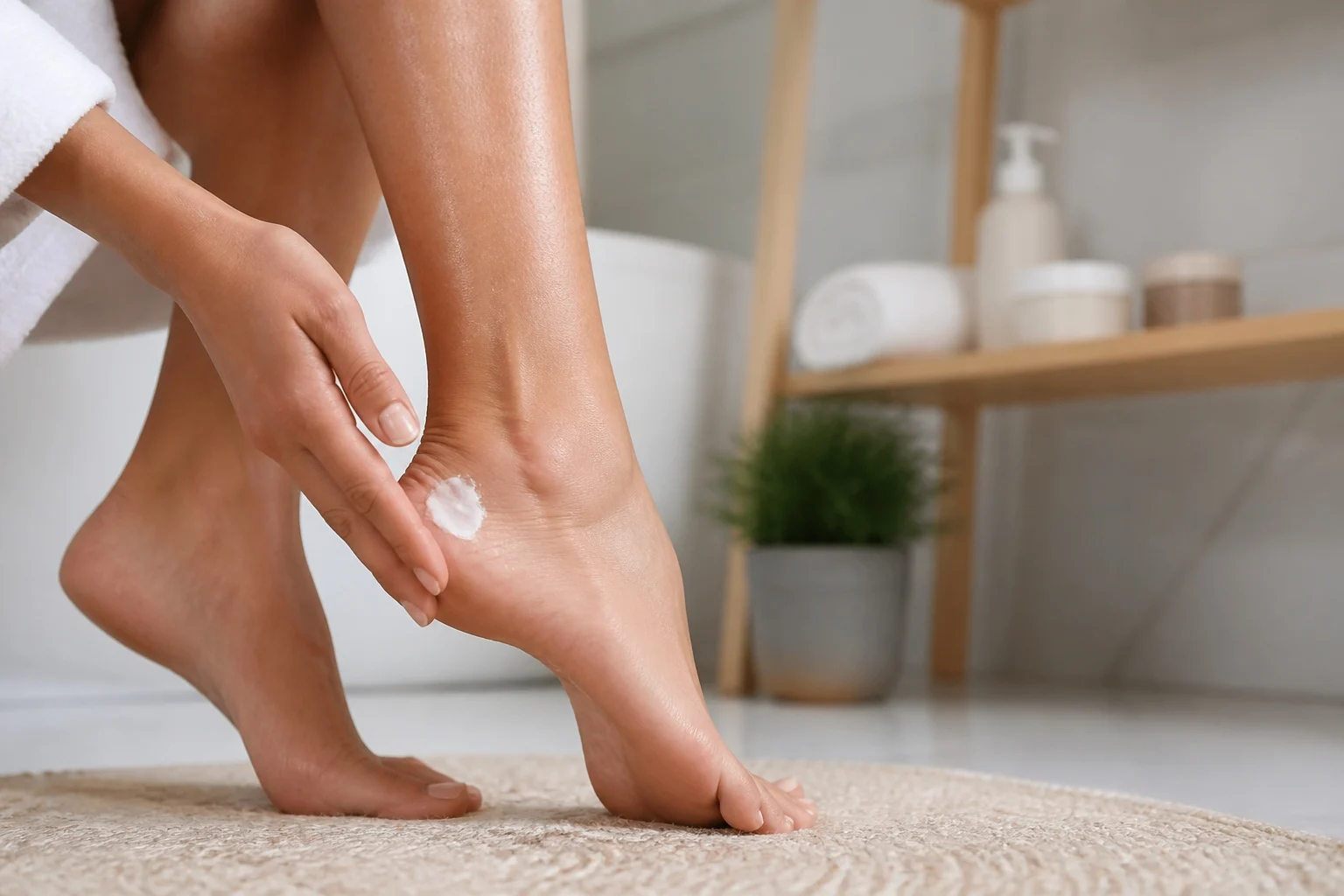
How to compare a foot cream according to the real needs of the skin
A foot cream does not always serve the same purpose. Some formulas mainly aim for daily hydration of dry feet, others provide more sustained nutrition when the skin becomes very dry, damaged or uncomfortable. There are also treatments designed for roughness and calluses, when the skin thickens and is no longer just due to a lack of hydration.
The correct guideline therefore consists of distinguishing three situations: dry feet on a daily basis, very dry feet with weakened heels, and rough feet with thickened areas. In this logic, Akileïne structures its offer around specific needs, with hydration, nutrition, smoothing and gentle exfoliation treatments.
-
The skin of the foot is naturally poor in sebaceous glands, which promotes dryness and justifies care formulated for this area.
-
The stratum corneum of the foot is much thicker than on other parts of the body, which modifies the choice of texture and active ingredients.
-
Repeated friction, age, certain shoes and exposure to sun, wind or sand can accentuate roughness and cracking.
-
A consistent routine often combines regular hydration, moderate exfoliation and adaptation of the treatment to the actual level of dryness.
-
A body cream does not necessarily have the same role as a treatment specifically formulated for dry or thickened feet.
The table below summarizes the most common profiles and the type of cream to favor depending on the main need.
|
Persona |
Main need |
Verdict |
Justification |
|
Adult with daily dry feet |
Hydrate regularly without a complicated routine |
Preferred for this use |
A daily hydration balm is best suited when the skin especially lacks suppleness and comfort, without marked thickening. |
|
Person with very dry or damaged heels |
Provide more nutrition and comfort |
Relevant for this need |
A more nourishing cream responds better to very dry feet and weakened heels, when simple hydration is no longer enough. |
|
Profile prone to calluses and roughness |
Smooth thickened areas without confusing them with simple dryness |
Adapted to this profile |
A kerato-smoothing treatment or a spot exfoliation is more consistent when the skin thickens and becomes permanently rough. |
|
Person looking for an intensive evening ritual |
Complete the routine with a prolonged treatment |
Accepts with reservation |
A night mask can complete the maintenance, especially if the need is for a more enveloping moment of care. |
For dry feet on a daily basis, the most consistent approach remains regular hydration.
When feet are tight, lack flexibility or become rough without showing heavy calluses, the main need remains daily hydration. This is the most common case in adults who walk a lot, wear open shoes for part of the year or notice dryness which returns quickly despite irregular applications.
In this profile, Akileïne Hydra-Defense Balm fits as the basic gesture. It is presented for dry feet, with an application once a day, a formula tested under dermatological control and hydration announced over 24 hours. The technical file also mentions a new formula with 95% ingredients of natural origin and a clinical hydration test on 22 subjects after one application.
This type of treatment is especially suitable for people who want to integrate their feet into a simple routine all year round. Regularity is as important as the product itself: moisturizing once or twice a day depending on the state of dryness, then maintaining this rhythm, remains a useful benchmark to prevent the skin from quickly becoming uncomfortable again.
For very dry, damaged or cracked heels, a more nourishing cream becomes more relevant
When the skin is drier, thicker in places and already marked by damaged heels, a classic hydration cream can show its limits. The need then changes in nature: it is no longer just about softening, but also about providing more sustained nutrition and supporting skin comfort over time.
Akileïne Nutri-Repairing Cream is suitable for very dry and damaged feet. It is indicated for application twice a day, on sensitive skin, and tested under dermatological control. The technical elements provided suggest a formula with 95.8% ingredients of natural origin, as well as a usage test on 22 subjects for 21 days, with a perception of nourished skin, softness and visibly repaired heels.
This choice seems more consistent for people who describe cracked heels, feelings of tightness or persistent dryness despite a lighter cream. On the other hand, if the skin has a deep crack or an unusual situation, it is better to seek the advice of a health professional rather than multiplying abrasive actions.
For calluses and roughness, we must distinguish hydration and kerato-smoothing action
A common mistake is to treat a callus as just a dry area. However, thickened skin is not only due to a lack of water. Friction, support disorders and corn accumulation can create rough areas that require a specific, more targeted approach than daily hydration alone.
In this case, Akileïne Kerato-Smoothing Balm is more appropriate. It is presented for calluses and roughness, with application twice a day, possible use from 3 years old and a mention of compatibility with diabetic feet. Technical data indicates an increase in hydration at 7 and 21 days, as well as a significant decrease in hyperkeratosis and roughness in 22 subjects for 21 days.
The good reflex is not to strip the skin. A thickened area also protects the foot against friction. The objective is therefore to gradually smooth, then maintain suppleness with appropriate care, rather than seeking a brutal result in a few gestures.
To clarify the routine, three simple benchmarks can help:
-
Dry skin especially requires regular hydration with a texture designed for the foot.
-
Very dry or damaged skin often requires a more nourishing formula and a more frequent application.
-
A visible callus requires treatment targeted at the thickening, sometimes supplemented by gentle, occasional exfoliation.
-
Rapid worsening despite treatment warrants professional advice, especially if the skin becomes painful or cracks deeply.
To complete the routine, the gentle scrub and the night mask have a different place
A foot cream isn’t everything. When dead cells accumulate, moderate exfoliation can prepare the skin to better receive moisturizing or nourishing treatment. The idea is not to remove the entire horn, but to prevent it from thickening to the point of making the routine less effective or less comfortable.
The Akileïne Scrub Cream is presented as a complementary weekly gesture. Available data mentions an immediate smoothing effect, a formula with 98.6% ingredients of natural origin and plant-based exfoliating powders. The technical interview reminds us that exfoliation, mechanical or chemical, must remain gentle and limited, generally once a week.
The Revita-Smoothing Night Mask has another use. It is aimed at dry to very dry feet and adds a dimension of prolonged care. The technical elements evoke hydration measured from 15 minutes, an enveloping texture and ingredients such as shea butter and hyaluronic acid. This format is especially suitable for people looking for a more intensive ritual in the evening, in addition to a foundation cream.
Regular hydration all year round remains a central benchmark, because feet do not only become dry in summer or when wearing sandals.
FAQs
Why are the feet often drier than the rest of the body?
The skin on the feet is naturally drier, because it is poor in sebaceous glands and subject to repeated friction. This area produces less sebum and has a thicker stratum corneum, which promotes dryness, roughness and sometimes cracking. Age, certain shoes, walking, sun, wind or sand can accentuate this phenomenon. This is also why a treatment formulated for the feet can be more consistent than a classic body cream when dryness becomes recurrent.
How often should you apply foot cream?
Frequency depends mainly on the level of dryness, but daily application is often the most realistic basis. For dry feet, one application per day may be sufficient if the skin remains supple and comfortable. When feet are very dry or damaged, an application once or twice a day may be more suitable. The main thing remains regularity. A routine interrupted too often leaves the skin quickly becoming rough again, especially if friction and shoes maintain the dryness.
Should you exfoliate your feet before applying a cream?
Gentle exfoliation can improve the routine, but it should not become an aggressive or too frequent procedure. Exfoliating helps remove some of the dead cells and smooth surface roughness, which can make it easier to apply a moisturizing or nourishing treatment. On the other hand, the stratum corneum also protects the foot. It is therefore better to limit this action to a moderate pace, often once a week, and avoid rubbing too hard, especially if the skin is fragile.
What is the difference between dry feet, very dry feet and calluses?
Dry feet especially lack flexibility and comfort, while calluses correspond to a more marked thickening of the skin. A dry foot becomes rough or tight, but without necessarily having very thick areas. A very dry foot can be accompanied by damaged heels and greater discomfort. Calluses and roughness appear when the skin thickens due to friction and pressure. This distinction helps you choose between simple hydration, reinforced nutrition and kerato-smoothing treatment.
Why do feet become dry again even after applying a cream?
The feet can become dry again if the routine lacks regularity or if the treatment chosen does not correspond to the real need. A one-time application often improves comfort at the moment, but is not always enough to maintain flexibility over time. It is also necessary to check whether the problem is simple dryness, very dry skin or thickening with calluses. Open shoes, repeated rubbing or overly aggressive exfoliation can also maintain dryness despite the use of a cream.
When should you choose targeted treatment rather than a simple moisturizer?
Targeted care becomes more relevant when the skin is very dry, damaged or thickened, and not just dehydrated. If heels are cracked, skin is tight despite regular moisturizing, or calluses are forming, a more nourishing cream or kerato-smoothing balm may be a better fit. The objective is not to accumulate products, but to adapt the response to the condition of the skin. A simple routine, well chosen and followed over time often remains more consistent than a single treatment used irregularly.
Do people with weakened feet need to take special precautions?
Weak feet require more careful actions, especially when there is a risk of cracking or increased sensitivity. In this context, it is better to avoid repeated abrasive actions and favor appropriate care, applied regularly. The context provided mentions that Kerato-Smoothing Balm is suitable for diabetic feet, but this does not replace the usual precautions or professional follow-up if necessary. In case of doubt, pain, deep crack or unusual development, medical or podiatric advice is preferable.
