
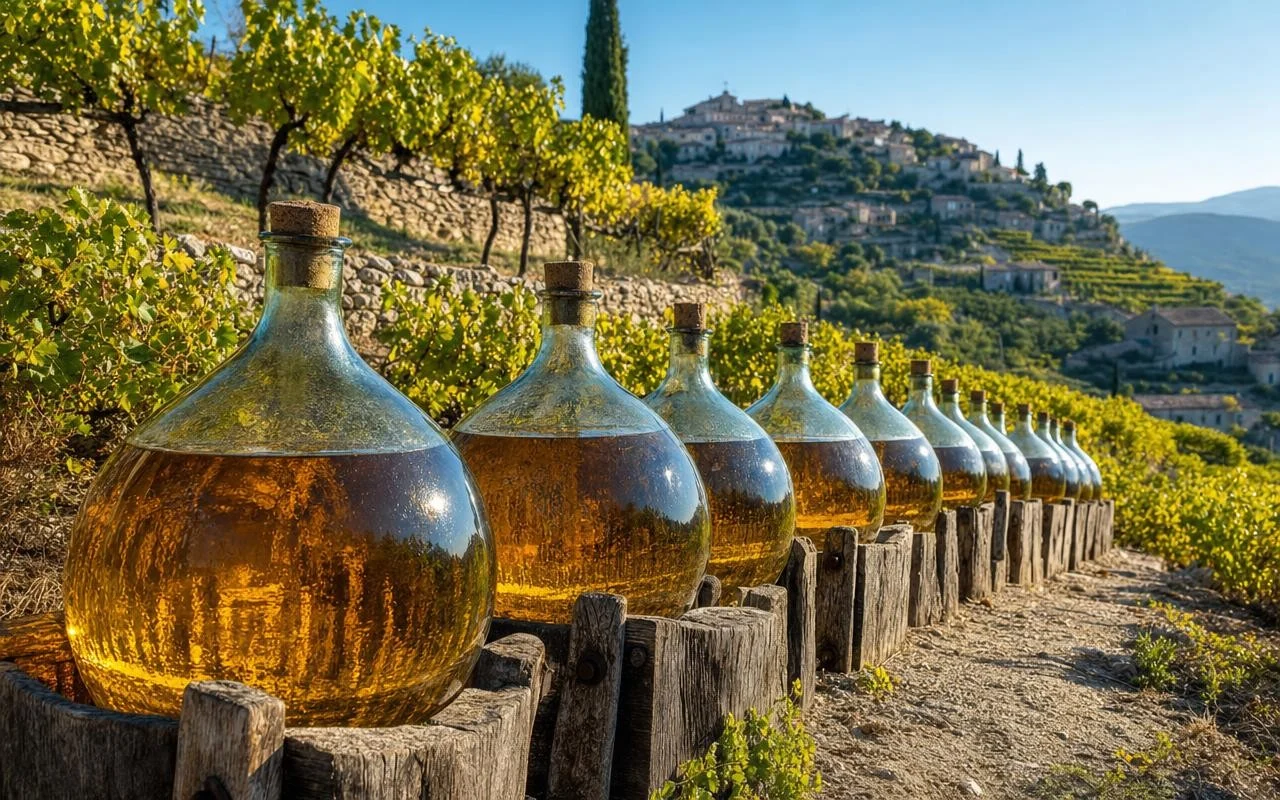
On the heights of Saint-Jeannet, in the Alpes-Maritimes, glass carboys rest in full sun, facing the sea. Inside, a still wine voluntarily undergoes what every oenology manual advises to avoid: direct light, heat, temperature differences. The image intrigues as much as it confuses.
Behind these demijohns hides the tuilé wine of Saint-Jeannet, a local specialty inherited from the Romans and preserved by the Rasse family. In this village which boasts nearly 300 days of sunshine per year, putting the wine outside is not a mistake, but a patiently mastered method.
In Saint-Jeannet, a grape variety is reborn in the sun
At the Hautes Collines estate, Manuel Rasse has reintroduced old grape varieties, including Saint-Jeannet, long abandoned. He describes it straightforwardly: , he explains to France 3 Provence-Alpes-Côte d’Azur.
The harvest is done by hand, after often scorching summers. The winemaker notes: . Of the 12,000 to 15,000 bottles produced each year, only around 10% then follow this journey in the sun which gives birth to tuilé wine.
Putting the wine in the sun, an assumed “fada technique”
Before being released, the wine ferments in oak barrels. Then part of it is transferred into large blown glass demijohns and left outside, sometimes on the roofs, as in the past. Manuel Rasse reminds us: For this winemaker, .
He claims the reverse side of the rules: . The canisters stay outside for between six months and two years. According to him, Sunlight and UV rays pass through the glass and naturally stabilize the wine, where others use sulphites to prevent it from turning sour.
An oxidative wine with notes of nuts, fig and spices
This open-air passage profoundly transforms the aromatic profile. Manuel Rasse summarizes the sensory shift: . The color is tiled, between amber and copper, with accents close to certain oxidative wines from the south such as a dry Madeira or an amber Rivesaltes, marked by nuts and dried fruits.
This style calls for power chords. In addition to blue or blue cheeses and spicy tagines, this type of wine likes sweet and sour combinations and desserts with character: roasted figs with goat cheese and honey, nuts and rustic bread, almond cakes, fig tarts, biscuits or dark chocolate. Served slightly chilled, the Saint-Jeannet tuilé wine then becomes a unique companion, far from a simple “mulled wine” forgotten in the sun.
What is Saint-Jeannet tuilé wine?
The tuilé wine of Saint-Jeannet is a local wine aged in glass demijohns exposed to the sun for several months, sometimes up to two years, to obtain an oxidative profile with notes of dried fruits, spices and nuts.
Why can this wine be exposed to the sun without turning vinegary?
The wine is first vinified then placed in thick, filled and closed carboys, which allows UV rays and temperature variations to naturally stabilize and clarify the liquid without it transforming into vinegar.
How long do demijohns stay in the sun?
According to Manuel Rasse, demijohns stay between six months and two years in the sun, and “One month in the sun is equivalent to one year of age.”
With what dishes should a Saint-Jeannet tuilé wine be served?
This oxidative wine goes well with blue cheeses, spicy dishes such as an olive tagine or Indian cuisine, but also with figs, nuts, almond or dark chocolate desserts.
