
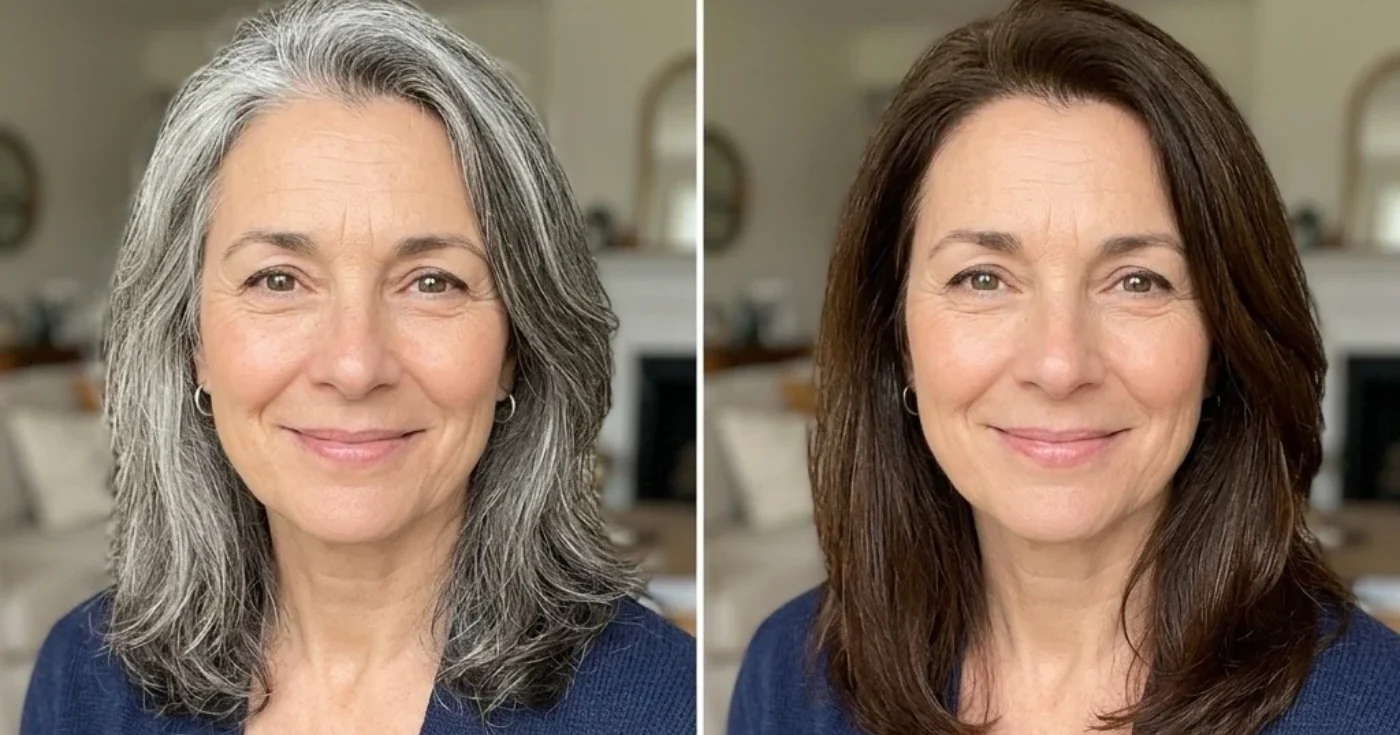
Seeing your first white hairs is often experienced as a necessary part of hair aging. Over time, these little silver threads sometimes become more numerous, until they gradually change the color of our hair. What if this process was not always irreversible? This is the question that researchers at Columbia University, in the United States, asked themselves by closely studying the pigmentation of human hair.
Their work highlighted a particularly surprising phenomenon: certain hair that has lost its natural color can, in certain circumstances, regain its pigmentation. A discovery that shakes up preconceived ideas about white hair and its evolution. Be careful, however: this is not a miracle solution to regain its original color, but a biological mechanism that is still largely unknown.
Researchers observed white hair which naturally regained its pigmentation
Published in June 2021 in the scientific journal, a study carried out by researchers at Columbia University shed new light on the phenomenon of white hair. To understand how pigmentation changes over time, scientists analyzed 397 hairs from 14 volunteers aged 9 to 65. Their particularity? Some hair had several areas of different colors on the same length.
By examining these variations on a microscopic scale, the researchers found that some initially pigmented hair had turned white before returning to a darker color at the root level. In other words, they had naturally started producing pigmentation again. The phenomenon was observed in several participants, men and women, and in different areas of the body. It was therefore not simply a visual impression or a change linked to coloring.
This discovery is particularly interesting because it demonstrates that hair bleaching can, in certain cases, be temporarily reversible. The researchers, however, insisted on an essential point: these episodes of repigmentation remain rare and concern isolated follicles. Over the two and a half years spent recruiting participants, only 14 volunteers were able to be included in the study. It is therefore impossible to conclude that the majority of people with white hair can hope to regain their natural color.
Could stress be responsible for the appearance of white hair… and its disappearance?
One of the most fascinating aspects of this study concerns the potential role of stress. The researchers notably linked the changes in pigmentation observed on certain hair to periods of stress reported by the participants. In some cases, the appearance of white hair seemed to coincide with a particularly stressful period, while its repigmentation was associated with a reduction in stress.
How to explain it? Hair growth is an active biological process that takes place in the hair follicle, under the scalp. This is where melanocytes, specialized cells, produce melanin, the pigment responsible for hair color. When their activity decreases or they are no longer able to perform their function correctly, the hair gradually loses its pigmentation.
However, stress can modify certain physiological mechanisms, notably through hormones and the nervous system. It could thus disrupt the functioning of cells involved in pigmentation. The authors of the study suggest that, when the follicle has not yet definitively lost its pigmentary capacities, the reduction of a stress factor could possibly allow melanin production to resume. However, we must remain cautious: these observations show a possible association, not proof that stress management is enough to make gray hair disappear.
Why can’t white hair all turn back to brown?
To understand why this repigmentation does not concern everyone, we must look at the aging of the hair follicle. The natural color of hair depends on pigment cells, but also on stem cells which allow these populations to be renewed throughout growth cycles. With age, these mechanisms become progressively less effective.
A scientific journal published in 2024 in recalls that hair whitening results from several biological phenomena: accumulation of oxidative damage and DNA damage, aging of melanocytes and alteration of the mechanisms that regulate melanin production. When pigment stem cells themselves are depleted, returning to natural pigmentation becomes much more difficult, if not impossible.
This is the difference between a follicle whose pigmentary activity is temporarily disrupted and a follicle which has permanently lost its ability to produce melanin. In the first case, occasional repigmentation remains biologically possible. In the second, no change in hair routine or cosmetic product can, on its own, reactivate cells that are no longer functional.
Can you naturally promote the return of your hair color?
The question is tempting: if certain hair can regain its pigmentation, are there habits to stimulate this phenomenon? To date, the scientific response remains disappointing. No natural protocol has been sufficiently demonstrated to reverse age-related hair whitening. Reducing stress, getting enough sleep, eating a balanced diet and avoiding tobacco remain good habits for your general health, but they are not a proven treatment for gray hair.
However, there is a particular situation to be aware of: when bleaching appears early, certain nutritional deficiencies or diseases may be associated with this phenomenon. Deficits in vitamin B12, folate or certain minerals, as well as thyroid disorders, have been studied in the scientific literature. When a medical cause is identified and corrected, repigmentation can sometimes be observed. This does not mean that taking food supplements at random will allow you to regain your natural color: supplementation is only useful when it meets a real need, ideally identified by a health professional.
Ultimately, science has clearly demonstrated that some white hair can naturally regain its pigmentation. But this discovery does not mean that hair aging can be reversed at will. For the moment, researchers are mainly seeking to better understand the cellular mechanisms that make this repigmentation possible. A promising avenue for research into hair aging, but not yet an alternative to coloring.
FAQ: everything you need to know about white hair and its repigmentation
1. Can white hair naturally turn brown again?
Yes, this has been observed in some situations. A study published in 2021 demonstrated that some hair could regain its pigmentation after bleaching. This phenomenon, however, remains rare and does not systematically concern the entire hair.
2. Can stress turn hair white?
Stress could contribute to faster whitening of certain hair. Researchers have observed an association between periods of psychological stress and changes in pigmentation. However, the mechanisms are still being studied and stress is not the only cause of white hair.
3. Can vitamin deficiency cause white hair?
Certain deficiencies, notably vitamin B12 and folate, have been linked to the early appearance of gray hair. Thyroid disorders may also be involved. If hair turns white abnormally early or quickly, medical advice may be helpful.
4. Can white hair turn black again after 50?
Occasional repigmentation has been observed in adults, but it remains exceptional. The possibilities of returning to pigmentation depend in particular on the state of the pigment cells and their stem cells in the hair follicle.
5. Is there a natural treatment to make white hair disappear?
No, no natural treatment has today been scientifically proven to permanently reverse age-related white hair. A balanced diet and a healthy lifestyle contribute to hair health, but do not guarantee the return of pigmentation.
