
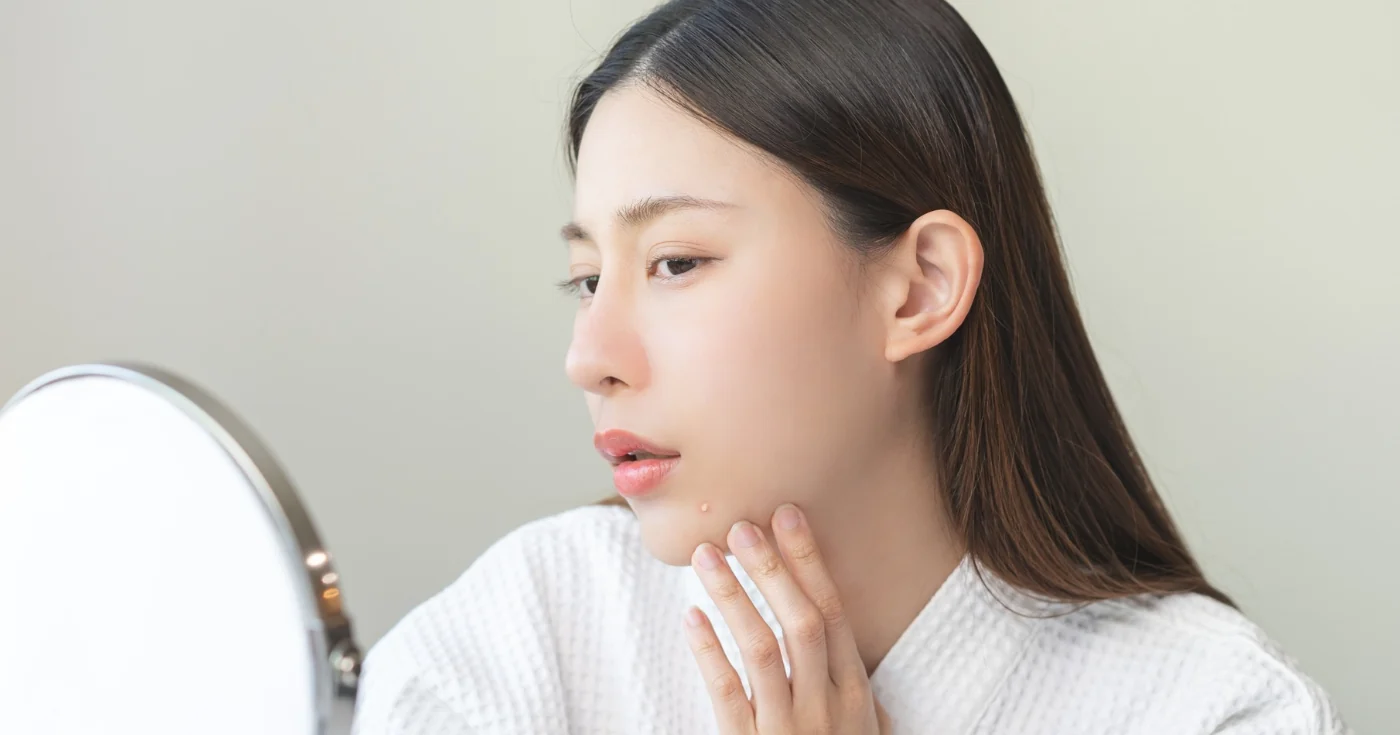
We tend to treat them as simple imperfections: a few small pimples around the lips, on the chin or in the folds of the nose. We then take out our purifying cleanser, exfoliant or anti-imperfection serum, hoping to quickly find clear skin. But when these lesions persist, are accompanied by redness or cause burning sensations, it is possible that the problem is completely different.
This condition has a name: perioral dermatitis. It can easily be confused with acne, although it is an inflammation of the skin that mainly occurs around the mouth. And the distinction is important: certain actions that we adopt spontaneously to make pimples disappear may, on the contrary, make the situation worse.
Perioral dermatitis: how to recognize these little pimples around the mouth?
Perioral dermatitis usually appears as small red or flesh-colored papules clustered around the mouth. They can also appear on the chin, around the nostrils, and in some cases near the eyes. The surrounding skin is often red, dry, or slightly scaly. Some people also feel itching, tingling, tightness or burning. However, the symptoms are not the same in everyone.
A detail can help to distinguish it: perioral dermatitis often leaves a thin strip of skin just at the edge of the lips. Conversely, acne is more likely to be characterized by the presence of comedones, in other words blackheads and whiteheads, as well as sometimes deeper pimples. Perioral dermatitis does not usually cause these comedones. Be careful, however: these signs are not enough to establish a diagnosis. Other conditions, such as contact dermatitis or eczema, can also cause irritation around the mouth.
What can cause perioral dermatitis?
The exact cause of this condition is not fully understood. Dermatologists nevertheless identify several factors likely to promote its appearance or maintain it. One of the best known is the use of corticosteroids applied to the face, including certain cortisone creams. These treatments may appear to improve redness temporarily, before the lesions reappear or worsen when stopped. Inhaled or nasal corticosteroids are also associated with this condition.
Cosmetic products can also play a role. A routine that is too rich, the accumulation of treatments, certain irritating products or even occlusive cosmetics are likely to weaken already reactive skin. Toothpaste and some of its components are also mentioned among the possible factors. This does not mean that a specific ingredient is systematically responsible: perioral dermatitis is multifactorial and its origin varies depending on the person. It is therefore preferable not to randomly remove all the products from your bathroom, but to take stock with a health professional.
How to make these pimples disappear without making the irritation worse?
First reflex: avoid treating these small lesions like an acne breakout. Exfoliants, AHA or BHA acids, retinol and anti-blemish treatments can increase irritation when applied to already inflamed skin. While waiting for medical advice, it is better to favor a very simple and gentle routine, without multiplying products or rubbing the area. Certain very rich or occlusive treatments may also be poorly tolerated.
Treatment depends on the intensity of the symptoms and their origin. In mild forms, simplification of care can sometimes be enough. When lesions persist, a dermatologist may prescribe topical treatment or, in some cases, an oral antibiotic. It is important not to suddenly stop a prescribed corticosteroid cream without talking to the doctor who recommended it: stopping can cause a rebound flare-up and must sometimes be supervised. Finally, it can take several weeks or even months for pimples to disappear. Patience is therefore required, even when the first signs of improvement are slow to appear.
FAQ: everything you need to know about small pimples around the mouth
Is perioral dermatitis a form of acne?
No. Despite sometimes appearing similar, the two conditions are different. Perioral dermatitis is a skin inflammation that causes small papules around the mouth. It is generally not accompanied by the blackheads and whiteheads characteristic of acne.
Is perioral dermatitis contagious?
No. It is an inflammatory skin condition that is not spread from one person to another.
Can toothpaste cause pimples around the mouth?
Certain components of toothpastes, notably fluoride in certain situations, are mentioned as possible irritating factors. However, they are not responsible for all cases of perioral dermatitis.
Can you use moisturizer when you have perioral dermatitis?
It depends on the skin and the formulation of the product. Some very rich or occlusive creams can make symptoms worse. A dermatologist will be able to advise a suitable routine, with gentle and well-tolerated treatments.
How long does it take for perioral dermatitis to go away?
The evolution is gradual. Depending on the case and the treatment implemented, improvement can take several weeks, sometimes a few months. Medical follow-up is recommended when the lesions persist or spread.
Sources:
- American Academy of Dermatology (AAD), .
- DermNet, July 2022.
- MSD Manual, , medical revision March 2024.
- British Association of Dermatologists, .
