
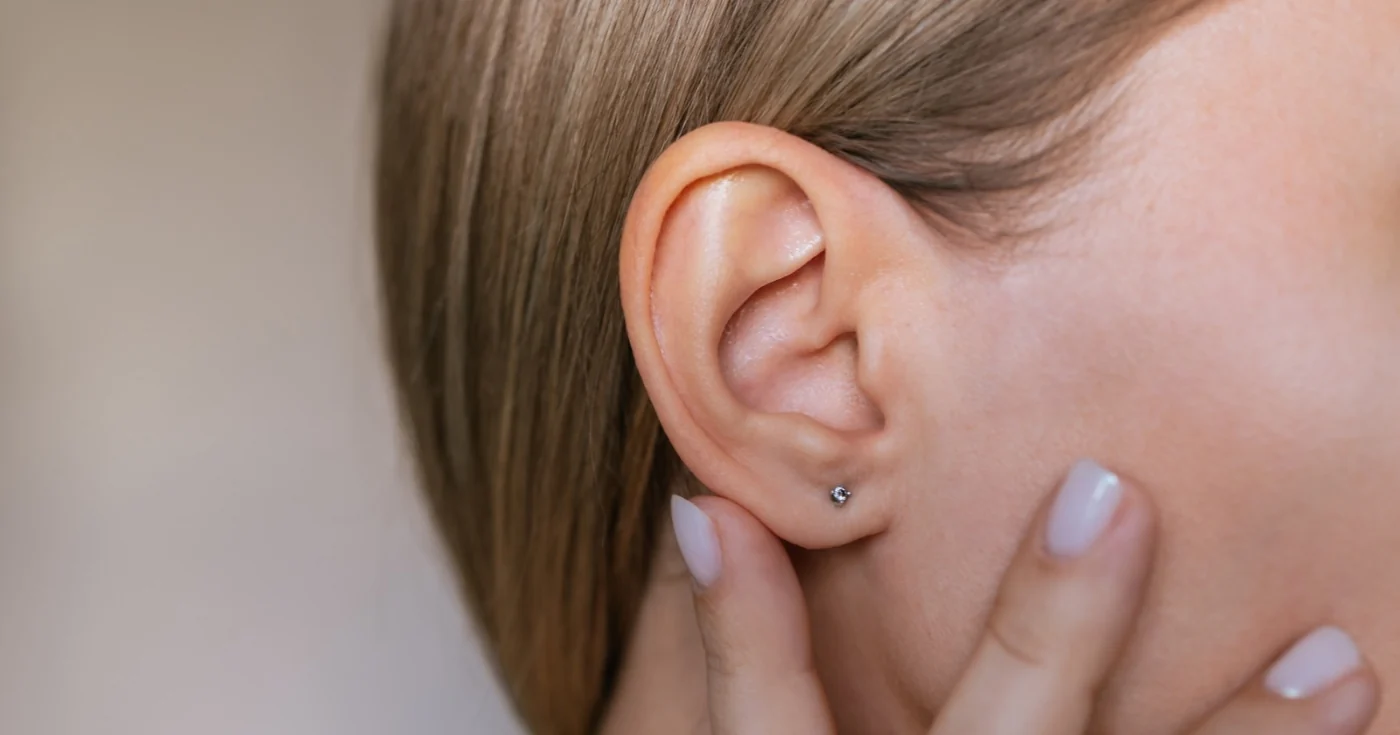
Persistent redness, small visible vessels, sensations of heat and sometimes inflammatory spots: rosacea is a chronic skin disease that can be particularly difficult to live with on a daily basis. Although dermatological treatments can alleviate the symptoms, flare-ups sometimes remain complicated to control. So when a scientific study suggests that targeted stimulation of the ear could help improve symptoms, the discovery is intriguing.
This is precisely what Chinese researchers studied in a clinical trial published on October 14, 2026 in the medical journal. Their work focuses on auricular acupressure, a technique which consists of exerting pressure on a specific area of the pinna of the ear. The results are interesting, but they must be interpreted with caution: this approach was evaluated as a complement to conventional treatments for rosacea, and not as an alternative.
Rosacea: why were researchers interested in pressure exerted on the ear?
Rosacea is a chronic inflammatory disease that mainly affects the center of the face, including the cheeks, nose, forehead and chin. It manifests itself in different ways depending on the person: temporary or persistent redness, small visible blood vessels, burning sensations, hot flashes and, in certain forms, papules and pustules. As Health Insurance points out, several factors can aggravate symptoms, including exposure to the sun, temperature changes, hot drinks or even alcohol.
To understand the importance of the ear, we must look at the nervous system. Certain areas of the ear pinna are innervated by a branch of the vagus nerve, a nerve involved in the regulation of many body functions. However, researchers have been interested for several years in the interactions between the nervous system, inflammatory mechanisms and skin manifestations. Their hypothesis: stimulating a specific area of the ear could help modulate certain neuroimmune responses involved in rosacea. This is the avenue that they wanted to explore in their clinical trial.
A study carried out on 204 people with rosacea
To evaluate this approach, researchers recruited 204 people with rosacea from a dermatology department in China. Participants were randomly divided into two groups of 102 people. All were already receiving first-line treatment for their illness. The difference concerned the acupressure technique assigned to them: the first group benefited from targeted stimulation, while the second received a simulated intervention, intended to serve as a comparison.
In the group studied, the researchers placed a small seed on a specific area of each ear, called the concha, which is innervated by a branch of the vagus nerve. The participants had to exert pressure on this seed three times a day, for 30 seconds, with the possibility of repeating the gesture during pushes. The protocol lasted eight weeks. In the control group, the seed was placed on another area of the ear, which did not have the same innervation. This device made it possible to compare the effects of targeted stimulation to those of pressure exerted elsewhere on the auricle.
56.9% of participants achieved improvement after eight weeks
The results published in are particularly interesting. After eight weeks, 56.9% of people who received targeted acupressure had skin considered clear or almost clear by the evaluators, compared to 35.3% in the control group. This represents 58 participants out of 102 in the first group, compared to 36 out of 102 in the second. The difference was statistically significant.
The researchers also observed an immediate improvement in certain vascular parameters in participants in the active group: the rate of improvement measured was 59.3%, compared to 7.4% in the control group. Finally, blood tests showed a greater reduction in several markers associated with inflammation and neurovascular mechanisms, including LL-37, CGRP, TNF-alpha and interleukin 6. The authors also indicated that certain benefits remained observable at follow-up at the twentieth week. No serious adverse events were reported.
Can you really calm redness by pressing on your ear?
These results suggest that auricular acupressure could have a complementary benefit in the management of rosacea. But they do not mean that a simple pressure applied to the ear from time to time would be enough to make the redness disappear. In the study, stimulation was carried out on a very specific anatomical area, according to a defined protocol, with a small seed placed on the ear pinna. Participants also followed their usual dermatological treatment throughout the experiment.
It should also be remembered that this trial was carried out in a single Chinese hospital center and that it only involved 204 people. Even if the protocol was randomized and included a control group, its results will need to be confirmed by other work, on larger populations and in different contexts. The changes observed in blood markers are interesting, but are not sufficient to demonstrate on their own the entire biological mechanism proposed by the researchers. At this stage, we can therefore speak of a promising avenue, not of a validated treatment.
What are the recognized treatments for rosacea today?
In France, the treatment of rosacea depends on its form and its manifestations. Depending on the symptoms, the dermatologist may prescribe local treatments such as metronidazole or azelaic acid, or even ivermectin in certain inflammatory forms. Oral antibiotics may be considered when the lesions are larger. For persistent redness and small visible vessels, certain vascular lasers may also be offered. The goal is to control symptoms and space out flare-ups, because rosacea is a chronic disease that cannot be cured permanently.
On a daily basis, it is also advisable to identify the factors that trigger or aggravate breakouts, to favor gentle care and to avoid irritating cosmetic products. The French Society of Dermatology, on its Dermato-Info website, notably recalls the importance of an adapted routine and medical follow-up. As for auricular acupressure, it could one day complete this therapeutic arsenal, if new research confirms its interest. In the meantime, it is better not to replace a prescribed treatment with this experimental technique.
FAQ: ear acupressure and rosacea
Can Acupressure on the Ear Really Improve Rosacea?
A study published in October 2026 in observed additional improvement in people with rosacea who performed auricular acupressure in addition to their usual treatment. The results are encouraging, but this method still needs to be studied before it can be considered an established treatment.
How does ear acupressure studied against rosacea work?
The protocol involved placing a small seed on the concha of each ear, an area innervated by a branch of the vagus nerve. The participants then exerted pressure for 30 seconds, three times a day, for eight weeks.
How many people participated in the acupressure and rosacea study?
The clinical trial included 204 people with rosacea, divided into two groups of 102 participants. All received usual dermatological treatment; only the area of atrial stimulation differed between the two groups.
Can you practice this technique yourself at home?
The study evaluated a precise protocol, with a seed placed on a specific anatomical area of the ear. It does not allow us to conclude that pressure applied randomly to the ear pinna will produce the same effects. It is therefore preferable not to improvise this method as a treatment for rosacea.
What treatments are recommended for rosacea?
Treatments depend on the form of rosacea and the symptoms. They may include medicated creams or gels, oral treatments in certain situations or vascular laser sessions to reduce redness and visible blood vessels. A dermatologist can determine the most appropriate treatment.
