
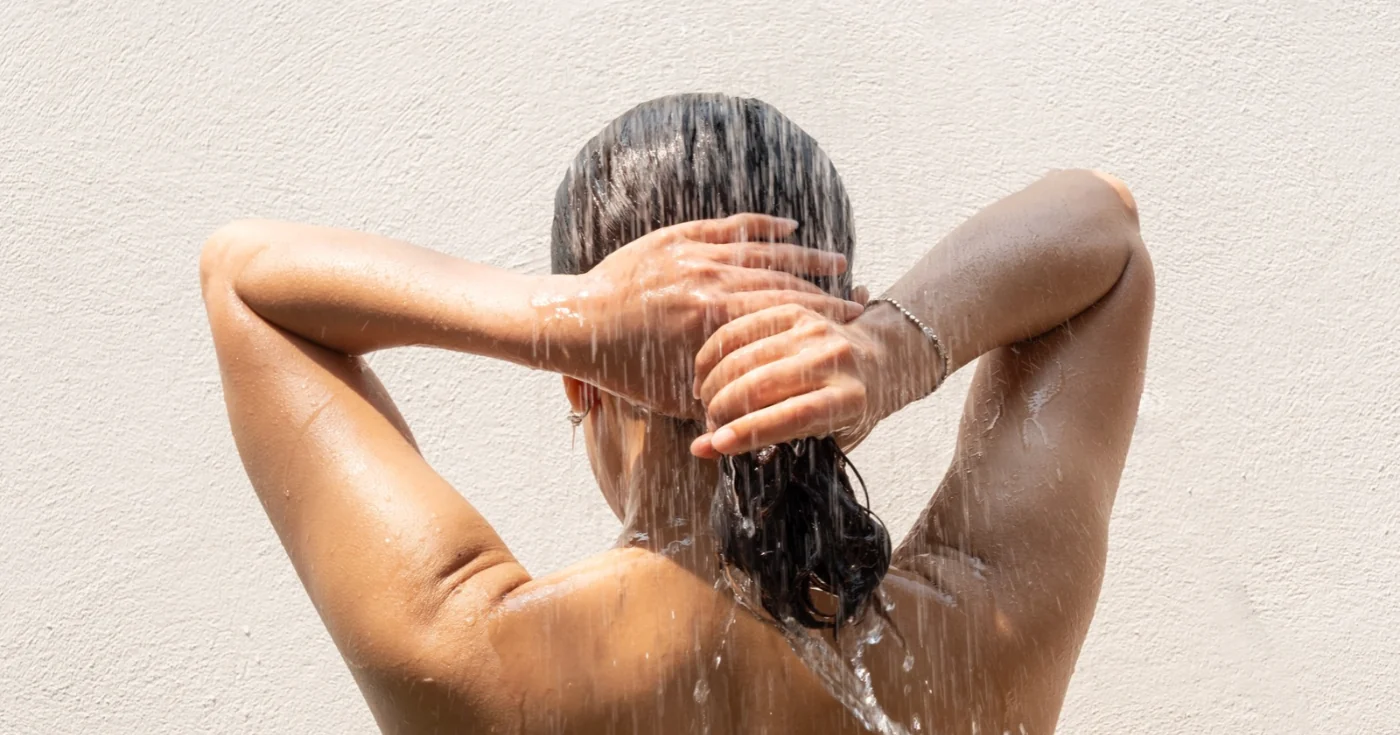
We rarely think to question the water we use to wash our hair. However, after repeated coloring, bleaching and blow-drying, another factor could contribute to weakening the hair fiber: residual chlorine present in tap water. In any case, this is what new work unveiled on November 10, 2026 by the Japanese manufacturer LIXIL suggests. According to its researchers, repeated exposure to this substance could alter the proteins that make up hair and disrupt its ability to retain moisture.
These results were presented at the IFSCC 2026 International Cosmetic Research Congress, held in Perth, Australia, from September 29 to October 1. They arrive as filtering shower heads are gaining ground in the beauty world. On November 11, an article was devoted to Jolie, an American brand which has largely contributed to transforming this domestic equipment into a beauty accessory and which has just launched a new hand model. But do you really need to revise your hair routine because of shower water?
Chlorine in tap water could weaken hair proteins
To understand the effects of tap water on the hair fiber, LIXIL researchers looked at residual chlorine, used in the treatment of drinking water to limit the development of microorganisms. Unlike the chlorine present in swimming pools, these are the low concentrations found in the water distributed on a daily basis. A much less significant exposure, but which could have consequences when it is repeated over washes.
The scientists thus exposed virgin hair, that is to say not chemically treated, to water containing a concentration of residual chlorine comparable to that of tap water. They then studied their behavior in two environments with different humidity levels: 25% and 80%. Using spectroscopic analyzes in particular, they observed changes in the proteins present inside the hair fiber, comparing the results with those obtained on hair exposed to filtered water and a bleaching product.
Their observations are particularly interesting. According to the results communicated by the company, repeated exposure to chlorine leads to an alteration of the proteins located in the cortex, the internal part of the hair. The researchers also found an increase in the fiber’s permeability to moisture: exposed hair absorbed more water when the air was humid and lost more when the environment was dry.
Dull, frothy or dry hair: what effects on the hair fiber?
Concretely, this modification of the hair structure could help to explain certain variations in texture that we observe on a daily basis. When ambient humidity increases, weakened hair may be more likely to absorb water from the air, which can lead to frizz, puffiness and a feeling of less manageable hair. Conversely, when the air becomes drier, the fiber would have more difficulty retaining its hydration. Potential result: rougher lengths, hair that appears dehydrated and less manageable material.
The study also provides a rather surprising element of comparison with discoloration. On some of the markers studied, notably the modification and loss of proteins inside the fiber, the researchers observed greater effects after exposure to chlorinated water than after a bleaching treatment. Be careful, however, not to interpret this result as proof that taking a shower would be more damaging overall to your hair than bleaching it. This is a comparison carried out in the laboratory on specific indicators, and not a general assessment of hair damage in real conditions.
Can a filter shower head protect hair?
The good news, according to researchers, concerns the use of water free of residual chlorine. In their experiments, samples rinsed with filtered water showed fewer protein changes and retained better water content stability. The company indicates in particular that these results remained observable after exposure corresponding to six months of simulated use. This suggests that water filtration could constitute an additional avenue for preserving the hair fiber, particularly when the hair is already weakened.
But should you still invest in a filtering shower head? Not necessarily. This work was carried out on strands of hair in the laboratory and does not yet allow us to confirm that such equipment visibly improves the quality of the hair in all the people who use it. Another important point: the study was carried out by LIXIL, a manufacturer which markets water filtration solutions. The results should therefore be confirmed by independent research, particularly on volunteers and under conditions of daily use.
In the meantime, this research reminds us that hair health does not only depend on the products we apply to it. The quality of the water used to wash them could also play a role, although its importance remains to be clarified. And if filtering heads are an interesting option, they obviously do not replace the essential actions of a suitable hair routine: limiting aggressive chemical treatments, protecting the lengths from heat and using treatments formulated for the needs of your hair.
FAQ: What you need to know about the effects of shower water on hair
1. Does chlorine in tap water damage hair?
New Japanese research suggests that residual chlorine in tap water may alter certain proteins in the hair fiber after repeated exposure. However, these results were obtained in the laboratory and must still be confirmed in humans.
2. Why can chlorine weaken the hair fiber?
According to LIXIL’s work, residual chlorine could modify the proteins present in the cortex of the hair. This alteration would be associated with poorer humidity regulation, with hair potentially more sensitive to variations between humid and dry air.
3. Is tap water more harmful than discoloration?
The researchers observed greater changes in certain protein markers after exposure to chlorinated water than after decolorization. This does not mean that tap water is generally more aggressive than bleaching: the results relate to specific measurements carried out on strands in the laboratory.
4. Is a filtering shower head effective against the effects of chlorine?
LIXIL’s experiments suggest that the elimination of residual chlorine could limit certain alterations of the hair fiber. However, the effectiveness of this equipment on hair in real conditions must still be further documented by independent studies.
5. How to protect your hair from external aggressions in the shower?
It is advisable to use a shampoo adapted to your scalp, to use conditioner on the lengths and to limit washing with very hot water. For colored or sensitized hair, protective and moisturizing treatments can also help preserve its appearance and suppleness.
