
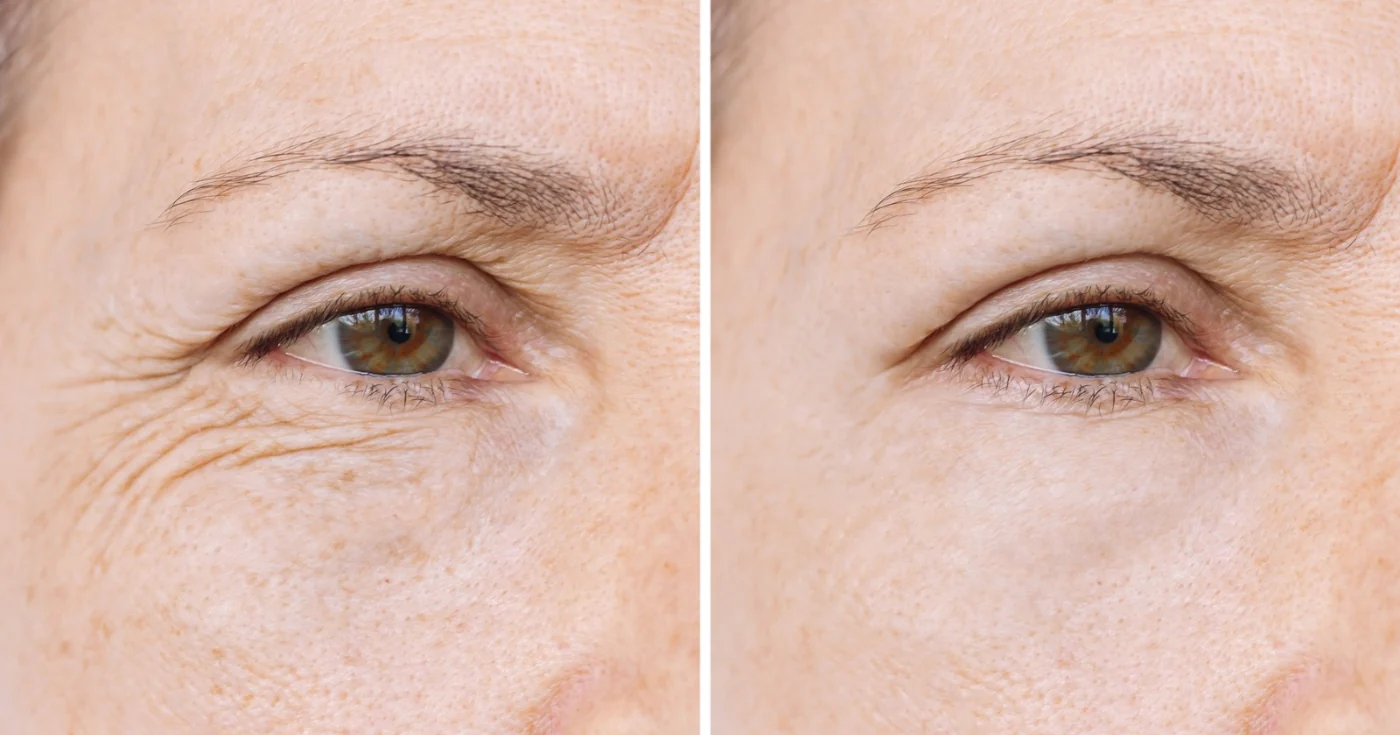
Crow’s feet are among the first expression lines to appear on the face. Located at the outer corner of the eyes, they appear particularly when you smile, squint your eyelids or express emotion. Over time, the reduction in collagen and skin elasticity contributes to making them more visible, including when the face is at rest. If cosmetic treatments can help prevent skin aging, another approach is attracting growing interest: facial massage.
This is notably one of the specialties of facialism, a practice which consists of working the muscles and tissues of the face through different manual techniques. Inspired by Kobido, drainage or even intra-oral massage, these gestures aim to relax the features and give the face a more rested appearance. Around the eyes, however, they must be particularly delicate: the skin there is thin and fragile, and it is certainly not a question of pulling on it to try to make the wrinkles disappear.
Why massage the eye area when you have crow’s feet?
Before reproducing the gestures of facialists, you must understand what massage can really provide. Crow’s feet are so-called dynamic wrinkles: they appear under the effect of repeated contractions of the orbicularis oculi muscle, the one that surrounds the eyelids. They can gradually become more permanent as the skin ages.
Massage does not remove these wrinkles or rebuild lost collagen. On the other hand, it can help to release certain muscular tensions, temporarily stimulate microcirculation and promote the drainage of fluids responsible for a swollen look. Result: the features can seem less tense and the look more rested. It is precisely this global approach that interests fans of facialism, who do not focus only on the wrinkle, but on all the tensions of the face.
3 facialism gestures to relax crow’s feet at home
Good news: you don’t need to master the techniques of a professional facialist to integrate a few movements into your beauty routine. The main thing is to work gently, without ever wrinkling or stretching the skin. To facilitate movements, start by applying a small amount of eye contour treatment or sufficiently slippery serum to clean, dry skin.
1. Make small circular movements at the outer corner of the eye
With the pulp of the ring finger, make tiny circular movements at the level of the crow’s feet, following the bony relief around the eye. The gesture must remain very light, without pressing on the eyeball or moving the skin. This massage allows you to become aware of the tensions accumulated in this area and to invite the facial muscles to relax.
2. Gently smooth towards the temples
Place the ring fingers at the outer corner of the eyes, then make small smoothing movements towards the temples. Repeat the action several times, without pulling on the skin. This technique, which is found in certain facialism routines, accompanies superficial drainage and helps to visually decongest the eye contour.
3. Release tension in the temples
Place the pads of three fingers on the temples and make slow circular movements, with comfortable pressure. This area can accumulate tension, especially when you frown or involuntarily tense your face. Taking a few seconds to massage it allows you to extend the feeling of relaxation beyond just the eye area.
The ideal is to devote one to two minutes to these movements, without trying to multiply the repetitions or exerting significant pressure. The massage should remain pleasant: if the skin reddens, feels tight or becomes sensitive, it is better to interrupt the routine.
Can facialism really reduce crow’s feet?
While the promises of certain facial massages may seem spectacular, the scientific evidence still remains limited. A study published in 2018 in the journal focused in particular on the effects of a massage roller on skin blood circulation. Conducted with small groups of participants, it observed an increase in blood flow in the massaged area, which persisted for at least ten minutes after a five-minute session.
More recently, a clinical trial published in 2025 in the compared the effects of gua sha and massage roller on 34 women for eight weeks. The researchers observed changes in certain parameters linked to facial contour, muscle tone and skin elasticity. These results are interesting, but they do not demonstrate that these techniques can specifically erase crow’s feet.
Facialism should therefore be considered as a complement to a skincare routine, rather than as an alternative to dermatological treatments. To preserve the eye area, daily sun protection also remains essential: exposure to UV rays contributes to premature aging of the skin and the appearance of wrinkles. Finally, suitable treatments containing in particular retinoids formulated for the eye area can be considered, with the advice of a dermatologist if necessary.
FAQ: questions we ask about anti-crow’s feet massages
Can eye contour massage make crow’s feet disappear?
No. Massages cannot erase established wrinkles or prevent their appearance. However, they can help to relax the features and temporarily give the eyes a less tired appearance.
How many times a week should you massage the eye area?
A short daily routine is possible, provided you respect the fragility of this area. A few minutes are enough: there is no need to multiply the gestures or press more to hope to obtain better results.
What product should I use to massage crow’s feet?
An eye contour treatment, a serum or an oil adapted to this area can facilitate movements. You should favor a comfortable texture, well tolerated by the skin and avoid direct contact with the eyes.
Is Kobido effective against wrinkles around the eyes?
Kobido is a Japanese facial massage that combines different kneading, pressure and smoothing techniques. It can help relax facial muscles and temporarily stimulate skin circulation. On the other hand, there is no solid evidence today to confirm that it permanently erases crow’s feet.
At what age can you start facialism?
There is no specific age to start. Facial massages can be integrated into a beauty routine whenever you feel like it, particularly to allow yourself a moment of relaxation and take care of your skin. The important thing is to adapt the actions to your skin sensitivity.
