
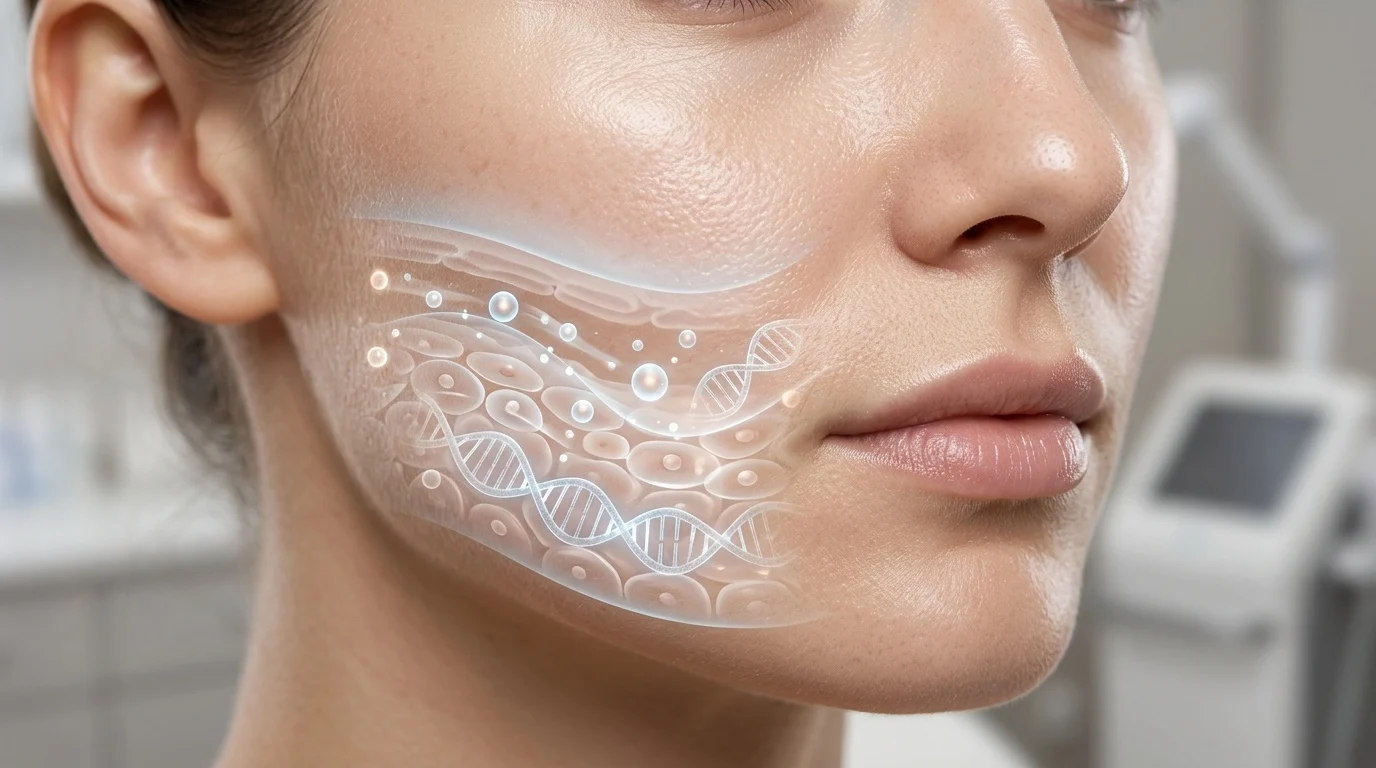
In beauty, a new generation of treatments promises to repair the skin from the inside out rather than simply smoothing visible wrinkles. Supported by K-Beauty, exosomes and PDRN are attracting attention for their supposed ability to restart natural regeneration mechanisms. A tandem that questions as much as it seduces.
On the cellular level, exosomes are extracellular vesicles released by cells, loaded with proteins, lipids and RNA fragments, while PDRN corresponds to highly purified DNA fragments originally from salmon. Together, they aim to support skin repair with a more preventative approach.
Exosomes and PDRN at the heart of regenerative beauty
Driven by this movement, routines inspired by K-Beauty favor ingredients capable of sustainably strengthening the skin barrier and preventing wrinkles, sagging or spots before they take hold. In the United States, experts such as dermatologist Y. Claire Chang describe this shift as a shift from a corrective logic to a strategy of active stimulation of the skin’s repair mechanisms.
This approach, often referred to as regenerative beauty, aims less to smooth the surface than to allow the epidermis to function like younger skin: increased cell renewal, better production of collagen and elastin, improved skin quality in depth. Exosomes and PDRN have become two highly commented pillars.
Exosomes: cellular messengers and new non-invasive avenues
Biologically, exosomes are a subtype of extracellular vesicles released by cells, responsible for transporting proteins, lipids and RNA fragments. They participate in homeostasis and intercellular communication. Since 2010, nearly 5,500 annual publications on PubMed mention these vesicles, with encouraging data on inflammation and healing.
In 2024, at Mayo Clinic, Saranya P. Wyles applied topical platelet-derived exosomes to 56 adults: after 12 weeks, 87.3% saw improvement in facial appearance, with an increase in collagen thickness on histological examination. For cosmetic use, dermatologist Laurent Blasco explains having collaborated with a Swiss company to develop exosomes of plant origin: , he confides to .
PDRN, L-PDRN and association with exosomes
Complementary to exosomes, PDRN, or polydeoxyribonucleotide, corresponds to highly purified DNA fragments, long extracted from trout or salmon sperm. Very rich in nucleotides, it is used to stimulate collagen and elastin, soothe chronic inflammation and support the repair of a weakened skin barrier.
To limit dependence on marine resources, a PDRN of microbiological origin, L-PDRN derived from , has been developed. Composed of shorter DNA fragments (less than 100 base pairs compared to 200 to 800 for salmon PDRN), it showed enhanced antioxidant activity and accelerated wound repair in vitro. This L-PDRN is positioned as a more sustainable alternative to salmon derivatives. By associating it with exosomes, which provide biological information, certain protocols seek integrative cellular regeneration without systematically resorting to invasive techniques.
What is an exosome in cosmetics?
These are small vesicles that carry messages between skin cells.
What is PDRN for for the skin?
It provides DNA fragments that help collagen, healing and the skin barrier.
Can we combine exosomes and PDRN in a routine?
Yes, but studies are still limited; a dermatological opinion remains preferable.
